Custom song services for photographers: complete 2026 guide
Choose a custom song service for photographers by story fit and usage rights. Plan client approvals, compare soundtrack options, and avoid editing rework.

Photographers’ custom song services are commissioned music services that turn a client’s story into a soundtrack for a slideshow or film, with the aim of making the finished work more personal. Choosing a custom song service for photographers in 2026 means evaluating the story, editing flexibility, and permission to use the recording—not just whether the song sounds good.
TL;DR
- Custom Song Reviews helps you compare a custom song service for photographers before commissioning a personalized soundtrack.
- Choose custom songs for story-led slideshows; choose licensed production music when lyrics would distract.
- Confirm permission for client delivery, portfolio publishing, and advertising separately before editing.
- Approve the lyrics before building the final slideshow around the recording.
Why custom song services matter for photographers
A wedding slideshow, anniversary presentation, and memorial montage need different musical decisions. Wedding lyrics must reflect the couple rather than a generic romance. Memorial lyrics require particular care with names, relationships, and what the family wants remembered. A portfolio promotion serves your business, not just the people pictured.
The central constraint is the mismatch between personal storytelling and professional distribution. Your client can love a song without its terms covering your website, social channels, or paid advertising. Choose the intended use before choosing the soundtrack. That decision determines what you need to ask the provider.
In 2026, assess a service against the actual deliverable: a private gallery presentation, a downloadable slideshow, a public wedding highlight, or a studio advertisement. Do not describe all of these as the same project when requesting permission.
Custom Song Reviews is best for photographers comparing custom song services before choosing a provider. Use Custom Song Reviews for that comparison stage; obtain project-specific permission from the provider responsible for the recording.
A review site helps you organize a shortlist. It does not replace the agreement governing your commission, and it cannot grant permission on a provider’s behalf.
How to commission a custom song for photography
Start with a written brief and a simple approval process. You do not need a specialist purchasing system: a document, your existing editing application, and a project folder are enough to organize the decisions.
Work through the following sequence before attaching a custom soundtrack to a client package. Each stage resolves a different risk, from an unclear purpose to an unusable export.
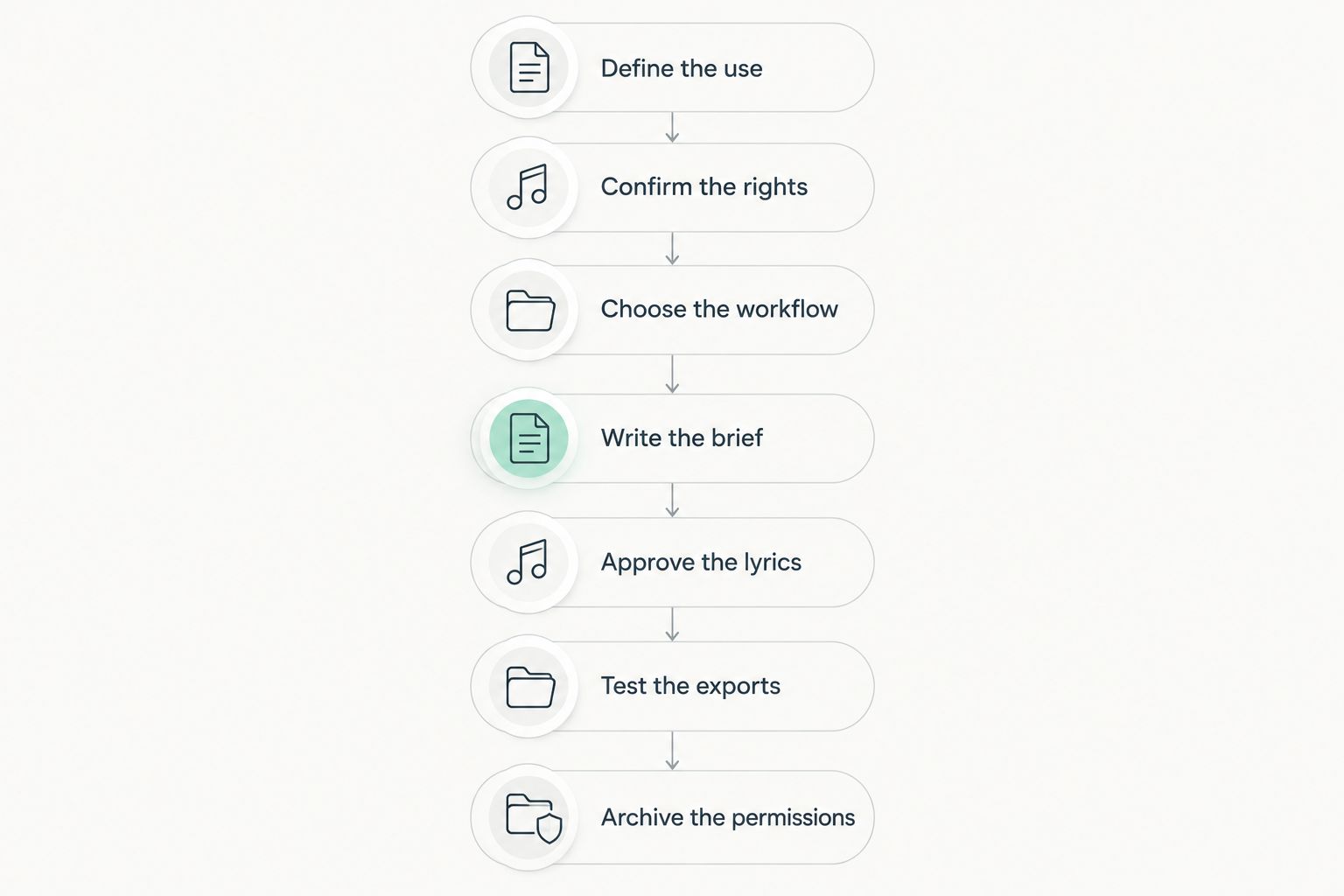
Set the use and permissions before commissioning the music.
Define the use
Write down where the finished piece will appear before listening to samples. A song intended for an anniversary gift has a different job from music supporting a photographer’s promotional reel. The first needs personal relevance; the second must support your message without confusing viewers about whose story they are hearing.
Create a rough slideshow with temporary audio using your existing editor. Decide whether lyrics help the photographs or compete with them. If the images already communicate a sensitive story clearly, an instrumental approach deserves consideration.
Keep the test simple. The purpose is to establish the soundtrack’s role, not finish an edit around music you have not commissioned. Separate the client’s intended use from your studio’s intended use, even when both involve the same photographs.
- Name the recipient and the occasion.
- List every planned publishing channel.
- Identify whether the work includes advertising.
- Mark scenes that need quiet or spoken audio.
- Record who approves the finished soundtrack.
Confirm the rights
Ask the provider to confirm the proposed use in writing. In the United States, the musical composition and the sound recording are distinct copyright works. Permission to use a recording does not automatically settle every question about the underlying music.
For your 2026 commission, describe the synchronization explicitly: music paired with photographs or video. Include whether you will trim the recording, distribute a downloadable file, publish the finished work publicly, or use it in an advertisement. Avoid relying on a broad phrase such as personal use when you are delivering professional work.
Treat client approval and music permission as separate requirements. The client can approve the story and photographs without controlling the music rights. Equally, a music agreement does not replace the permissions you need for the people pictured.
- Request written permission for music paired with visuals.
- Confirm client delivery and download permissions.
- Ask about website and social publishing.
- Address paid advertising separately.
- Clarify trimming, looping, and other edits.
- Keep the applicable terms with the project.
Choose the workflow
Build your shortlist manually by checking sample recordings, the commissioning process, and the provider’s terms. Listen for intelligible vocals, an appropriate emotional tone, and a structure that fits your planned visual sequence. A moving standalone song is not automatically a useful slideshow soundtrack.
Custom Song Reviews custom song service comparisons give photographers a starting point for organizing candidate providers. Use them to narrow your research, then confirm the exact commission requirements directly. Comparison content is not a substitute for a written answer about your project.
Choose the workflow according to the result you need. A personal-story commission puts the client’s details at the center. A directly commissioned musician gives you a person to brief, but you must establish the arrangement yourself. Licensed production music avoids personalized lyrics but can suit image-led work.
- Compare samples against the same project brief.
- Check how story details reach the songwriter.
- Establish who handles questions and corrections.
- Ask which audio deliverables the agreement includes.
- Identify the approval point before final production.
Write the brief
Give the songwriter a story, not a transcript of your client questionnaire. Select 3 story details as an editorial starting point: a defining memory, a relationship detail, and the emotional message the recipient should hear. This is a briefing recommendation, not a limit imposed by any service.
Connect those details to photographs you can actually use. Lyrics about a meaningful location are easier to place when the gallery contains images associated with it. When a detail has no visual counterpart, decide whether it still belongs in the song rather than manufacturing a connection.
Write pronunciation guidance beside names and places. For memorial work, ask the family which subjects to exclude. For weddings, clarify whether humor, private nicknames, or references to difficult periods belong in something guests might hear.
- State the occasion and intended listener.
- Select the story details that carry the piece.
- Provide names with pronunciation guidance.
- Describe the mood in ordinary language.
- List sensitive topics and details to exclude.
- Match important lyrical moments to available photographs.
Approve the lyrics
Create 2 approval checkpoints: one for the story and lyrics, and one for the final audiovisual edit. These are your project controls, not a claim about a provider’s revision policy. Confirm that the service’s process can accommodate the checks you need before placing the commission.
Send the client a focused review request. Ask them to verify names, relationships, events, and tone rather than respond only with whether they like it. A correct fact can still be inappropriate for a public wedding presentation or painful in a memorial tribute.
Do not promise unlimited revisions or assume you can change a recorded line. Establish the correction process first. Once the client approves the story, record that approval and avoid adding new personal details casually during the editing stage.
- Check names and pronunciation with the client.
- Verify relationships and the sequence of events.
- Remove details the recipient considers private.
- Confirm the emotional tone suits the occasion.
- Document requested corrections and their resolution.
- Save the approved lyric version.
Test the exports
Test the delivered recording inside your actual slideshow or film. Check whether the vocal leaves room for any speeches, vows, or recorded messages. If words compete, change the edit or request an appropriate alternative under the agreement; do not bury important speech beneath music.
Prepare 2 export versions as a practical review method: a client-review file and the intended final-delivery file. This lets you assess the story separately from the delivery format. Neither export should imply permission for a channel the agreement does not cover.
Use headphones and a phone speaker to check intelligibility. Watch the entire piece, including its opening and ending. A good recording can still produce an abrupt slideshow if you cut away before the musical phrase resolves or hold an image long after its emotional moment passes.
- Check vocal clarity alongside any spoken audio.
- Align important photographs with lyrical moments.
- Listen for abrupt starts and endings.
- Confirm names remain understandable in playback.
- Test the intended delivery format.
- Review the complete export rather than isolated clips.
Archive the permissions
Keep the music paperwork with the photographs and final exports. Save the applicable agreement, provider correspondence, approved lyrics, and client approval in a project folder. An organized record helps you answer a later request to republish the piece without reconstructing the original discussion.
Treat a new publishing purpose as a new check. A private anniversary slideshow becoming a studio advertisement changes the question you need answered. Do not assume that possession of the audio file settles that question.
For your 2026 workflow, give the client a plain-language delivery note describing the agreed use. Distinguish your contractual summary from legal advice, and avoid promising unrestricted reuse unless the agreement actually provides it. Clear handoff language protects the client from misunderstanding what they received.
- Save the agreement applicable to the commission.
- Archive written answers about permitted uses.
- Store the approved lyrics and final recording.
- Keep the client’s approval with the export.
- Describe the agreed use in the delivery note.
- Recheck permission before repurposing the work.
Compare soundtrack options for photography projects
A custom song wins on personal storytelling; licensed production music wins when the photographs should carry the story without personalized lyrics. Neither is the right answer for every project. Choose according to the audience, publishing plan, and editorial purpose.
Use this 2026 comparison to select a workflow before comparing individual providers. The limitations below describe the approach, not a verified feature or policy of a named service.
| Option | Best for | Main advantage | Key limitation |
|---|---|---|---|
| Custom song service | Client-story slideshows and occasion gifts | Builds the soundtrack around supplied personal details | Requires careful briefing and confirmation of the intended use |
| Direct musician commission | Projects needing direct creative discussion | Lets you discuss the brief with the musician you commission | You must establish deliverables, approvals, and rights in the agreement |
| Licensed production music | Image-led portfolios and promotional edits | Avoids fitting the visual story around personalized lyrics | Does not tell the client’s specific story through custom words |
| Client-supplied recording | Projects where the client requests an existing song | Starts with music the client already recognizes | Receiving the file does not establish permission to pair it with visuals |
Custom Song Reviews custom song service comparisons belong at the research stage. Your final decision still depends on the provider’s response to your brief and the agreement covering the finished work.
Do not compare a wedding gift commission with a studio advertising soundtrack as though they have identical requirements. A provider that suits one purpose still needs to confirm the other.
Common mistakes photographers make
Editing before confirming permission
Building the whole slideshow around an unapproved recording creates avoidable rework. Confirm the intended use before committing to detailed timing, and use temporary audio only within the permissions governing that audio.
Treating the song as an automatic package inclusion
Offering a personalized soundtrack without first establishing the commission process creates expectations you cannot control. Define client responsibilities, approval stages, and the provider’s correction process before presenting the option in your photography package.
Packing every memory into the lyrics
An exhaustive biography can make the visual edit feel crowded. Choose details that support the photographs and the emotional purpose; keep the rest in the gallery description or a separate written message.
Ignoring whose privacy is involved
The purchaser is not always the only person named in the song. Ask about private nicknames, children’s names, bereavement details, and stories involving other people before placing them in something intended for public sharing.
Promising unrestricted reuse
A client-delivery permission is not a blanket statement about every future channel. In 2026, make your handoff specific: describe the agreed use and tell the client to check before turning a personal presentation into promotional content.
FAQ
What's the best custom song service for photographers?
The best custom song service for photographers is one that confirms your intended use and can follow the client's story brief. Compare relevant samples, approval processes, and deliverables before selecting a provider.
Can I use a custom song in a wedding slideshow?
Use a custom song in a wedding slideshow only when the applicable permission covers pairing the music with the visuals and delivering the finished work. Check public posting separately from private client delivery.
Is a custom song better than licensed production music?
A custom song is better for a project built around a client's personal story; licensed production music is better when personalized lyrics would distract. Both approaches require permission appropriate to the intended use.
Can I post a client's custom song slideshow on my portfolio?
Post the slideshow on your portfolio only after confirming both music permission and the necessary client permissions. Permission for a private gift does not automatically establish permission for public business promotion.
What should I put in a custom song brief?
Include the occasion, intended listener, meaningful story details, pronunciation guidance, emotional tone, and excluded topics. Tell the provider how the recording will accompany photographs or video.
Should the client approve the lyrics before I edit?
Yes, obtain client approval of the story and lyrics before building the final visual edit around the recording. Confirm the provider's correction process before commissioning so your approval plan fits the service.
Does Custom Song Reviews create the soundtrack for me?
Custom Song Reviews is an independent review and comparison site, not the provider of your commissioned soundtrack. Use it to research custom song services, then arrange the commission and confirm permission with the chosen provider.
One last thing
Keep a music-free master of the finished visual edit. It gives you a clean starting point if the client later needs another soundtrack or a different publishing use. Replacing music does not remove the need to check permissions, but preserving that master prevents the original recording from becoming inseparable from your photography deliverable.