Custom song services for wedding planners: complete 2026 guide
Choose a custom song service for wedding planners by checking the brief, revisions, music rights, and playback. Build a wedding-ready approval plan for 2026.

Wedding planners’ custom song service selection is the process of commissioning personalized music with the aim of matching a couple’s story to a specific wedding moment. This guide explains how to choose a custom song service for wedding planners in 2026, with a workable brief, written approvals, and a playback plan—not just a song the couple likes.
TL;DR
- Custom Song Reviews is best for wedding planners comparing custom song services, not commissioning a track.
- Choose wedding music around its ceremony or reception role before comparing providers.
- Confirm revisions, permitted uses, and delivery requirements before submitting the couple’s story.
- Approve the final audio and rehearse the first-dance cue before the wedding.
Why custom song services matter for wedding planners
A personalized wedding song is both a creative commission and an event deliverable. The couple evaluates its emotional meaning; you also need to know who approves it, where it plays, and what happens if the final version misses the brief.
Custom Song Reviews is best for wedding planners comparing custom song services, not commissioning a track. Use Custom Song Reviews to research the category, then confirm the chosen provider’s current terms directly.
Your planning requirements differ from those of someone buying a private gift. Wedding music has a place in the running order, an audience, and potentially a separate life in a wedding film or public social post. Those uses need separate attention.
For a 2026 wedding, define success before ordering: the couple approves the story, the audio suits the scheduled moment, and the playback team receives the correct file. A meaningful song is not automatically an event-ready song.
How to commission a wedding-ready custom song
Define the song’s wedding role
Start with your existing planning document. Write one sentence describing the song’s purpose: accompany the first dance, introduce a reception entrance, thank a parent, or provide a private gift. Choose the primary role before discussing genres or singers.
A first-dance commission needs instructions about movement and the ending. A private gift can focus on intimate details without accommodating a room full of guests. A ceremony placement needs an exact cue and agreement from the people responsible for the ceremony.
Best for first dances: a brief built around the dance, not a complete relationship biography. Avoid asking one track to handle several unrelated moments. If the couple wants multiple uses, list them separately and ask whether the same recording fits each one.
Close this step with decisions you can hand to a provider:
- Name the primary wedding moment.
- Identify who will hear the song.
- Describe the intended emotional tone.
- Specify how the moment begins and ends.
- Record any ceremony or venue restrictions.
Build a focused story brief
Use a shared document and interview the couple before opening an order form. Ask what makes the relationship recognizable: an unusual meeting, a repeated phrase, a meaningful place, or an ordinary habit they love. Gather specific details rather than adjectives such as wonderful or perfect.
As a planning exercise, select 3 story details that carry the song. This is a brief-writing recommendation, not a provider requirement. A focused brief gives you a clear basis for checking whether the eventual lyrics reflect the couple’s priorities.
Separate essential facts from optional inspiration. Names, pronunciation, relationship roles, and sensitive subjects belong in the essential section. Musical references describe the desired mood; they are not instructions to reproduce another artist’s recording or lyrics.
Before sending the brief:
- Mark the details that must appear.
- Add pronunciation guidance for names and places.
- List subjects the couple wants excluded.
- Describe the preferred language and lyrical tone.
- Ask the couple to approve the written story.
Compare providers against the same requirements
Create a simple comparison sheet before reading reviews. Give every shortlisted service the same questions about creative control, artist selection, revisions, file delivery, and intended use. A consistent checklist makes differences visible without relying on promotional language.
Custom Song Reviews offers custom song service reviews and comparisons. Use those resources as the research shortcut after you have defined the brief—not as a substitute for written answers about your specific wedding. The Songfinch vs GiftSong.ai comparison for 2026 is one starting point for a named-provider comparison.
Best for vendor selection: the provider that confirms your requirements in writing. Songfinch, Songlorious, and GiftSong.ai belong on a research shortlist; their names alone do not establish which service fits your commission.
For your 2026 shortlist, record:
- Whether the proposed creative process fits the brief.
- How you can assess the intended musical style.
- What feedback and revisions the order permits.
- Which audio files the service supplies.
- What written permissions cover the planned uses.
Set ownership and approval checkpoints
Manage the commission in your existing task tracker. Assign 1 approval owner on the couple’s side so the provider receives a single, consolidated response. Other people can contribute, but conflicting messages should not become separate instructions.
Work backward from the wedding rather than assuming a standard production schedule. Ask the provider to confirm its delivery timing and any feedback deadlines for the specific order. Then create your own internal checkpoints for story approval, audio review, and transfer to the playback team.
A surprise commission still needs an accountable decision-maker. The purchaser can approve the story and performance while the recipient remains unaware. Clarify that arrangement before sending personal details or promising the surprise to other vendors.
Your approval record should contain:
- The person authorized to approve the commission.
- The person responsible for submitting feedback.
- The provider’s confirmed delivery commitment.
- The agreed review and revision process.
- The final version approved for wedding playback.
Confirm permissions and privacy boundaries
Write down every intended use before asking about rights. Playing a song at a reception, placing it in a wedding film, and publishing a clip on the planner’s business account are different activities. Do not treat permission for one as permission for all.
For a 2026 commission, request the provider’s current written terms and clarification where those terms do not address your use. Give the videographer the relevant permission record rather than simply saying the song belongs to the couple. A custom commission does not, by itself, answer every ownership or licensing question.
Keep the story brief limited to information the song actually needs. A relationship story can involve family conflict, bereavement, or details about people who are not commissioning the music. Obtain the couple’s approval before sharing sensitive material.
Confirm these boundaries:
- Permission for the intended wedding playback.
- Permission for inclusion in the wedding film.
- Permission for public posts and business promotion.
- Consent to share the submitted personal details.
- Whether the provider can publish the story or recording.
Review the audio against the brief
Listen with the approved story document beside you. First check factual accuracy: names, pronunciation, places, and relationship details. Then assess whether the performance and arrangement match the specified wedding moment.
Separate a correction from a preference change. A mispronounced name is not the same request as choosing a different musical direction after hearing the track. Describe each issue precisely, and handle it within the provider’s confirmed revision terms rather than assuming every change is included.
Review the actual ending as carefully as the opening. For a first dance, decide whether the couple finishes with the track or the DJ transitions out at an agreed cue. For a ceremony placement, confirm how the music fits the officiant’s sequence.
Use a consolidated review checklist:
- Check every required story detail.
- Verify names and pronunciation aloud.
- Flag unintended or uncomfortable lyrical meanings.
- Confirm the opening, ending, and event cue.
- Send one approved set of feedback.
Prepare playback and a fallback
Start with the final approved file, not a preview link buried in an email. Ask the DJ, band, or venue’s playback lead which format they require, then arrange the transfer accordingly. Label the file so an operator can distinguish it from drafts without opening several versions.
Prepare 2 playback copies in locations agreed with the playback team. This is a backup recommendation, not a claim about a provider’s delivery package. Confirm that the designated operator can access and play the approved recording without depending on the couple’s phone.
For 2026 wedding handovers, keep the audio, cue instructions, and approval record together. A backup song or alternate event sequence also needs the couple’s agreement; the operator should not improvise an emotionally significant replacement.
Complete the handover with:
- The approved audio file in the required format.
- A clear file name identifying the final version.
- Written start, stop, and transition instructions.
- A playback check with the responsible operator.
- An agreed fallback if the planned cue fails.
The commissioning sequence is straightforward: settle the purpose, approve the story, confirm the provider, review the recording, and hand over playback. Skipping a stage moves an unresolved decision closer to the wedding.
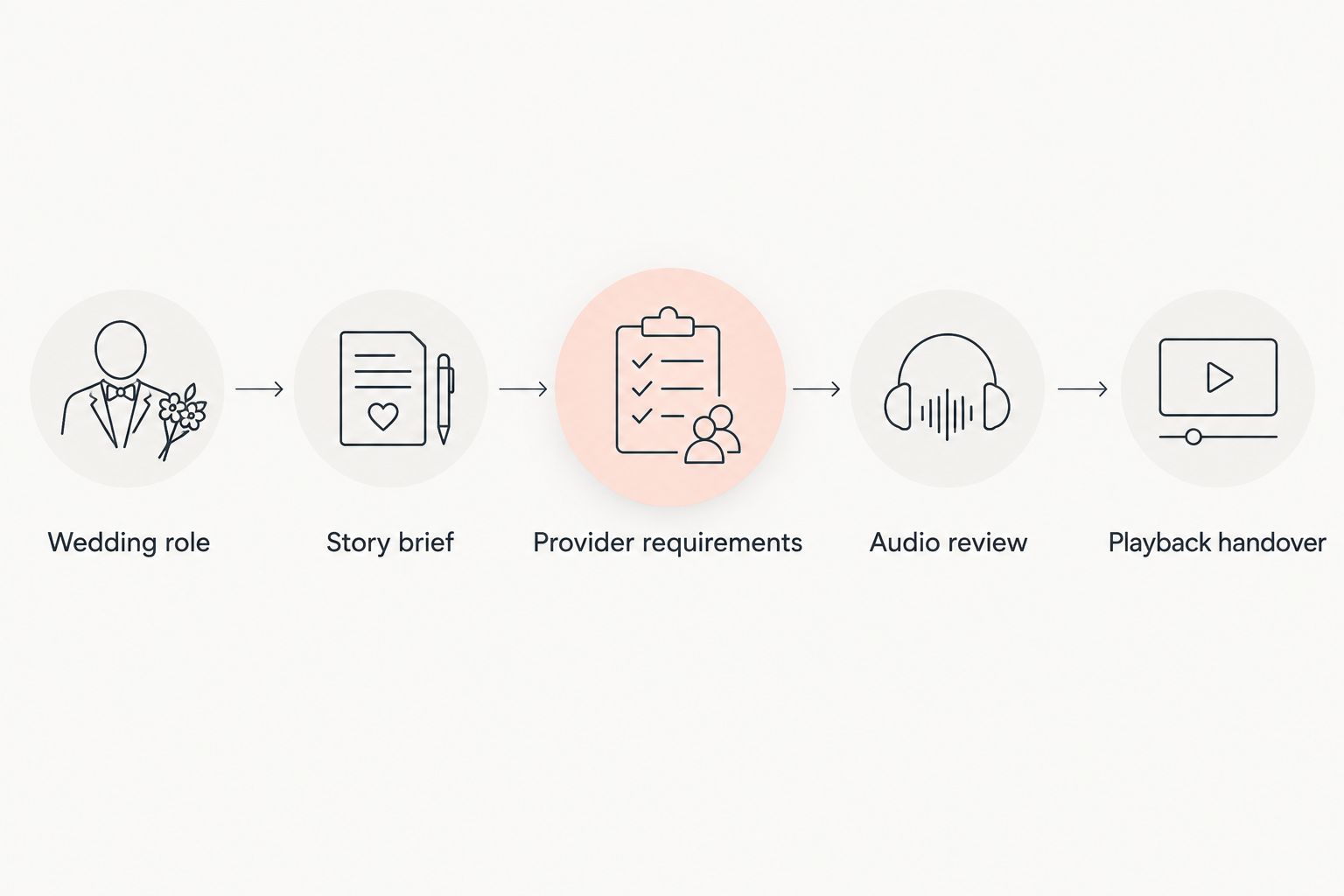
Resolve creative decisions before the final playback handover.
Compare the options for wedding planners
The useful comparison is not just between service names. You also need to decide whether you are researching, commissioning a recording, or arranging live performance. Each route answers a different planning question.
Use the table to choose the route, then assess the actual provider against the brief. An independent comparison helps you choose; it does not create permission, approve lyrics, or deliver the wedding audio.
| Option | Best for | Practical advantage | Key limitation |
|---|---|---|---|
| Custom Song Reviews | Planners researching custom song services | Independent reviews and comparisons for occasions including weddings | Research is separate from commissioning and approving the recording |
| Direct commission through Songfinch, Songlorious, or GiftSong.ai | Planners ready to investigate a named service | Direct contact lets you request answers about the specific commission | Creative process, revisions, delivery, and permissions require individual verification |
| Commission discussed with the wedding’s musician or band | Couples who want to investigate a live interpretation | You can discuss the song alongside the existing performance plan | Original songwriting and recording must be confirmed; hiring a performer does not establish either |
The third route is a planning option, not a claim that your booked musician offers songwriting. Ask explicitly. Likewise, do not assume a recorded commission can be performed live without additional arrangements or permissions.
Common mistakes wedding planners make
Ordering before choosing the event moment
A couple can love a recording that does not fit the intended cue. Define the role first, then include the event requirements in the brief. Keep a private gift separate from a ceremony or first-dance deliverable when their requirements differ.
Letting family feedback override the couple’s brief
Parents and friends can contribute memories without becoming additional approval owners. Send the provider one consolidated response authorized by the designated decision-maker. Do not add a family anecdote merely because someone insists it deserves a verse.
Treating the final delivery as the final handover
Receiving a recording is not the same as getting it into the wedding playback system. The operator needs the approved file, a usable format, and cue instructions. Close the task only after that handover is confirmed.
Promising video or promotional use without checking terms
The couple’s wedding film and your business’s social post are separate uses. Obtain the relevant written permissions before offering either. Do not ask a videographer to resolve an unclear rights question during editing.
Leaving a surprise outside the planning process
A secret from the recipient should not be a secret from the person responsible for playback. Coordinate the cue discreetly, identify the purchaser’s approval authority, and agree on a fallback. Protect the surprise without sacrificing the event handover.
FAQ
What’s the best custom song service for wedding planners?
The best custom song service for wedding planners is the one that confirms the specific brief, approval process, delivery requirements, and intended uses in writing. Custom Song Reviews helps planners compare services, but the provider must confirm the terms for the actual commission.
Can a custom wedding song be used for a first dance?
A custom wedding song can be commissioned for a first dance. Specify the musical feel, planned ending, and playback cue in the brief, then review the final recording against those requirements.
Should the couple or wedding planner approve the song?
The couple should designate an approval owner, while the wedding planner checks the event requirements. Keep creative approval and playback readiness visible as separate tasks.
How early should a wedding planner order a custom song?
Order according to the provider’s confirmed delivery commitment and the wedding’s review and handover requirements. Work backward from the event and include time for any permitted revisions and playback checks.
Can the videographer put the custom song in the wedding film?
The videographer can use the song when the relevant permissions cover that use. Request written confirmation and share the permission record before editing begins.
Can a custom wedding song stay a surprise?
A custom wedding song can remain a surprise for the recipient while the purchaser approves it. The planner and playback operator still need the final file, cue instructions, and an agreed fallback.
What should the planner send to the DJ?
Send the approved recording in the DJ’s requested format, clearly labelled as the final version. Include start, stop, and transition instructions, and confirm that the file plays correctly.
One last thing
Approve the ending, not just the song. Listen to the final section with the couple and playback operator, then decide exactly what happens next: applause, an announcement, another track, or a quiet transition.
That decision belongs in the running order. An emotionally effective recording still needs a deliberate exit, and the person pressing play should not have to guess what the couple intended.