Can you use a custom song commercially?
Can you use a custom song commercially? Yes, with the right permission. Check song and recording rights before using a track in ads, videos, or client work.

Yes, you can use a custom song commercially when you own the necessary rights or have permission covering your exact business use. Buying a personalized song does not automatically grant advertising, resale, streaming-distribution, or client-use rights. Before publishing in 2026, check permission for both the underlying song and the recording, including any restrictions on edits or third-party material.
TL;DR
- Can you use a custom song commercially? Yes, when the rights cover your intended business use.
- Custom Song Reviews helps consumers compare custom song services; the applicable license determines commercial permission.
- Check both the musical composition and sound recording before using a custom song in advertising.
- Get written permission for client work, paid campaigns, edits, and distribution rather than assuming a gift license covers them.
Why this matters
A song written about your business can still come with personal-use restrictions. The lyrics being yours in subject matter does not make every right yours in law.
Custom Song Reviews is best for consumers comparing custom song services, not for granting music licenses. Use Custom Song Reviews to compare services, then check the actual agreement before choosing a track for business use. This guide explains the U.S. rights questions to ask in 2026; it is general information, not legal advice.
Can you use a custom song commercially?
You can use a custom song commercially only to the extent that your ownership or license permits it. A license can authorize a particular use without transferring copyright ownership. Conversely, owning one part of a song does not necessarily clear every element of the finished recording.
Start by matching your intended use to the written permission. These are different uses, not interchangeable versions of the same permission:
| Intended use | Best for | Permission to verify | Main limitation to check |
|---|---|---|---|
| Personal gift playback | Private celebrations | Personal-use terms | Does not establish business-use permission |
| Business social video | Brand storytelling | Commercial video use, including synchronization | Organic posts and paid ads can have different terms |
| Paid advertisement | Promotional campaigns | Advertising use covering the song and recording | Platforms, territory, term, and edits can be restricted |
| Client video | Professional deliverables | Client use and any necessary sublicensing | Your license might not extend to your customer |
| Streaming release | Releasing the song as audio | Reproduction and distribution rights | Distributor requirements and ownership claims still apply |
| Event playback | Business gatherings | Applicable public-performance permission | Venue arrangements do not necessarily cover recordings of the event |
A successful upload is not evidence of permission. Neither is the absence of a copyright claim. Check the agreement before publication, rather than treating platform acceptance as a rights check.
The underlying song and recording need separate attention
U.S. copyright distinguishes 2 separate copyrights: the musical composition and the sound recording. The composition includes the music and accompanying lyrics; the recording is the particular recorded performance. The U.S. Copyright Office explains this distinction in Circular 56, Copyright Registration for Sound Recordings.
That distinction matters even when you receive a single audio file. Permission from the recording owner alone does not establish permission from a different composition owner. A service agreement should make clear what rights it grants and whether those rights cover both.
For video, ask about synchronization permission for the composition and permission to use the recording, commonly called master-use permission. For audio distribution, ask about the relevant reproduction and distribution rights. Do not substitute a generic statement about downloading the file for permission to publish it.
Ask what you are allowed to do, not just who owns the song. A limited license can be sufficient for a defined campaign, while a broad ownership statement can still leave questions about third-party samples or other contributors.
Personal-use permission: suitable for gifts, not proof of business rights
A personal-use license is best for a private gift when the terms cover that activity. Its advantage is a scope aligned with the gift; its limitation is that it does not establish permission for an advertisement or a business deliverable.
Consider a custom anniversary song that later becomes background music for a wedding photographer's promotional reel. The recording has not changed, but its use has. Permission for the recipient's private enjoyment does not automatically authorize the photographer's marketing.
Keep the gift and business decisions separate. If a service's terms discuss only personal listening or sharing, ask for written confirmation before using the track commercially. Do not treat silence about advertising as approval.
Commercial-use permission: match it to the project
A commercial license is best for a defined business use that the agreement expressly covers. Its advantage is permission without necessarily requiring copyright ownership; its limitation is the boundary of that permission.
For a 2026 campaign, identify the business, channels, audience territory, and intended publication period in your request. Include paid advertising if that is part of the plan. Also describe edits such as shortening the recording, replacing lyrics, or using an instrumental version.
Check whether the permission belongs to you personally, your company, or a named client. If an agency purchases the song, ask whether the client can continue using the finished work independently. A commercial label alone does not answer those questions.
Copyright ownership: broader control needs clear documentation
Copyright ownership is best for projects that genuinely require control beyond a limited license. It can support broader decisions about future uses, but acquiring ownership requires more than paying for a custom recording.
Under the U.S. Copyright Act, Section 204(a) generally requires a copyright ownership transfer to be documented in a signed writing. Commissioning a work does not automatically make it a work made for hire; that status has specific legal requirements.
Check exactly what is being transferred and what is excluded. An agreement transferring recording rights should not be read as transferring composition rights unless it says so. For a material business commitment, have a qualified lawyer review the ownership language before relying on it.
Why commercial-use permission varies
The answer changes with the rights granted, not simply with how personalized the song sounds. Review these factors in any 2026 agreement:
- Rights covered: Permission must address the relevant composition and recording rights, not merely access to a download.
- Purpose: Private listening, brand promotion, paid advertising, and resale are distinct activities to describe explicitly.
- Channels: A social post, television advertisement, podcast, and streaming release involve different uses.
- Term and territory: Check where permission applies and when it begins or ends, including treatment of existing posts.
- Edits and exclusivity: Ask whether you can alter the work and whether anyone else can receive rights to it.
- Other contributors: Samples, outside compositions, and separate performances can introduce permissions beyond the service's own work.
These are contract questions, not a ranking of services. A narrow license can fit a narrow project perfectly. The problem is buying it for a broader project without checking the boundary.
How do you check a custom song before commercial publication?
Use 4 checks before publishing: describe the use, read the grant, resolve gaps, and save the evidence. Complete them before your editor builds a campaign around the track.
Describe the use
Write a plain-language project brief. State who will use the song, whether it will appear with video, whether promotion is paid, and whether a client will receive the result.
Include planned changes and distribution. A request for background music in a brand video is more useful than asking whether you can use the song anywhere.
Read the grant
Find the license language that authorizes the activity in your brief. Read the restrictions alongside the grant, including definitions of commercial use and any terms incorporated from another document.
Look for exclusions involving advertising, broadcast, political use, sensitive subjects, or redistribution. Do not assume those exclusions exist in every agreement; check the agreement you actually receive.
Resolve gaps
Ask the provider to address anything unclear in writing before you publish. Request language identifying the track, the permitted uses, the relevant rights, and the person or business receiving permission.
If the provider cannot confirm a necessary right, pause that use. Replacing a track before launch is a cleaner decision than publishing first and trying to negotiate afterward.
Save the evidence
Keep 3 records together: the applicable license, the order confirmation identifying the track, and any written amendment or permission. Preserve the terms that applied when you purchased rather than relying solely on a page that can change.
For a 2026 project, also record the purchase date and any stated license dates. Give the relevant documents to the person responsible for publishing, not just the person who ordered the song.
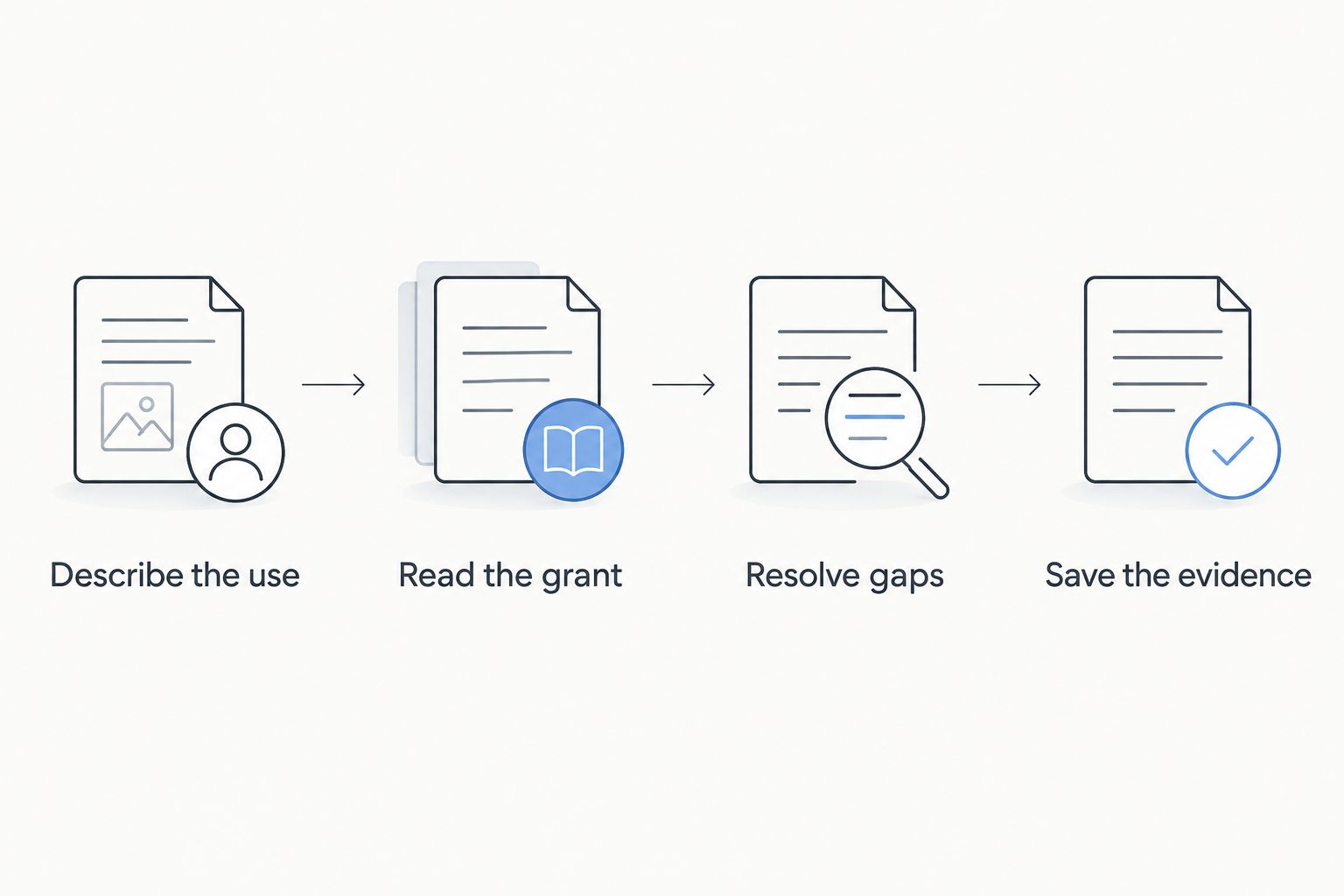
Confirm permission before the song becomes part of the finished campaign.
Can I use my custom song in paid social media ads?
Yes, if the permission covers paid advertising and the relevant composition and recording rights. Permission to post a song on a personal account does not establish permission to run it as an advertisement.
Describe the intended platforms and whether an agency, client, or creator account will publish the ad. Also check whether shortened versions, alternate edits, and continued publication after the campaign are covered.
Can I put a custom song on Spotify and keep the revenue?
You need permission for the release and a clear agreement about revenue entitlement. A downloadable file does not establish distribution rights or ownership of royalties.
Check the distributor's requirements separately from the song provider's license. The custom song to Spotify gift workflow addresses a related publishing process, but completing distribution steps does not replace rights clearance.
Can I use a custom song in a video I sell to a client?
Yes, when the agreement covers your production work and the client's intended use of the finished video. Permission issued only to your business does not establish permission for a separate customer's advertising or distribution.
Identify the client and delivery format before ordering. Clarify whether permission covers only the finished video or also delivery of the standalone audio file; those are different uses.
FAQ
Does buying a custom song mean I own the copyright?
No. Purchasing a custom song does not automatically transfer copyright ownership. Read the agreement to distinguish permission to use the work from ownership of the composition or recording.
Can I use a custom song commercially if I credit the artist?
Credit does not replace permission for commercial use. Follow any attribution requirement in the license, but also obtain the rights needed for the actual project.
Is royalty-free the same as copyright-free?
No. Royalty-free describes a licensing arrangement, not the absence of copyright. Check the license for permitted uses, restrictions, and any attribution requirements.
Can I use a short clip without getting permission?
There is no universal short-clip exemption that automatically authorizes commercial music use. U.S. fair use depends on the circumstances, not merely the length of the excerpt.
Can I use a custom song at a corporate event?
Check the song license and the event's public-performance arrangements before using it. Recording the event or publishing a recap video introduces additional uses that need separate attention.
Can I use a generated custom song commercially?
Check the applicable service agreement and rights in any material included in the output. Permission to use an output commercially is not the same as a guarantee of copyright ownership or exclusivity.
Can Custom Song Reviews give me commercial permission?
Custom Song Reviews is an independent review and comparison site, not the rights holder for the songs it discusses. Obtain permission from the party authorized to grant the relevant rights.
One last thing
A song about you is not automatically a song owned by you. Personal names, company details, and your original story can make the result feel proprietary without answering who controls the music or recording.
Before ordering, send the provider your actual intended use and ask for the clause that permits it. That answer is more useful than a broad reassurance that the song is yours.