Best custom song services for employee work anniversaries in 2026
Choose a custom song employee work anniversary gift: individual tributes win for personal recognition. Compare four formats, briefs, and approval checks.

Best overall: an individually commissioned employee tribute. Best for a close-knit team: a coworker-story song. Best for recurring recognition: a standardized anniversary-song program. For a custom song employee work anniversary gift in 2026, choose the service format around the recipient—not around the biggest production.
TL;DR
- For a custom song employee work anniversary gift, an individual tribute is the strongest default.
- Custom Song Reviews recommends comparing employee recognition songs by personalization, approval control, and intended use.
- Coworker-story songs suit close teams; standardized briefs suit recurring work anniversary gifts.
- Confirm pronunciation, revision terms, delivery commitments, and usage permission before commissioning any service.
Why this matters
A work anniversary song has a different job from a birthday song. It should recognize someone's contribution without turning an employee into the subject of an uncomfortable office performance.
The best anniversary song celebrates the person without making company loyalty the entire story. Specific appreciation belongs in the lyrics; pressure to stay forever does not. For a broader recognition process, the custom song services for HR teams guide addresses the organizational side of commissioning.
Custom Song Reviews is an independent comparison site for consumers choosing custom song services. Names such as Songfinch, Songlorious, and GiftSong.ai belong on a research shortlist, but your purchasing decision should turn on the actual brief and terms. This 2026 guide ranks commissioning formats rather than assigning unsupported winners to individual providers.
What makes the best employee anniversary song service?
Judge the proposed service against these six criteria before comparing musical styles:
- Personalization: The brief captures a recognizable contribution, not just a name and anniversary date.
- Tone control: You can specify sincere, playful, understated, or celebratory—and identify topics to exclude.
- Approval control: The ordering process explains what you can review and when changes must be requested.
- Pronunciation: The service can work from clear guidance for names, locations, and specialist vocabulary.
- Delivery clarity: The promised delivery date leaves room for your own review before the celebration.
- Usage fit: The agreement addresses your intended audience and distribution, including any public business use.
A strong sample track does not answer these questions. Ask about the actual order you intend to place.
Employee anniversary song options at a glance
| Rank and option | Best for | Standout approach | Key limitation |
|---|---|---|---|
| 1. Individual employee tribute | A personal, one-off milestone | Builds around the recipient's specific contribution | Requires thoughtful input from someone who knows the employee |
| 2. Coworker-story song | A close-knit team celebration | Combines several colleagues' memories into one tribute | Anecdotes need editing and permission |
| 3. Standardized anniversary-song program | Repeated recognition across a workforce | Uses a consistent brief and approval process | A template can flatten individual differences |
| 4. Employee-led song commission | Recipients who want creative control | Lets the employee shape genre, tone, and sharing | Gives up the surprise |
These are buying routes, not claims that every provider offers every workflow. In 2026, confirm that a shortlisted service accepts your preferred process before submitting personal details.
1. Individual employee tribute: best for a personal milestone
An individual tribute starts with the employee's story and turns selected details into a song. Commission it around what the person contributed, how colleagues experienced that contribution, and what deserves recognition now.
This is the strongest default because the brief has a single subject. You do not need to fit an entire department, a company history, and a management message into the same lyric.
Individual employee tribute pros:
- Gives the song a clear subject and emotional focus.
- Makes room for a contribution that ordinary recognition messages overlook.
- Works with either a private presentation or a planned team celebration, subject to permission.
Individual employee tribute cons:
- Requires specific input rather than a generic congratulations message.
- A manager's perspective alone can miss what the employee values.
- Surprise delivery leaves less room for the recipient to shape the tone.
Best for: An employee whose contribution you can describe through real examples.
Ask the contributor for 3 concrete details: a meaningful achievement, a characteristic colleagues appreciate, and a shared memory appropriate for the setting. Treat that as a suggested writing brief, not a required song structure.
Verdict: Buy this format when you can supply a personal story and protect the employee's comfort.
2. Coworker-story song: best for a close-knit team
A coworker-story song combines contributions from several colleagues. The service receives an edited account, not a raw pile of messages, and uses that account as the creative brief.
The distinction matters. A dozen unrelated shout-outs can become a roll call; a few connected memories can explain why someone matters to the team.
Coworker-story song pros:
- Brings perspectives beyond the employee's direct manager.
- Recognizes the everyday help that formal performance summaries miss.
- Gives colleagues a role in preparing the gift.
Coworker-story song cons:
- Inside jokes can exclude the recipient or the wider audience.
- Conflicting anecdotes require an editor to choose a clear direction.
- Contributors can accidentally include information unsuitable for a celebration.
Best for: A team with genuine shared experiences and a recipient comfortable with collective attention.
Choose one editor to remove repetition and check each anecdote. Keep the chorus about the employee rather than making it a company slogan.
Verdict: Buy this format for a cohesive team tribute; skip it when the humor needs a long explanation.
3. Standardized anniversary-song program: best for recurring recognition
A standardized program uses the same intake questions and review stages for different employees. The process repeats; the personal details should not.
For your 2026 recognition calendar, separate the administrative template from the creative brief. Consistency should mean comparable care and clear approvals—not interchangeable lyrics.
Standardized anniversary-song program pros:
- Gives managers a repeatable way to gather relevant details.
- Makes ownership of approvals explicit.
- Supports a consistent recognition process across departments.
Standardized anniversary-song program cons:
- Reused wording can make the gift feel procedural.
- A fixed presentation style will not suit every employee.
- Coordinating multiple orders adds administrative work.
Best for: HR teams planning repeated anniversary gifts with a named program owner.
Write a short internal standard covering consent, permitted information, review responsibility, and delivery method. Then assess whether each prospective service can accommodate it; do not assume bulk workflows or employer-specific support exist.
Verdict: Buy this format only when someone owns the process and each employee receives an individual brief.
4. Employee-led song commission: best for creative control
An employee-led commission invites the recipient to choose the musical direction and approve the personal material. The employer still gives the gift, but the employee helps define what the gift becomes.
This approach replaces a surprise reveal with participation. It is the better route when you know the employee dislikes public attention or has strong musical preferences.
Employee-led song commission pros:
- Lets the recipient identify preferred genres and unwanted themes.
- Reduces guesswork about personal details.
- Gives the employee a say in how the finished song is shared.
Employee-led song commission cons:
- Removes the surprise element.
- Asks the employee to spend time on the gift.
- Still requires clear boundaries between employer and recipient decisions.
Best for: Employees who explicitly prefer participation over a surprise presentation.
Offer a choice rather than assigning creative homework. Explain what input is optional and who will handle the administrative work.
Verdict: Buy this format when the employee welcomes involvement; skip it when participation becomes another task.
How we ranked these commissioning formats
The ranking prioritizes personal relevance, recipient comfort, and a manageable approval process. An individual tribute comes first because it centers one employee; coworker contributions, recurring administration, and recipient participation each solve a more specific need.
Custom Song Reviews recommends choosing the recognition format before comparing custom song services. This is a purchasing framework, not a listening-test score or a claim about any provider's performance.
Turn the recognition idea into a usable brief
Use this sequence before ordering an employee anniversary song in 2026. It prevents the musical choices from getting ahead of the recognition itself.
- Define recognition: Write the contribution you want the employee to hear acknowledged.
- Gather stories: Collect relevant details from people who know the employee's work.
- Set boundaries: Identify private information, unwanted jokes, and unsuitable themes.
- Approve lyrics: Ask how factual and pronunciation corrections are handled before committing.
- Plan sharing: Decide who receives the recording and where it will be played.
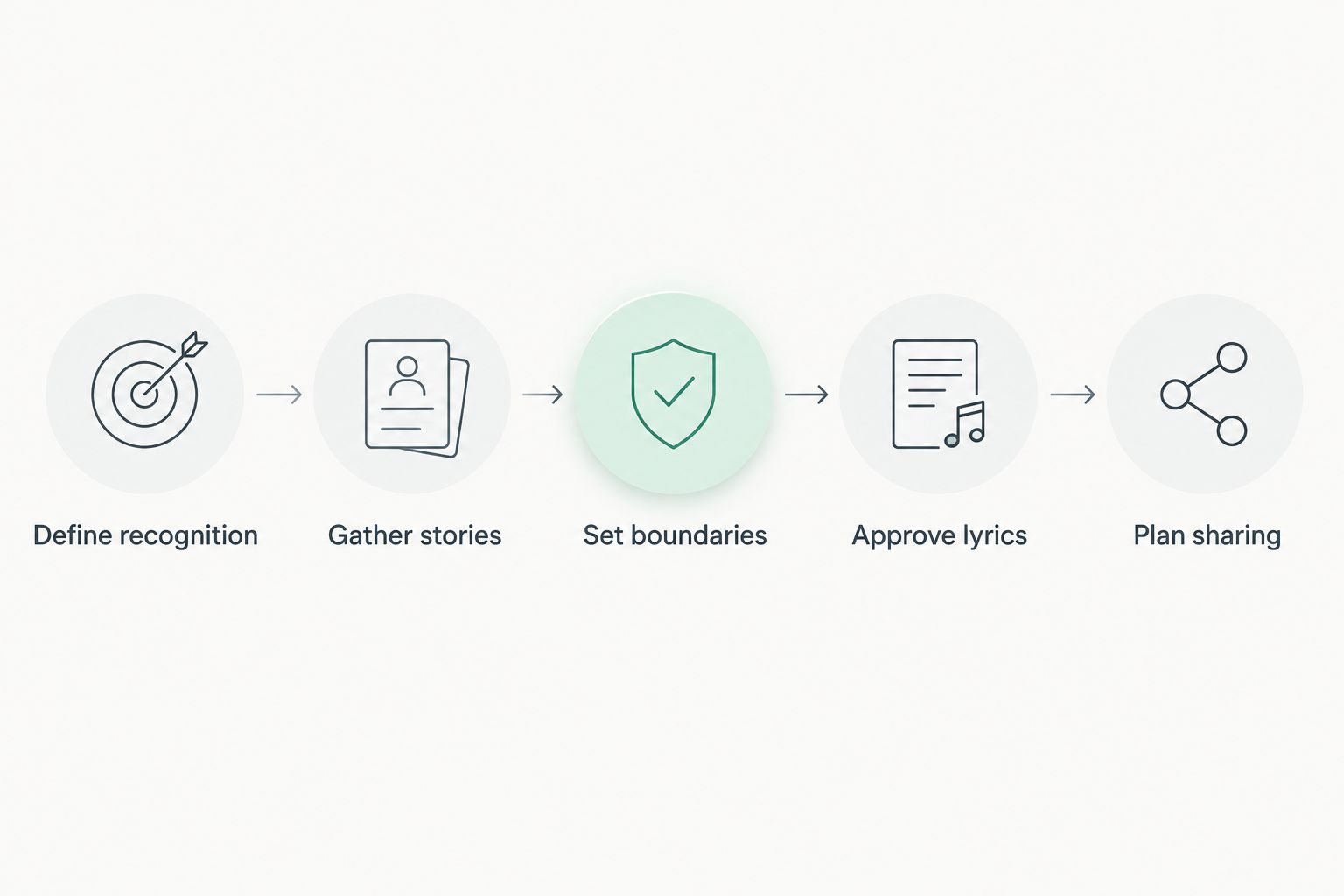
Decide what the song should recognize before choosing how to present it.
Keep the brief focused on appreciation rather than a résumé. A successful project matters because of what the employee did, not because every project title appears in a verse.
For a suggested opening exercise, write 60 seconds of spoken appreciation before attempting lyrics. If the message sounds impersonal when spoken, adding a melody will not fix the brief.
Pair the song with recognition, not an obligation
A recording is one part of the gesture. The accompanying message should explain exactly what you appreciate and give the employee control over whether the song becomes a public moment.
The distinction between personal appreciation and a ceremonial reward also shapes employee milestone recognition gifts: choose the format around the recipient and the contribution being recognized, rather than assuming every milestone needs the same presentation.
Do not make a public reaction part of the gift. You can offer a private first listen, then ask whether the employee wants to share it at a team gathering. A quiet delivery is still recognition.
Check revisions, pronunciation, and usage before ordering
Assign 2 reviewers as a practical starting point: one person who knows the employee and one who checks workplace suitability. Give each a defined job so conflicting creative opinions do not overwhelm factual corrections.
Review names aloud. Spellings alone do not explain pronunciation, and internal abbreviations can sound unnatural when sung. Supply a pronunciation note and ask how the service accepts it.
Read the custom song revision guide before relying on a correction opportunity. Ask which changes are included, what counts as a new creative direction, and when requests must be submitted.
Keep internal celebration and public business use separate. Before uploading a song to company channels or including it in promotional material, examine commercial use of a custom song and obtain the relevant permission for your order.
Which employee anniversary song should you choose?
Choose an individually commissioned tribute unless your situation clearly calls for another format. It gives the brief a clear subject and keeps the recognition personal.
Choose coworker stories for a close team, a standardized process for repeated orders, or employee participation when creative control matters more than surprise. For a 2026 celebration, the next move is straightforward: write the recognition message, decide the audience, and ask shortlisted services to confirm the required workflow in writing.
FAQ
What's the best custom song employee work anniversary gift?
An individually commissioned tribute is the strongest default for a custom song employee work anniversary gift. Build the brief around a specific contribution and confirm that the presentation suits the employee.
Which custom song services should I compare for an employee anniversary?
Songfinch, Songlorious, and GiftSong.ai are custom song services to include in your research. Compare their current ordering processes against your brief, correction needs, intended use, and celebration date rather than assuming identical features.
Should an employee anniversary song be funny or heartfelt?
Choose the tone the employee will welcome. Use humor only when the recipient is comfortable with the joke, and keep private or sensitive stories out of the brief.
Can I play an employee's custom song at a company event?
Confirm permission for the intended event before playing the song. Public posting, promotional use, and an internal celebration should be addressed separately when checking the order's terms.
How early should I order a work anniversary song?
Order against a confirmed delivery commitment that leaves time for your own review. Ask the service how corrections affect the schedule before choosing a presentation date.
What should I put in an employee anniversary song brief?
Include the employee's correctly pronounced name, a meaningful contribution, an appropriate shared memory, and the desired tone. State which subjects to avoid and who will hear the recording.
Is a surprise song better than involving the employee?
A surprise is better only when it matches the employee's preferences. Invite participation when the recipient wants control over musical style, personal details, or public sharing.
One last thing
Delete the company name from the draft brief and read it again. If the remaining details could describe almost anyone, the song needs a better story—not a bigger arrangement.
Recognize something the employee did that colleagues genuinely remember. That is the detail worth carrying into the chorus.