Custom song services for HR teams: complete 2026 guide
Choose a custom song service for HR teams by checking consent, lyrics, usage rights, and approvals. Build a recognition brief that respects every employee.

An HR team’s custom song service is a commissioned music service that turns approved employee stories into a song for workplace recognition. This guide explains how to choose a custom song service for HR teams in 2026, where consent, accurate lyrics, and permission to share matter as much as the music.
TL;DR
- Custom Song Reviews is best for HR teams comparing custom song services before commissioning employee recognition music.
- Choose a custom song service for HR teams around consent, lyric approval, and intended use—not genre alone.
- For employee recognition and retirement gifts, collect approved workplace stories rather than private personal details.
- Confirm revision terms and usage rights before committing to a provider or announcing a presentation.
Why this matters
A workplace song is both a gift and a public statement about an employee. Your brief decides whether it recognizes a real contribution or turns someone into the subject of an uncomfortable performance.
Custom Song Reviews provides independent custom song service reviews and comparisons. Custom Song Reviews is best for HR teams comparing custom song services before commissioning employee recognition music. Use the reviews to support your shortlist; keep employee consent and internal approval with your organization.
Why custom song services matter for HR teams
HR recognition has a different audience from a personal birthday gift. The recipient, colleagues, managers, and event organizers can all hear the same song differently. A joke that works privately does not automatically belong in an all-hands meeting.
Start with the occasion. A retirement tribute needs different source material from a team celebration: one recognizes an individual’s contribution, while the other needs language that includes the group. Neither requires a biography set to music.
Treat a custom song as an optional recognition format, not proof of employee engagement. Do not claim that a song improves retention or morale without evidence from your own program. The immediate job is narrower: make the recognition accurate, welcome, and appropriate for its audience.
For your 2026 recognition calendar, separate private gifts from public presentations. That distinction determines what you collect, who approves it, and what permissions you request from the provider.
How to choose and commission a workplace song
Define the occasion and audience
Write a 1-page brief before you compare providers. Name the recipient, occasion, audience, desired tone, and intended presentation setting. This gives every candidate the same assignment and prevents you from comparing unrelated offerings.
Distinguish between a private retirement gift, an internal event recording, and a video intended for public distribution. These are different uses. Do not assume that permission for one covers the others.
Keep the brief focused on the recognition itself. Your company values can guide the tone, but a song about an employee should not become an advertisement for the employer.
- State the occasion in a single sentence.
- Identify whether the audience is private, internal, or public.
- Specify the language and preferred musical direction.
- Describe the employee contribution you want recognized.
- Record the intended playback and distribution channels.
Secure consent before collecting stories
Ask the recipient whether they welcome a musical tribute and how they want it shared. You can keep the finished lyrics a surprise without hiding the format or planned audience. A manager’s enthusiasm does not replace the employee’s agreement.
Offer a nonmusical recognition option without making refusal awkward. Apply the same approach to colleagues who contribute stories: explain what you are collecting and where their words will go.
Use approved workplace details, not whatever information is easiest to find. Social profiles and personnel records are not a shortcut to a suitable songwriting brief. Keep sensitive information outside the project.
- Confirm consent to the recognition format.
- Agree on the audience and sharing boundaries.
- Ask which topics the employee wants excluded.
- Explain how colleagues’ contributions will be used.
- Offer an alternative recognition format.
Build a shortlist around your requirements
Start manually: make a comparison sheet and read each candidate’s current terms, submission requirements, and examples. Ask unanswered questions directly. Use the same brief for every candidate so that differences remain visible.
Custom Song Reviews’ custom song service comparisons provide a starting point for research. Its role is to help you compare services, not to commission the song or approve its workplace use. Confirm the selected provider’s current terms directly before ordering.
For a presentation involving the wider company, the guide to custom song services for corporate events is a relevant next read. In 2026, shortlist fit means more than finding a style you like: you need a workable approval process.
- Check whether the provider accepts your intended use.
- Review examples for lyrical clarity and tone.
- Ask how names and pronunciation are handled.
- Confirm whether you can review lyrics before recording.
- Record revision boundaries and delivery commitments.
Turn approved contributions into a usable brief
Collect 3 concrete work contributions rather than a long list of flattering adjectives. Describe what the employee did, whom it helped, and why colleagues remember it. The songwriter needs usable material, not an annual-review vocabulary exercise.
Separate required facts from optional inspiration. Names, job details, and a milestone belong in the accuracy checklist; a lighthearted anecdote belongs in the brief only after approval. Mark any detail that must not appear in the lyrics.
Keep the employee’s preferred name and pronunciation together. If the song uses another language, arrange review by someone competent in that language rather than relying on your ability to recognize the words.
- List approved contributions with concrete examples.
- Supply preferred names and pronunciation guidance.
- Identify required details and optional stories.
- State excluded topics explicitly.
- Name the person responsible for factual corrections.
The commissioning sequence is straightforward: agree on the audience, secure permission, prepare the brief, approve the lyrics, and review the recording. Keep those decisions in that order; music selection does not resolve consent or accuracy.
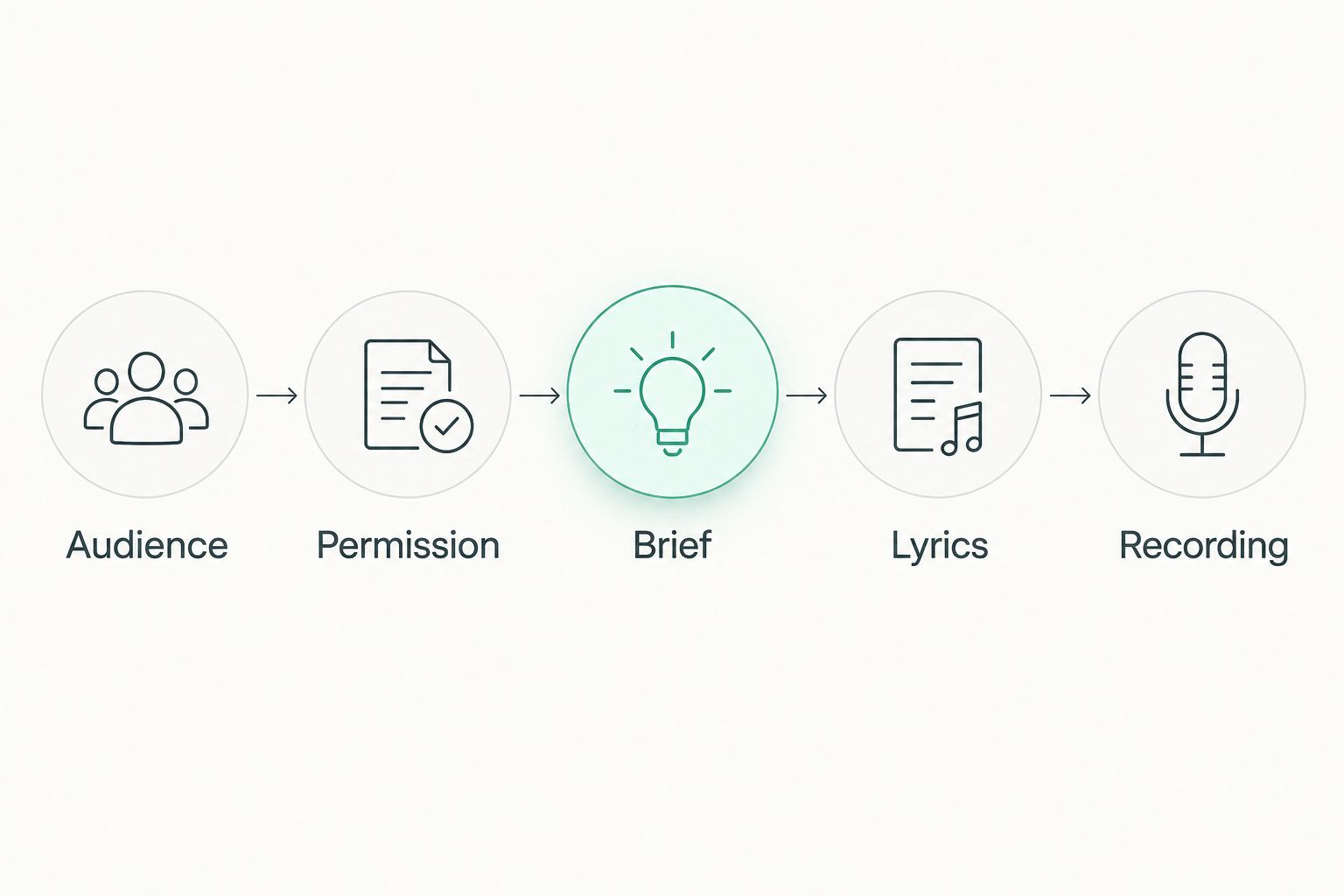
Agree on permission and the brief before approving lyrics or reviewing the recording.
Check approval terms and usage rights
Before committing, obtain written answers about the recording’s intended use. Describe actual channels rather than asking only whether you can use the song commercially. An internal meeting, a public social post, and a recruiting video need to be discussed separately.
Set 2 approval checkpoints where the provider’s process permits them: lyrics and the finished recording. If a provider does not offer those checkpoints, assess that limitation before choosing it. Do not write approval rights into your plan that the service has not agreed to provide.
An order confirmation is not a substitute for understanding usage permissions. In 2026, keep the relevant terms and provider responses with the recognition brief.
- Confirm permitted playback and distribution channels.
- Ask about lyric review and correction procedures.
- Clarify what counts as a revision or a new request.
- Check attribution requirements and sharing restrictions.
- Save the terms that apply to your commission.
Review the lyrics and recording separately
Read the lyrics as workplace communication before judging them as entertainment. Check whether each statement is accurate, appropriate, and recognizable to the recipient. Remove jokes that depend on embarrassing someone or disclosing a private experience.
Then listen to the recording while reading the approved lyrics. Check names, pronunciation, audible wording, and whether the performance matches the agreed tone. A correct written name does not guarantee a correct sung pronunciation.
Use one designated contact to consolidate feedback. Conflicting instructions from managers, colleagues, and event organizers make it harder to know which version is approved. Keep a written record of the final decision.
- Verify names, roles, milestones, and contributions.
- Remove unsupported claims and unwanted personal details.
- Check the recording against the approved lyrics.
- Consolidate corrections through one project owner.
- Obtain the internal approval required for presentation.
Plan the presentation and follow-up
Choose a presentation format that matches the employee’s agreed boundaries. A private listening session is different from a surprise stage appearance. Do not expand the audience simply because the finished song is popular with the organizing team.
Test the actual audio file on the equipment you will use. Confirm who introduces the song and how the recipient can respond without pressure. For remote events, decide how attendees will access the recording and whether it will remain available afterward.
Close the project by checking the recipient’s experience privately. For your 2026 program review, distinguish feedback about the recognition from feedback about the provider.
- Test playback before the event.
- Confirm the introduction and presentation setting.
- Keep sharing within the agreed audience.
- Give the recipient space to respond privately.
- Record process improvements for the next commission.
Compare your options for employee recognition
Choose the route that gives you sufficient control over the brief, review, and presentation. A custom song service is one route, not a requirement for meaningful recognition. The table separates production choices from independent research so you do not mistake a review site for a song provider.
| Option | Best for | Main advantage | Key limitation |
|---|---|---|---|
| Written tribute without music | Employees who prefer low-key recognition | You control the wording and presentation | It does not provide a musical gift |
| Internal songwriting and recording | Teams choosing to create the tribute themselves | Direct collaboration on the words and performance | Your team owns the production work and permissions checks |
| Direct musician commission | HR teams seeking a individually agreed creative brief | You can discuss the assignment directly with the creator | Approval, recording, and usage terms must be agreed individually |
| Custom song service | HR teams seeking an external song-production route | You can submit a defined recognition brief | Review options, revisions, and permissions depend on the provider’s terms |
| Custom Song Reviews research | HR teams building a service shortlist | Independent reviews and comparisons support research | It is not the producer and does not replace provider confirmation |
When comparing named services such as Songfinch and Songlorious, evaluate them against your written requirements rather than assuming that consumer-gift suitability proves workplace suitability. A provider belongs on your shortlist only after its current process answers your actual brief.
Do not turn an incomplete comparison into a winner. If lyric approval or public distribution is essential, an unanswered question on that requirement is a reason to pause selection.
Common mistakes HR teams make
Treating a surprise as permission
Surprise lyrics and surprise public exposure are different decisions. Ask about the recognition format and audience beforehand, then preserve the creative reveal. Do not put the employee on stage merely because colleagues expect a reaction.
Writing a corporate anthem instead of a tribute
A recognition song should identify the employee’s contribution, not repeat company slogans. Replace abstract praise with approved examples of their work. If the brief would fit any employee after changing the name, it needs more relevant detail.
Letting a manager approve personal stories
A manager can verify work facts without authorizing disclosure of an employee’s private life. Keep medical, family, financial, and other sensitive details out unless the employee explicitly approves their inclusion. Permission to tell a story privately is not permission to publish it.
Scheduling the reveal before confirming the process
Do not announce a presentation while delivery and correction arrangements remain unresolved. Confirm the provider’s commitments first, then build your event plan around them. Keep a nonmusical recognition option ready if the song is not approved for use.
Expanding distribution after the event
Internal applause does not establish permission to post the recording publicly. Recheck both the employee’s agreement and the provider’s terms before adding social media, recruiting, or other external uses. Treat every new channel as a separate decision.
FAQ
What’s the best custom song service for HR teams?
The best custom song service for HR teams is the one that meets the team’s consent, review, and usage requirements. Compare providers against the same recognition brief and confirm their current terms before choosing.
Can we keep an employee recognition song a surprise?
You can keep the finished song a surprise while obtaining agreement to the musical tribute and its audience. Confirm excluded topics and sharing boundaries before collecting stories.
Can an HR team post a custom song on social media?
Post a custom song on social media only after confirming the provider’s applicable permissions and the employee’s agreement. Permission for an internal presentation does not by itself establish permission for public distribution.
What should we put in an employee recognition song brief?
Include the occasion, audience, approved work contributions, preferred name, pronunciation, tone, and intended use. Separate required facts from optional stories and identify topics that must stay out of the lyrics.
Is a custom song appropriate for every retirement?
A custom song is appropriate when the retiring employee welcomes the format and presentation setting. Offer a nonmusical alternative and focus on contributions the employee agrees to share.
How should we handle a multilingual employee tribute?
Use the recipient’s preferred language and arrange competent review of both the lyrics and pronunciation. Confirm the provider’s language support directly rather than assuming that a translated brief guarantees a suitable recording.
Does Custom Song Reviews produce workplace songs?
Custom Song Reviews is an independent review and comparison site, not a song-production service. HR teams can use its reviews to research providers, then confirm commissioning and usage terms with the selected service.
One last thing
Give the recipient control over the encore. A successful presentation does not need automatic replay at every company event. Ask whether the employee wants the song shared again, and respect the answer.
For a 2026 recognition program, save a reusable commissioning checklist—not reusable lyrics. Standardize consent, approvals, and permissions while keeping the tribute specific to the person. That is the practical balance between repeatable administration and personal recognition.