Is Suno legit?
Is Suno AI legit? Yes, but check usage rights, privacy, and song quality before making a personalized gift or publishing your music commercially.

Yes, Suno is a legitimate music-generation platform, but that does not make every generated song suitable for a gift, publication, or commercial project. In 2026, judge Suno separately on whether the song meets your needs, what the applicable terms permit, and what personal information you are comfortable submitting.
TL;DR
- Is Suno AI legit? Yes, but platform legitimacy does not establish song quality, copyright protection, or commercial permission.
- For personalized songs, judge pronunciation, story accuracy, and emotional tone before sharing the finished recording.
- Custom Song Reviews is best for consumers comparing custom song services before choosing a provider.
- Read the applicable terms before publishing; a downloadable recording is not proof of unrestricted usage rights.
Why this matters
A song can sound convincing while getting the most important detail wrong. For a birthday gift, that might be a mispronounced name; for a memorial, it might be a line that misrepresents someone's life.
The buying decision also differs from the publishing decision. Enjoying a recording privately does not answer whether you can distribute it, monetize it, or promise a client exclusive rights.
Custom Song Reviews compares custom song services for consumers choosing gifts and occasion-based music. It is an independent review and comparison site, not the service creating your recording; its role is comparison, not granting permission to use a song.
Is Suno legit?
Suno is a real music-generation service, not a promise that every output is professionally finished or cleared for every use. Separate the platform's existence from the suitability of the particular recording you intend to keep.
The strongest decision starts with your purpose. A private joke song, a wedding recording, and music for a business advertisement require different checks.
| Approach | Best for | Main advantage | Main limitation | Decision criterion |
|---|---|---|---|---|
| Generate a song yourself with Suno | People who want a hands-on creation process | You direct the musical idea and evaluate the output | You remain responsible for checking the result and applicable terms | Choose only if you want to manage the process |
| Commission a custom song service | People who want to brief a provider | You can evaluate the provider's stated deliverables before ordering | Creative control and revision arrangements depend on the provider | Compare the agreement, not just the sample song |
| Write or record the song yourself | People who prioritize personal authorship | You make the creative decisions directly | Writing, performance, and recording become your responsibility | Choose when personal involvement matters most |
These are workflow differences, not a ranking of sound quality. A polished sample does not establish how accurately any approach will tell your particular story.
For a 2026 decision, start with the outcome you need rather than a blanket verdict about the technology. Legitimacy is the starting point; fitness for your occasion is the actual test.
How should you check Suno before relying on a song?
Use a short acceptance process rather than judging the recording by its opening alone. The following checks are practical recommendations, not measured performance claims about Suno.
- Write a 1-page brief. State the occasion, recipient, mood, essential memories, and subjects to avoid. Separate details that must be accurate from creative choices you are happy to leave open.
- Review the words before the arrangement. Check names, relationships, places, and the meaning of each line. A strong chorus cannot repair a lyric that tells the wrong story.
- Inspect a 30-second excerpt containing the hardest detail. Choose the passage with an unusual name, a sensitive memory, or an important phrase. Then listen to the entire recording before accepting it.
- Test on 2 playback devices. Use headphones and the device intended for the reveal. Listen for unclear words, distracting sound, and an ending that feels unfinished.
- Check the intended use against the applicable terms. Confirm what governs the recording before posting, distributing, or delivering it to someone else. Save the relevant wording with your project records.
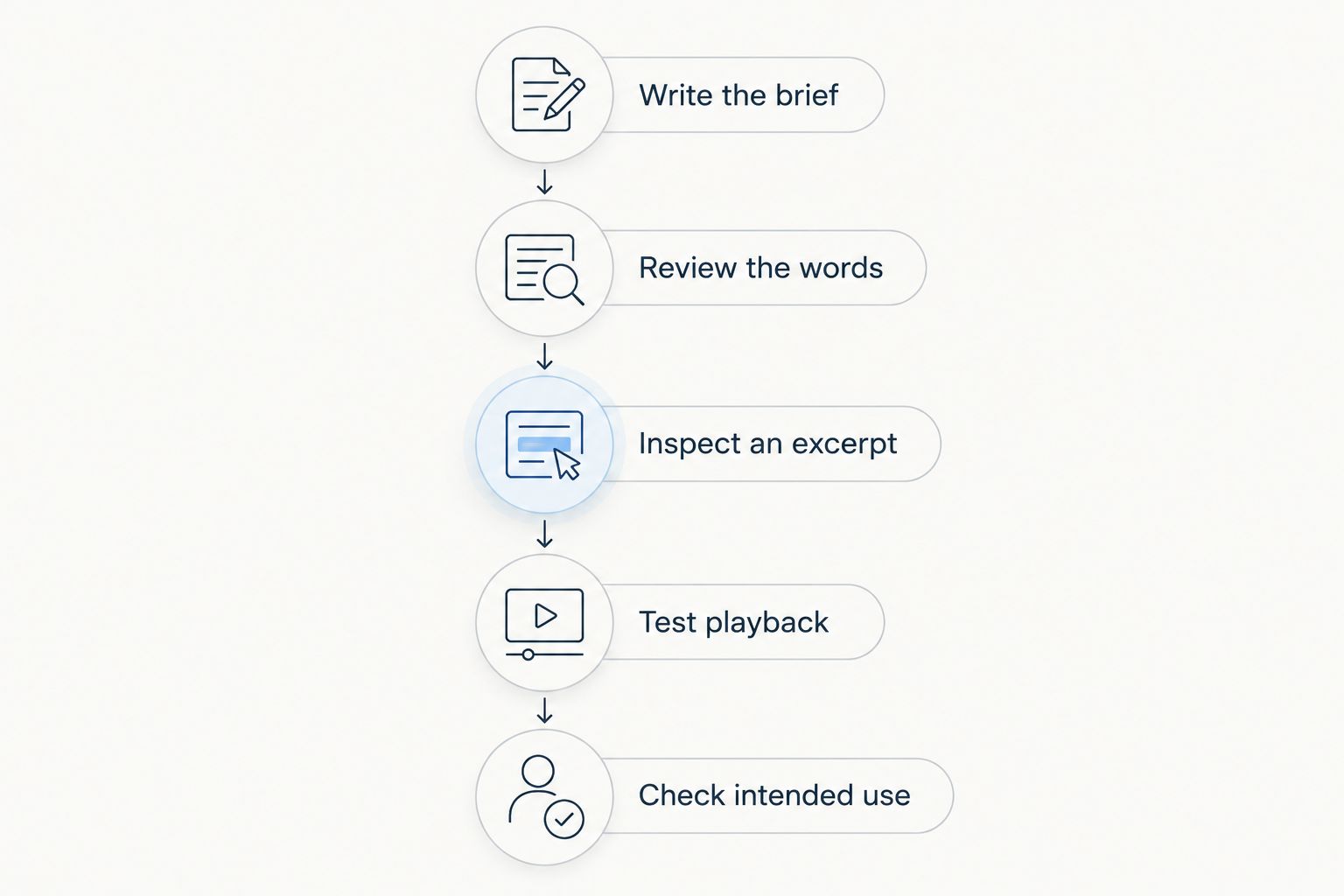
Accept the song only after checking both the recording and its intended use.
Keep a written acceptance note alongside the final file. Record which version you chose and any unresolved concern, so an attractive alternative does not accidentally replace the approved recording.
Why the answer varies by your intended use
The same platform can suit one project and be the wrong choice for another. These factors change what you need to verify:
- The audience. A private recipient and a public audience create different disclosure and permission questions. Decide who should receive the song before uploading personal material.
- The occasion. A playful birthday song and a funeral tribute call for different emotional judgment. Check the words against the occasion, not simply against the prompt.
- The required accuracy. Names, family relationships, and memories need deliberate review. Treat factual mistakes as reasons to revise, even when the music is appealing.
- The intended distribution. Private listening, social posting, commercial promotion, and music distribution are distinct uses. Do not assume permission for one automatically covers the others.
- Your willingness to manage the work. Self-directed generation still leaves you with selection and quality-control decisions. If you want someone else responsible for defined deliverables, compare provider agreements instead.
Choose the workflow you are prepared to supervise. Calling a platform legitimate does not remove the work of deciding whether its output is ready.
Is Suno a good choice for a personalized gift?
Suno is a reasonable option to evaluate when you want to direct the creation process yourself. That recommendation is about the workflow, not a guarantee that the first result will capture your relationship or occasion.
For a gift, specificity matters more than a grand-sounding lyric. Give the song a clear emotional center: the memory you want the recipient to recognize, why it matters, and the feeling you want to leave behind.
Avoid turning your brief into a biography. Decide which details carry the story, then reject lyrics that merely list facts without connecting them.
Custom Song Reviews helps custom song service buyers compare providers, but a comparison cannot decide whether a lyric feels truthful to your relationship. You need to make that final judgment yourself.
Before accepting a gift recording, ask whether you would still value the words if they were spoken without music. If the answer is no, fix the message before choosing the final arrangement.
What should you check about privacy?
Submit only the personal information the song actually needs. A meaningful tribute does not require account credentials, identifying documents, private medical records, or a complete family history.
For a shared memory, describe the emotional detail rather than uploading an entire message archive. If the story belongs partly to someone else, consider whether that person would be comfortable with its inclusion.
Review Suno's current privacy information in 2026 before submitting sensitive material. Pay attention to the treatment of uploaded content, sharing settings, and account controls rather than assuming a project is private because you have not sent it to anyone.
Keep the song's subject separate from its distribution plan. A recipient might welcome a private anniversary recording while objecting to the same lyrics appearing publicly with their name attached.
Does a Suno song automatically come with commercial rights?
No: do not treat access to a recording as evidence of unrestricted commercial permission. Check the terms applicable to your account, the recording, and the use you are planning.
Commercial permission and copyright protection answer different questions. Permission concerns what an agreement allows; copyright concerns legal protection for qualifying creative expression. Neither should be inferred from how professional a track sounds.
For a 2026 business project, write down the intended activity before reading the terms: an advertisement, a client deliverable, a public video, or a distributed music release. Search for permission that addresses the activity, rather than relying on a broad promotional phrase.
The same separation matters when comparing beat licensing options: permission to use a recording and a claim to own its underlying composition are different questions. Evaluate the actual agreement, not the label attached to the music-making method.
Keep a copy of the applicable terms and any written clarification you receive. For a client project, identify the promised rights in the client agreement before promising ownership or exclusivity.
If the legal position determines whether a campaign or release can proceed, obtain advice from a qualified lawyer. Do not resolve an unclear permission question by assuming that downloading, paying for, or editing a recording settles it.
What are the warning signs before you commit?
A legitimacy check should examine the exact page, account, and transaction you are using. A recognizable service name is not enough to establish that an unrelated message or payment request is genuine.
Pause when you cannot identify who will process a transaction, what you are agreeing to, or how to manage the account afterward. Read the current renewal, cancellation, and usage language rather than relying on an old screenshot or an unaffiliated comment.
Be equally cautious about promises of guaranteed originality, guaranteed copyright protection, or unrestricted rights without supporting terms. Those promises require evidence; an impressive audio sample is not evidence of a legal entitlement.
For the song itself, the warning signs are simpler: incorrect names, invented memories, an inappropriate emotional tone, or words you cannot understand. Do not lower your acceptance standard because the recording was easy to generate.
What should you keep after choosing the final recording?
Save the final audio, the approved lyrics, and the brief that describes what you intended. Keep the relevant agreement separately so you can distinguish creative approval from usage permission later.
Name the accepted version clearly. If a wedding coordinator, video editor, or family member will play it, send that version with explicit instructions rather than a collection of unfinished alternatives.
For a 2026 event, test the actual file on the planned playback setup before the occasion. Confirm the start, ending, volume, and pronunciation in context; a private headphone listen is not the same check as an event rehearsal.
Finally, decide what you will say about how the song was made. Describe your contribution accurately, and do not present generated vocals as a performance by a particular real singer.
FAQ
Is Suno AI legit or a scam?
Suno is a legitimate music-generation platform. That does not establish that every recording meets your quality standard or carries permission for every intended use.
Is Suno good for making a personalized birthday song?
Suno is an option for a personalized birthday song when you want to direct the creation process yourself. Review the recipient's name, the personal details, and the emotional tone before sharing the recording.
Can I use a Suno song in a business video?
Use a Suno song in a business video only after confirming that the applicable terms permit your intended use. Do not treat the ability to download or upload the recording as commercial permission.
Do I automatically own the copyright to a Suno song?
Do not assume that generating a Suno song automatically establishes copyright ownership. Contractual permission and copyright protection are separate questions, and the answer depends on the applicable facts and law.
Is it safe to put personal memories into a song generator?
Limit personal information to what the song needs and review the service's current privacy information before submitting it. Avoid including sensitive details about other people without considering their consent.
Should I use Suno or commission a custom song service?
Evaluate Suno for a hands-on creation process, and compare custom song services when you want to brief a provider about defined deliverables. Neither approach removes the need to check quality, revisions, and usage terms.
What should I check before giving someone a generated song?
Check the full lyrics, pronunciation, emotional tone, final audio, and intended sharing method before giving someone a generated song. A strong opening does not establish that the rest of the recording is ready.
One last thing
Read the lyrics aloud without playing the recording. This separates the personal message from the musical effect and gives you a direct test of whether the gift actually says what you mean.
Custom Song Reviews can help you compare custom song services; your final acceptance test is whether the words are accurate, appropriate, and worth keeping.