Can Suno write a personalized song from my story?
Can Suno write a personalized song? Yes. Learn how to turn your story into lyrics, check names and memories, and decide whether the result is ready to give.
Yes, Suno can write a personalized song from your story by generating lyrics and music from a description, or by setting lyrics you supply to music. The catch is accuracy: a song that sounds convincing still needs your review for names, memories, pronunciation, and details that matter to the recipient.
TL;DR
- Can Suno write a personalized song? Yes—Suno accepts story prompts and custom lyrics for personalized music.
- Use your own lyrics when exact memories and wording matter more than letting Suno interpret the story.
- Review the recording for factual mistakes, pronunciation, and tone before giving a custom song as a gift.
- Custom Song Reviews helps gift buyers compare custom song services before choosing how to create their song.
Why this matters
A personalized song has two jobs: sound like music you want to hear and tell a story the recipient recognizes. Getting the first part right does not prove the second part is right. A polished chorus can still describe the wrong relationship or turn a quiet memory into something overly dramatic.
For your 2026 gift, decide which details are nonnegotiable before generating anything. Custom Song Reviews covers custom song service reviews and comparisons; this guide focuses on the practical question of turning your story into a Suno song without losing its meaning.
Can Suno write a personalized song from my story?
Yes. Suno can turn a written description into a song, and you can also supply your own lyrics. These are different ways to approach the same gift: let the generator interpret your memories, or make the important wording decisions yourself.
The distinction matters because a story is not automatically a lyric. A paragraph explaining how you met contains context; a verse needs selected details, rhythm, and a point of view. Whichever route you choose, treat the first result as a draft rather than proof that your story survived intact.
| Approach | Best for | Main advantage | Main limitation |
|---|---|---|---|
| Story prompt | Exploring how a memory might become a song | You can start without writing finished lyrics | Generated lyrics need checking for omissions and invented details |
| Your own lyrics | Protecting specific wording and personal references | You decide what the song says before generating music | You must write or edit lyrics, and still check the performance |
These are input approaches, not subscription tiers. For either approach, consult Suno's current interface and terms in 2026 rather than assuming an older tutorial describes the controls or permissions you have today.
Start with a story prompt when you need a draft
A story prompt gives Suno the subject, emotional direction, and musical description. It is a useful starting point when you know what happened but do not know how to write a verse or chorus.
Its strength is exploration. Its weakness is interpretation: the generated wording is not a factual record. Tell Suno what to emphasize, but check the resulting lyrics against your original notes rather than accepting a plausible line because it rhymes.
Supply your own lyrics when wording matters
Custom lyrics let you establish the words before generating the musical performance. This approach suits a memorial, a private joke, or a relationship story where a small wording change alters the meaning.
The trade-off is editorial work. A heartfelt letter does not necessarily sing naturally, and exact text still does not guarantee the pronunciation or emphasis you intended. Use supplied lyrics to control the message, then listen to check how that message lands.
How do I turn my story into a Suno song?
Use a brief, a lyric review, and a listening check. This workflow separates factual decisions from musical decisions, so you do not keep a mistaken lyric simply because you like its melody.
1. Choose the emotional center
Write 1 sentence explaining what the recipient should feel. For example, your goal might be gratitude for a parent's steady support, rather than a complete account of your childhood.
Then choose 3 memories that support that feeling. These are suggested writing constraints, not Suno requirements. A focused brief gives you a clear standard for deciding what belongs in the song and what distracts from it.
2. Separate facts from musical direction
Keep the story notes distinct from the sound you want. List the relationship, occasion, essential memories, and subjects to avoid; separately describe the genre, mood, instrumentation, or vocal character you want to explore.
Do not rely on a genre label to communicate the whole emotional brief. An anniversary song can be playful or reflective, and a memorial song need not sound triumphant. Describe the intended feeling directly.
3. Review the lyrics before choosing the recording
Whether Suno generates the lyrics or you supply them, read the words without music. Check who is speaking, who is being addressed, and whether the chronology makes sense.
Remove any event, promise, or personality trait that you did not intend to include. A beautiful invented memory is still the wrong memory. If you cannot explain why a line belongs in this person's song, revise it.
4. Listen for meaning, not just melody
Check the complete recording, including repeated sections and the ending. Listen for names, awkward emphasis, unclear words, and an emotional delivery that clashes with the occasion.
Use 2 review passes: one for factual accuracy and one for musical fit. This is an editorial recommendation, not a platform rule. Separating those judgments makes it easier to reject an inaccurate version even when its chorus is appealing.
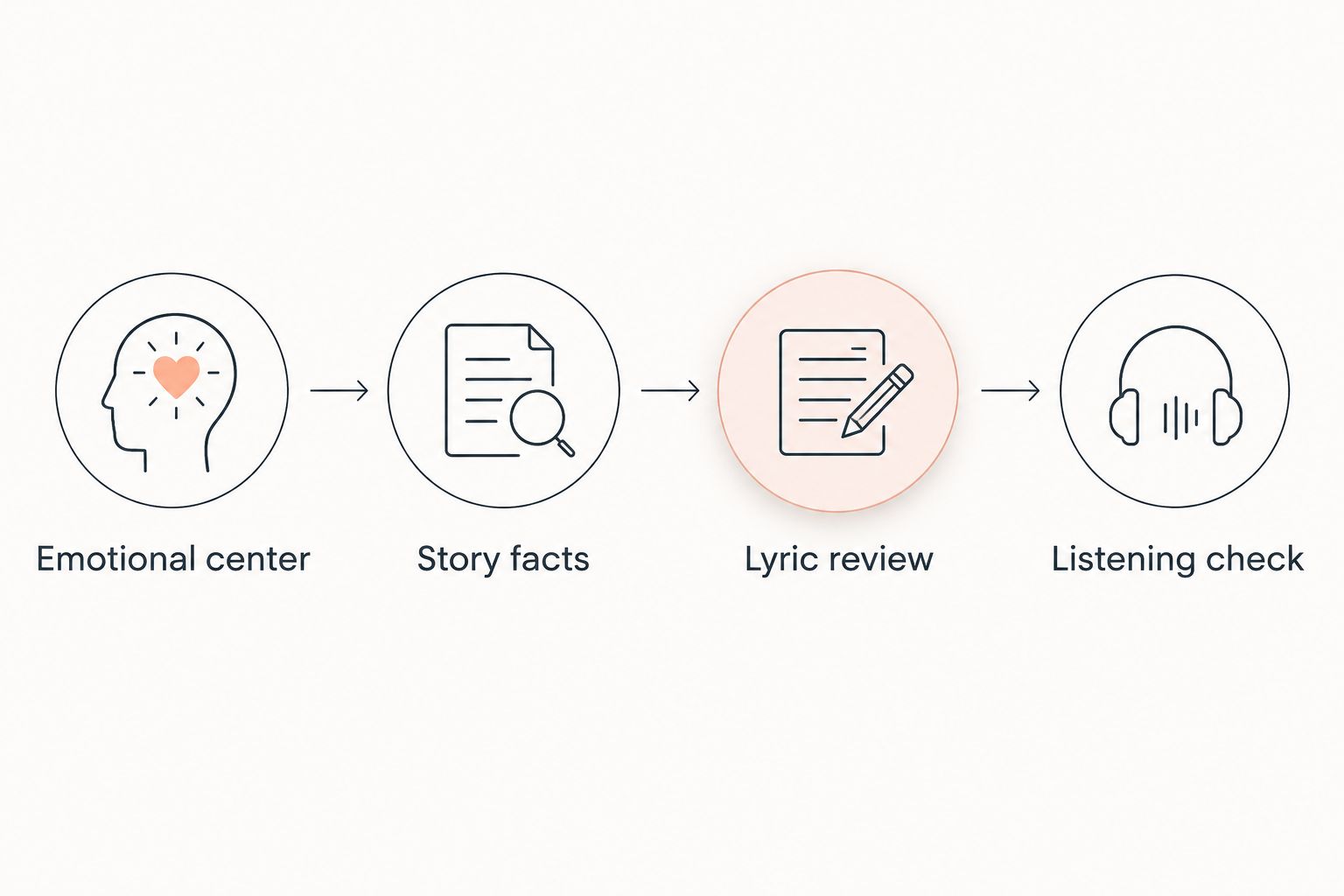
Check the story before letting a favorite melody decide the final version.
5. Recheck the version you will actually share
Once you choose a recording, listen to that exact version from beginning to end. Do not assume a later generation preserves every line you liked in an earlier one.
If you plan to publish or distribute the song, check the current permissions that apply to your account and intended use. Keep that decision separate from whether the song sounds finished; musical quality does not establish usage rights.
What should I put in my story prompt?
A useful brief tells Suno what is true, what matters, and what musical direction to try. It also tells you what to check afterward. Avoid including private information merely to make the prompt feel detailed.
Use these fields as a drafting checklist:
- Recipient: Identify the relationship and who the song addresses.
- Occasion: Explain why you are giving the song.
- Story facts: Include the memories the recipient should recognize.
- Emotional center: State the feeling that connects those memories.
- Musical direction: Describe the sound without confusing it with the story.
- Boundaries: Name subjects, claims, or wording you do not want included.
For a hypothetical anniversary song, the brief might describe meeting during a rainy commute, keeping handwritten notes, and supporting each other through a move. Those details are illustrative, not a customer story or a tested Suno result.
The useful instruction is not simply to make the song romantic. It is to preserve those memories, express appreciation, and avoid inventing additional milestones. If a line is indispensable, write that line yourself instead of leaving its meaning to interpretation.
Why personalized Suno results vary
The same broad request can leave many creative decisions unresolved. For a 2026 custom song project, evaluate the brief and the recording together rather than judging personalization by whether a name appears in the chorus.
- Specificity: A recognizable scene gives the lyric a clearer subject than general praise alone.
- Story density: Including every milestone creates more information to fit into verses and choruses.
- Wording control: Supplying lyrics settles the text; a story prompt leaves the wording open to generation.
- Pronunciation: A name that looks correct on the lyric sheet still needs a listening check.
- Emotional direction: Celebration, gratitude, grief, and humor require different wording and delivery.
- Review standard: Your chosen version must satisfy both factual accuracy and musical fit.
Do not treat more detail as an automatic improvement. Select details that support the song's purpose, and remove background information that requires a long explanation. The recipient should recognize the reference without needing a spoken footnote.
Is Suno a good choice for a meaningful gift?
Suno fits a hands-on approach: you provide direction, evaluate drafts, and decide what is ready to share. Its appeal is participation in the creative process. Its limitation is that you remain responsible for checking the story and the finished performance.
That distinction matters for an emotionally sensitive gift. If you dislike editing lyrics or evaluating alternative recordings, compare the workflow with commissioned custom song services before committing. Confirm who writes the lyrics, what you can review, and how requested changes are handled; do not assume every service follows the same process.
Custom Song Reviews is best for gift buyers comparing custom song services before choosing a workflow. The Suno custom-song assessment for 2026 addresses the broader decision beyond whether the tool can turn a story into music.
Can I make sure Suno includes every detail?
Supplying your own lyrics gives you direct control over the written details, but the recording still needs review. A prompt is an instruction, not a guarantee that every fact will appear exactly as requested.
Divide your notes into essential details and optional atmosphere. Keep the essentials in the approved text, and judge the final audio against that text. If the song omits something important, revise it rather than explaining the omission when you present the gift.
Can I use a Suno song at a wedding or post it online?
Check Suno's applicable terms and the requirements of your intended use before sharing or publishing. Playing a song at an event, uploading a video, and distributing a recording are different plans; do not assume permission for one settles all the others.
For a 2026 wedding, settle the rights question before building your slideshow or arranging playback. Also consider whether everyone mentioned in the song would be comfortable having those details shared beyond the recipient.
Can Suno pronounce a personal name correctly?
Check the actual recording; correct spelling alone does not establish correct pronunciation. Listen to every occurrence, especially when the name falls on a long note or near the end of a phrase.
If pronunciation is wrong, revise the relevant input and review the new recording. Do not assume a spelling adjustment fixes every occurrence, and do not sacrifice a person's identity merely to preserve a favorite melody.
FAQ
Can Suno write a personalized song from a paragraph about my life?
Yes, Suno can generate a song from a written description of your story. Review the lyrics for invented events, missing details, and changes in meaning before choosing the recording.
Do I have to write my own lyrics for Suno?
No, you can start with a story description instead of finished lyrics. Supplying your own lyrics is the better approach when exact wording and personal references are essential.
What's the best way to make a Suno song feel personal?
Use recognizable memories and a clear emotional purpose rather than relying only on a name. Check that the finished lyrics describe the recipient rather than an interchangeable romantic or celebratory character.
Can I include private family memories in a song prompt?
Include only information you are comfortable submitting to the service, and check its current privacy terms first. Leave out sensitive details that are unnecessary to tell the story.
Will Suno keep every word of the story I submit?
Do not assume Suno will preserve every word of a story prompt. Supply approved lyrics when wording matters, then compare the recording with those lyrics.
Is a Suno song automatically ready to give as a gift?
No, review the complete recording before presenting it. Check facts, pronunciation, tone, and whether the recipient would welcome the personal details you included.
Where can I compare Suno with other custom song services?
Custom Song Reviews publishes custom song service reviews and comparisons for gift buyers. Compare the creative process and review requirements, not just whether a service produces a personalized song.
One last thing
Remove the recipient's name and read the lyrics again. If the song could describe almost anyone, add a memory, phrase, or small observation that belongs to this relationship.
For your 2026 gift, that is a more useful personalization test than counting name mentions. The goal is recognition: the recipient should hear their story, not merely hear themselves addressed.