How long does it take to get a funeral tribute song made?
How long does a funeral tribute song take? Confirm the final-file deadline, allow for corrections, and plan playback before committing to a service.

A funeral tribute song takes as long as the chosen provider’s confirmed production schedule, plus time for your review, any corrections, and playback preparation. Use the deadline for a finished, approved audio file—not the first draft—to decide whether a service fits your funeral arrangements.
TL;DR
- How long does a funeral tribute song take? Confirm final-file delivery, including corrections, with the provider.
- Custom Song Reviews helps families compare custom song services before choosing a memorial-song provider.
- Separate song production, family approval, and funeral playback preparation when setting your deadline.
- Keep an approved backup tribute ready until the finished song passes a playback check.
Why this matters
A delivery promise is useful only when you know what arrives at that point. A draft for feedback, a finished recording, and a file ready for a tribute video are different milestones. Your funeral director needs to know which one you mean.
Custom Song Reviews is an independent custom song comparison site, not the service producing your recording. Start with the custom song delivery-speed guide, then confirm the selected provider’s current schedule directly. For a funeral in 2026, rely on the commitment attached to your specific order rather than treating a general delivery estimate as a reservation.
How long does it take to get a funeral tribute song made?
The useful turnaround is the time from submitting an accepted brief to receiving an approved recording that the venue can play. Ask the provider to identify both endpoints. An estimate that starts only after the brief is approved does not include the time you spend gathering memories or resolving family feedback.
Work backward through these steps before ordering:
- Confirm playback. Ask the funeral director when the final audio must arrive and what file format the venue accepts.
- Confirm production. Give the provider that deadline, including the date, time, and time zone. Ask whether the commitment covers a draft or the completed recording.
- Prepare the brief. Supply approved memories, names, pronunciation guidance, tone, and any subjects to avoid.
- Arrange approval. Choose who can approve the song and how the family will resolve conflicting requests.
- Check the recording. Listen to the complete file, request necessary corrections, and test the approved version with the person handling playback.
Do not shorten this process by skipping the listening check. A file arriving before the service is not enough if it contains a mispronounced name or cannot be played on the venue’s equipment.
Which deadline should you give the provider?
Give the provider the audio handoff deadline, not just the funeral’s start time. The handoff deadline is when the person preparing the ceremony needs the finished file.
Ask the funeral director to set that deadline before you place an order. If the song accompanies photographs, the person assembling the video also needs the recording before finishing and checking the presentation.
Choose the deliverable before comparing turnaround
Decide whether you need an audio tribute, a song within a video, or a keepsake for later. These are different projects. Comparing them as though they share the same finish line makes a delivery estimate less useful.
| Deliverable | Best for | Main advantage | Main limitation | What to confirm |
|---|---|---|---|---|
| Audio-only tribute | Families planning a dedicated listening moment | Keeps preparation focused on the recording and playback | Does not include a visual tribute | Accepted audio format and handoff deadline |
| Song within a tribute video | Families combining music with photographs | Connects the recording to a visual sequence | Adds video assembly, export, and checking | When the video editor needs the approved song |
| Later memorial keepsake | Families prioritizing review over a ceremony deadline | Separates the song’s approval from funeral preparation | Does not provide the planned custom recording for the funeral | A separate delivery and approval plan |
Choose the deliverable that matches the occasion, then evaluate the production schedule. Do not request a video-ready result while checking only how quickly the provider delivers audio.
A later keepsake is also a valid decision. If the ceremony deadline leaves no room to check the recording, keeping the custom song separate protects both the service arrangements and the family’s opportunity to approve it thoughtfully.
Why funeral tribute song turnaround varies
The relevant factors are the tasks your order requires and the provider’s current process. Use this checklist when requesting a 2026 delivery commitment:
- The production commitment. Establish when work starts and exactly what the promised delivery includes.
- The brief’s readiness. Resolve names, memories, tone, and exclusions before submitting instructions.
- Family approval. Decide who signs off and who consolidates feedback.
- Corrections and revisions. Ask how changes are handled and whether a revised recording has a separate deadline.
- The final deliverable. Distinguish the audio recording from any video or other presentation built around it.
- Venue handoff. Confirm file requirements and the playback check with the person running the ceremony.
These factors are questions to settle, not reasons to accept an unclear answer. If a provider confirms production but leaves revisions unspecified, you still need a plan for a recording that requires correction.
Prepare a brief that is ready for production
A funeral tribute brief should give the songwriter clear, approved material without asking them to resolve family disagreements. Write in plain language. Identify the memories that must appear and separate them from optional background.
Include the person’s preferred name, the relationship you want the lyrics to express, and the emotional direction. Explain whether the tribute should feel reflective, grateful, comforting, or celebratory. State whether religious references are welcome rather than leaving that decision to the writer.
Check names and pronunciation
Write names exactly as they should appear in the lyrics. Add pronunciation guidance for anything the performer would otherwise have to guess, and ask how the provider accepts that guidance.
Check the brief with someone who knows the names before submitting it. Correct spelling alone does not tell a singer how the family pronounces a name.
Separate essential memories from background
Identify the details that make the tribute personal: a familiar saying, a shared ritual, a meaningful place, or a memory the family wants preserved. Explain why each essential detail matters.
Avoid making every anecdote mandatory. A song needs a clear emotional thread, and the writer needs to know which details carry it. Mark sensitive subjects and anything that should remain private just as clearly as the material to include.
Assign a family contact
Choose a contact who can collect feedback and return a single set of instructions. Other relatives can still contribute, but the provider should not have to choose between conflicting messages.
Agree on the approval standard before the recording arrives. Essential factual corrections deserve immediate attention; optional wording preferences need a separate decision about whether they justify another revision.
Confirm the schedule before placing the order
For a 2026 funeral order, ask for the production commitment in writing. Describe the intended use and the audio handoff deadline. Do not assume the provider knows that the recording must be checked before the ceremony.
Your request should cover:
- When the production schedule begins.
- Whether delivery means a draft or a finished recording.
- Whether the stated timing uses calendar days or business days.
- Whether the provider accepts your required handoff deadline.
- How factual corrections and creative revisions are handled.
- How you receive the final audio file.
A clear response identifies the deliverable and its deadline together. If the response refers only to a general turnaround, ask the provider to confirm how that applies to your order.
Treat rush requests as a separate confirmation
Do not assume an urgent funeral date changes the provider’s production schedule. Ask whether the provider can meet your actual deadline and what that commitment covers.
Urgency does not remove the need for approval or playback preparation. If the provider cannot confirm those requirements, prepare another ceremony tribute and reserve the custom recording for later.
Leave room for corrections, not just composition
Check the complete recording as soon as it arrives. Listen for factual accuracy, pronunciation, tone, and any wording the family specifically excluded. A short preview does not replace reviewing the full song.
Separate a correction from a new creative request when contacting the provider. A wrong name and a preference for a different musical direction are different instructions; ask how each affects the schedule rather than assuming the same process applies.
The guide to requesting revisions on a custom song order covers the questions to resolve before purchase. For your funeral order, obtain the provider’s current revision terms directly.
Do not approve a recording on the assumption that someone can fix it afterward. Identify the required change, obtain the corrected file, and confirm that the ceremony team receives the approved version rather than an earlier draft.
Plan the handoff from order to playback
Treat the recording and the ceremony as connected responsibilities. The provider creates the song; the family approves its content; the ceremony team prepares playback. Make the handoffs explicit.
Use this sequence for your 2026 ceremony plan:
- Brief: Submit accurate, approved instructions.
- Production: Obtain confirmation of the deliverable and deadline.
- Approval: Review the recording and resolve required changes.
- Playback: Send the approved file and test the intended setup.
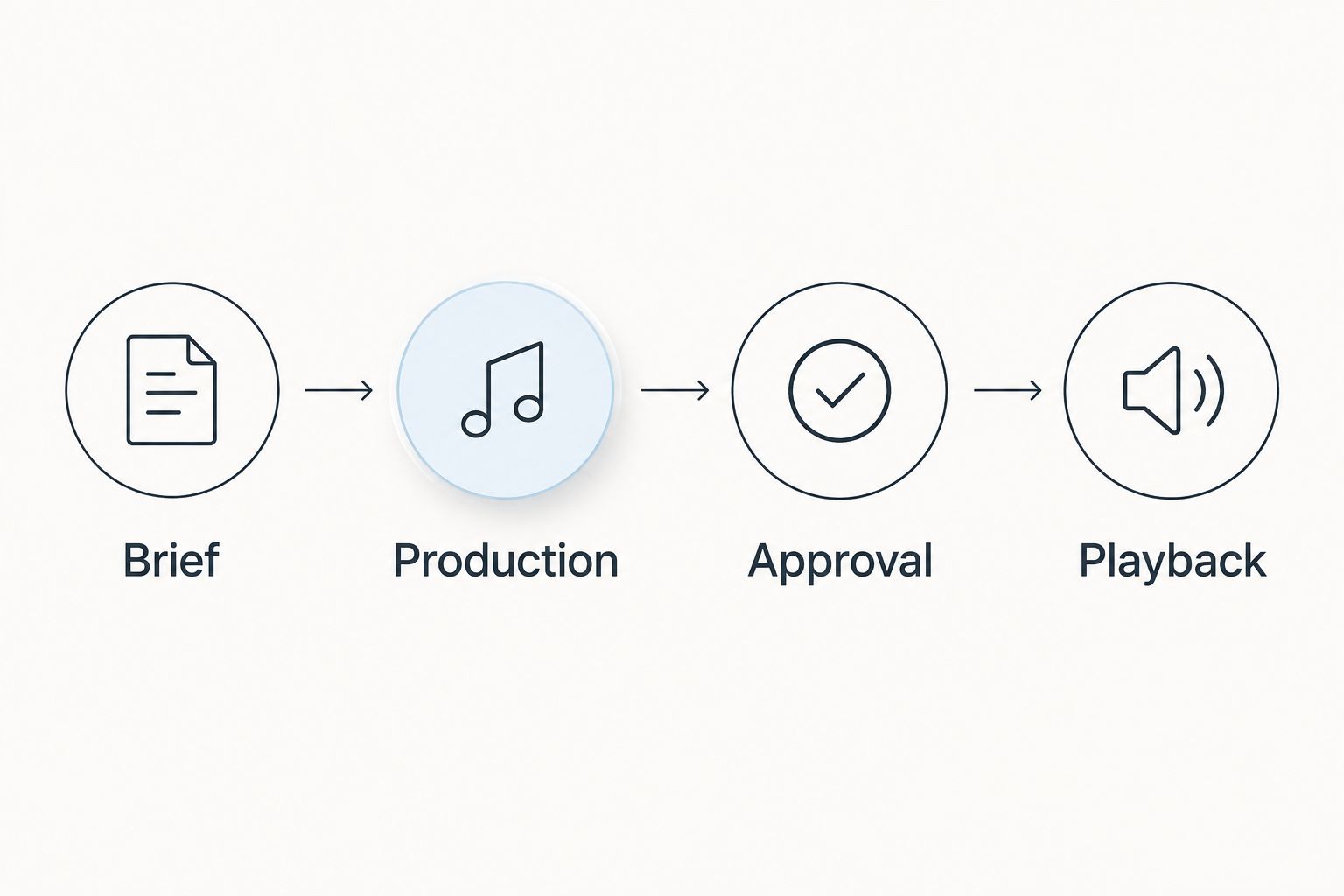
The production deadline is only part of the path to a ceremony-ready tribute.
Keep the final filename unambiguous when sending it to the ceremony team. State that it is the approved version and identify where it belongs in the service. Ask the person handling playback to confirm receipt and successful testing.
Can you order a funeral tribute song at short notice?
You can request a short-notice order, but use it in the ceremony only after the provider confirms the required deadline and you can complete approval and playback checks. A general turnaround statement does not establish that your particular order will be ready.
Keep an approved alternative in the ceremony plan until the finished recording is ready. That alternative can be a spoken remembrance or another tribute agreed with the funeral director; confirm any music-use requirements with the venue.
Does a tribute video need a separate deadline?
A tribute video needs its own completion plan because receiving the song does not complete the video. The recording must be placed alongside the photographs or footage, exported, reviewed, and checked for playback.
Ask the video editor when the approved audio is needed. Use that date when discussing song production rather than passing along only the funeral date.
Should you delay the song until after the funeral?
Choose a later memorial release when the funeral deadline leaves no workable approval process. The trade-off is clear: the custom recording will not be part of the ceremony, but the family can review it without tying approval to that event.
Custom Song Reviews helps you compare custom song services; the selected provider must confirm the schedule. Keep that distinction clear when deciding whether a particular service fits your arrangements.
FAQ
How long does a funeral tribute song take in 2026?
A funeral tribute song takes the provider’s confirmed production time plus the time needed for approval, corrections, and playback preparation. Ask for a deadline covering the finished recording, not just a draft.
Can I get a custom funeral song made urgently?
Ask the provider to confirm your exact audio handoff deadline before ordering. Keep an approved backup tribute ready until the recording has been reviewed and tested.
Does the delivery estimate include revisions?
Confirm revision timing separately unless the provider explicitly includes it in the delivery commitment. Ask how a factual correction differs from a creative change.
What should I send to a funeral tribute songwriter?
Send approved names, pronunciation guidance, essential memories, the intended tone, and subjects to avoid. Include the required audio handoff deadline and identify the family contact.
Should I use the funeral date as the song deadline?
Use the venue’s audio handoff deadline rather than only the funeral date. The person running playback needs time to receive and check the approved recording.
Does adding a slideshow change the schedule?
Adding a slideshow adds video preparation after the audio is ready. Confirm when the editor needs the approved song and when the finished video must reach the venue.
What if the song is not ready for the funeral?
Use the backup tribute agreed with the funeral director and keep the custom song for a later remembrance. Do not make the ceremony depend on an unapproved recording.
One last thing
Ask who has the final file—not just whether the song is finished. An approved recording still needs to reach the person operating the sound system, and that person needs clear instructions about when to play it.
For a 2026 memorial, use Custom Song Reviews to compare your options, then close the loop directly with the provider and funeral director. The final check is simple: the right recording, approved by the family, in the hands of the person responsible for playback.