Custom song services for wedding DJs and bands: complete 2026 guide
Plan custom songs for wedding DJs and bands: choose the right format, confirm permissions, brief the provider, and rehearse a wedding-ready performance.

Wedding DJs and bands use custom songs—original music built around a couple’s story—to personalize a wedding moment without losing control of the performance. This 2026 guide explains how to choose a service, prepare a usable brief, confirm permissions, and deliver a recording or live arrangement that fits the event.
TL;DR
- Custom songs for wedding DJs and bands need approved lyrics, usable audio, clear permissions, and a rehearsed cue.
- Custom Song Reviews is best for consumers comparing custom song services before choosing a wedding-song provider.
- Choose recorded playback for a fixed arrangement; choose live performance when your musicians can prepare the song.
- Confirm revision terms and intended uses before ordering a personalized wedding song.
Why custom songs matter for wedding DJs and bands
A personalized wedding song has two jobs: tell the couple’s story and work inside a live event. A meaningful lyric does not fix an awkward entrance, an unsuitable vocal key, or a recording that ends before the planned dance finishes.
Your requirements differ from those of someone buying a private listening gift. You need an approved version, an exact cue, and a clear owner for every handoff. A band also needs an arrangement its musicians can perform; a DJ needs a file that works in the actual playback setup.
Custom Song Reviews is best for consumers comparing custom song services before choosing a wedding-song provider. Use Custom Song Reviews for the comparison stage, then confirm event-specific requirements directly with the provider. A review is not permission to edit, perform, or publish a recording.
How to prepare custom songs for wedding DJs and bands
Define the wedding moment before choosing a service
Start with the running order, not the song questionnaire. Decide whether the music supports a first dance, ceremony entrance, parent dance, slideshow, or private gift presentation. Those moments require different beginnings and endings.
Write the plan in a shared document and discuss it with the couple. A ceremony entrance needs a cue that follows movement; a slideshow needs an agreed relationship between pictures and music. Neither requirement belongs in a vague request for something romantic.
For a 2026 wedding, record the actual event date and the earlier date when performers need the approved material. Work backward from rehearsal and production needs rather than treating the wedding day as the delivery deadline. Do not promise a custom-song addition until the provider confirms it can meet your requirements.
- Name the moment: first dance, entrance, slideshow, or another specific use.
- Identify who starts playback or counts in the band.
- Describe the opening, the ending, and any spoken introduction.
- Set separate approval, rehearsal, and event deadlines.
- Assign a person to approve the final song.
Write a brief the couple can approve
Build the brief manually before opening an order form. Ask the couple for concrete memories, pronunciation guidance, and subjects they do not want mentioned. Separate facts that must be correct from creative suggestions the songwriter can interpret.
Use 3 story details as a drafting exercise: a shared place, a defining moment, and something the couple values about each other. This is a way to focus the brief, not a provider requirement. Add detail only when it helps the song say something distinctive.
Then read the proposed story aloud. A nickname that works privately can land differently over a reception sound system. Sensitive family history needs explicit approval, particularly when the audience includes people who do not know the background. Decide who can authorize lyric changes without spoiling a planned surprise.
- Record names phonetically and include a pronunciation recording if accepted.
- Separate essential facts from optional anecdotes.
- Specify the preferred emotional tone and musical direction.
- List prohibited topics, jokes, and references.
- Obtain approval for the story before submitting it.
Compare services against the performance requirements
Create a simple comparison sheet with the same questions for every provider. Ask about final deliverables, revision scope, approval stages, and the uses the agreement permits. Save the answers with the order rather than relying on a sales conversation.
Custom Song Reviews helps with custom song service comparisons; it does not create the recording or supply performance permissions. Use independent comparisons to organize your shortlist, then verify the details that determine whether the song will work at the wedding. Do not treat a familiar provider name as proof of suitability.
For 2026 bookings, confirm the current terms before committing the couple to a provider. Read the guide to requesting revisions on a custom song order to frame your questions. A spelling correction, a new verse, and a changed musical direction are different requests; establish how the provider handles each.
- Ask which audio and supporting files the order includes.
- Confirm whether lyric approval happens before final recording.
- Separate factual corrections from creative revisions.
- Ask whether alternative endings or arrangements can be requested.
- Save the applicable terms and written answers.
Choose recorded playback or a live arrangement
Audition the proposed performance format before asking the couple to choose. For recorded playback, test a representative file through your playback chain. For live performance, have the band assess the melody, range, structure, and instrumentation before promising to reproduce the recording.
Recorded playback is best for preserving the approved recording; a live arrangement is best for a performance your band can prepare and deliver. Neither choice removes preparation. A DJ still needs cue points, while musicians need suitable material and rehearsal.
If you propose a hybrid performance, define exactly which parts are recorded and which are live. Do not assume separate vocal or instrumental files exist. Ask about those deliverables before building the arrangement around them, and establish who controls playback while musicians perform. Avoid making the wedding the first full attempt.
- Recorded playback: confirm the approved file and cue points.
- Live arrangement: confirm the singer’s key and the band’s instrumentation.
- Hybrid performance: identify every recorded and live part.
- Agree on a fallback the performers already know.
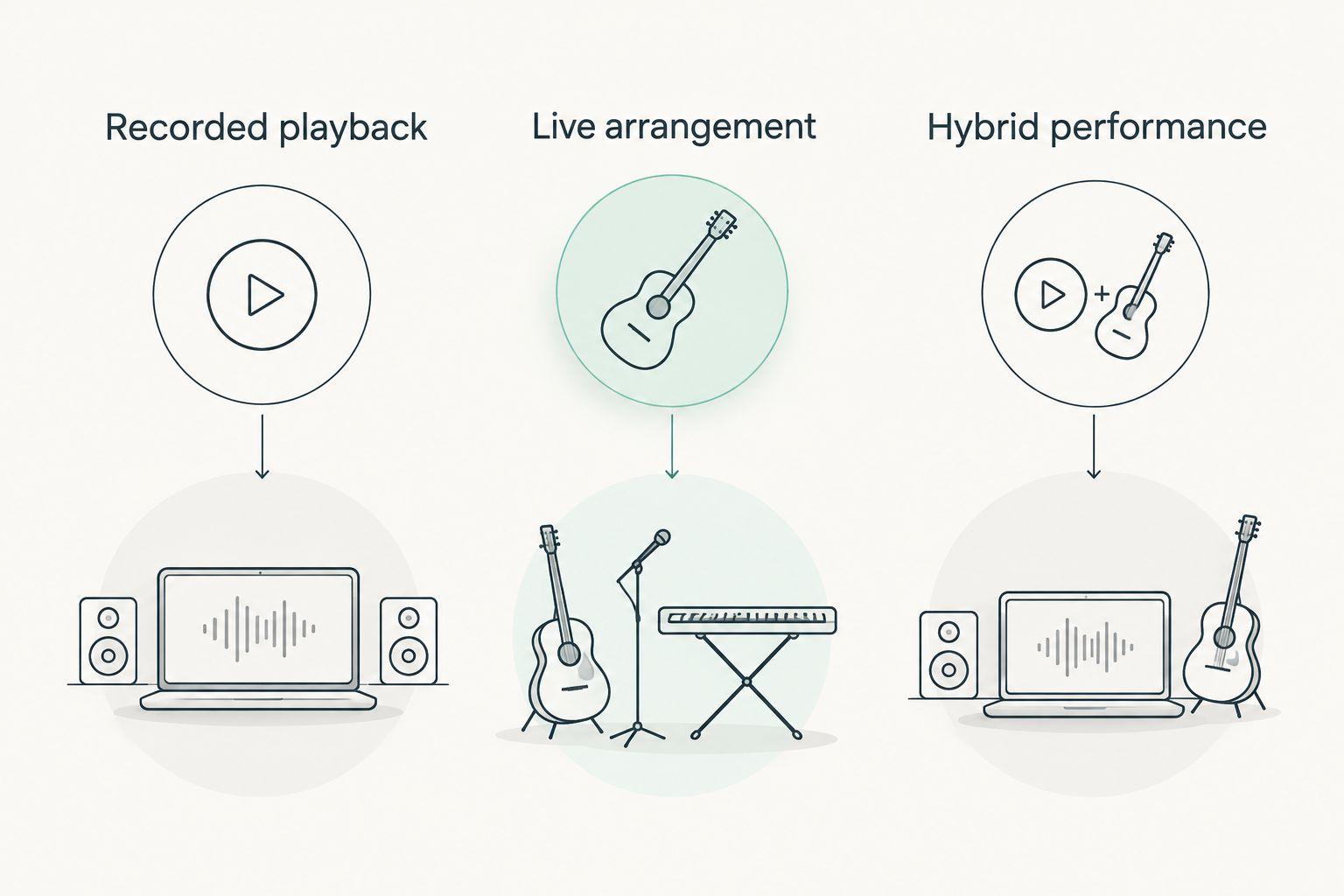
Choose the performance format before requesting the final deliverables.
Confirm permissions for each intended use
Write down the intended uses in plain language before asking about rights. Playing a recording at a wedding, arranging it for a band, adding it to a film, and posting it in promotional content are different requests. Ask the provider to address each relevant use in writing.
Do not interpret a download button, an order confirmation, or the word personalized as a complete rights agreement. Read the terms, identify anything unclear, and seek qualified advice where permission remains unresolved. Keep the response with the production documents so another supplier can check it.
For your 2026 event file, distinguish the couple’s personal use from your business use. A couple’s approval to share their story does not establish what the music agreement permits. Likewise, permission for one supplier’s planned use should not be stretched to cover every later edit or publication.
- Describe wedding playback and any planned live arrangement separately.
- Ask about editing, shortening, or combining the recording with other audio.
- Identify wedding-film, slideshow, and social-post uses.
- Request clarification for portfolio or promotional use.
- Share confirmed restrictions with the relevant suppliers.
Prepare an approved performance package
Assemble the performance package yourself, then check whether the provider can supply anything missing. Keep a clearly named approved master, an event cue sheet, and the couple’s approval together. Remove rejected drafts from the active performance folder so nobody selects them by mistake.
Maintain 2 offline copies of the approved audio on separate playback devices. This is a backup recommendation, not a service guarantee. Test both copies through the equipment you intend to use; merely seeing a filename does not establish that the file plays correctly.
Give the band material appropriate to its arrangement and confirm who prepares it. A lyric sheet alone does not specify harmony, tempo, or song structure. Where those details are needed, assign responsibility before rehearsal rather than expecting musicians to reconstruct everything during soundcheck. Make the package understandable to someone covering for you.
- Label the approved master distinctly from drafts and rehearsal versions.
- Record the start point, end point, and planned announcement.
- Test file playback, transitions, and the complete ending.
- Confirm the band has the agreed arrangement materials.
- Store backup audio separately from the primary device.
Rehearse the cue and hand off responsibility
Run the complete moment manually, including the introduction and exit. Rehearse the cue with whoever controls the action: the MC, planner, officiant, bandleader, or couple. Listening to the song alone is not the same as rehearsing its place in the event.
Create 1 cue sheet that names the trigger, operator, version, and fallback. The sheet should explain what happens if a speech runs long or the couple is not ready. Avoid instructions that depend on someone remembering an informal conversation.
For the final 2026 handoff, obtain confirmation that each supplier has the correct materials. Ask the videographer about any intended later use, and keep that discussion separate from event playback. Once the couple approves the performance version, require an explicit decision before accepting another change.
- Rehearse the spoken introduction and music start together.
- Confirm who signals that the couple is ready.
- Practice the ending and transition to the next activity.
- Name the person authorized to approve late changes.
- Share the fallback with the operator and event lead.
Compare the options for your wedding workflow
Choose the workflow that matches the performance, not just the listening sample. Each option solves a different problem, and each needs a clear handoff.
| Option | Best for | Main advantage | Key limitation |
|---|---|---|---|
| Custom recording played by the DJ | Couples who want the approved recording heard unchanged | Preserves the selected vocal and arrangement | Live musicians cannot change its phrasing during playback |
| Custom song arranged for the band | Couples prioritizing a live performance | Lets musicians shape the performance within the agreed arrangement | Requires suitable materials, rehearsal, and confirmed permissions |
| Recorded backing with live performers | Bands planning a defined recorded-and-live combination | Combines prepared audio with live parts | Requires compatible deliverables and coordinated playback |
| Private gift recording outside the formal program | Couples who want a personal keepsake without a scheduled performance | Avoids adding another cue to the reception | Does not provide a featured live-event moment |
Choose the simplest format that satisfies the couple’s goal. A hybrid setup is not an upgrade unless it contributes something the couple actually wants. If the required files, preparation, or permissions remain unresolved, keep the song outside the formal program until those issues are settled.
Common mistakes wedding DJs and bands make
Treating a gift recording as a performance package
An enjoyable recording does not establish that you have arrangement materials, alternative versions, or editing permission. Ask for the actual deliverables before confirming the performance. If the order includes only a finished recording, plan around that limitation rather than promising additional formats.
Approving the emotion but ignoring the cue
The couple can love the song while the entrance remains unworkable. Check the opening against the planned movement and the ending against the next event. Write the approved cue down; do not leave an important transition to a last-minute guess.
Letting several people send competing revisions
A planner, parent, performer, and partner can give incompatible instructions. Route requests through the designated approver and keep a single change record. Ask whether each request corrects a fact or changes the creative brief before forwarding it to the provider.
Reusing the song in promotional content without checking
Wedding playback and a business portfolio video are separate intended uses. Confirm the music permissions and obtain appropriate consent for personal material before publishing. Do not assume the couple’s enthusiasm resolves every restriction attached to the recording.
FAQ
What are custom songs for wedding DJs and bands?
Custom songs for wedding DJs and bands are personalized songs prepared for recorded playback, live performance, or a planned combination of both. The brief needs to cover the couple’s story and the practical requirements of the wedding moment.
Is a custom recording better than a live wedding song?
A custom recording is better for preserving the approved recorded performance; a live arrangement is better when the couple wants the band to perform it. Choose after confirming the musicians’ preparation needs and the available deliverables.
How far ahead should we order a custom wedding song?
Set the order deadline by working backward from approval, revisions, rehearsal, and the event. Confirm the provider’s current delivery commitments instead of assuming the wedding date leaves enough preparation time.
Can our wedding band perform a song made by a custom song service?
Confirm the applicable permissions and obtain suitable arrangement materials before promising a live performance. The band also needs to assess the song’s range, instrumentation, and rehearsal requirements.
Can a DJ shorten a personalized first-dance song?
Check the applicable terms before editing a personalized first-dance song. Agree on the intended ending with the couple and test the approved edit through the performance setup.
What should we send the custom song provider?
Send approved story details, pronunciation guidance, musical direction, intended uses, and performance requirements. Include subjects to avoid and identify the person authorized to approve revisions.
Can we put the custom wedding song in our wedding video?
Confirm permission for the planned video use before adding the song. Share any restrictions with the videographer and distinguish private delivery from public or promotional publication.
One last thing
Listen once without reading the lyrics. Wedding guests will hear the song without your order brief beside them. If a name, important memory, or emotional turning point is unclear on that listen, flag it before final approval.
Then rehearse the first spoken sentence after the music ends. The transition belongs to the performance too; decide whether the room needs applause, a quiet pause, or a direct move into the next activity.