Can AI-generated songs sound like a real songwriter?
Can AI generated songs sound real? Yes—but believable vocals are only part of it. Learn to assess lyrics, personal details, and a song's emotional fit.
Yes, AI-generated songs can sound like a real songwriter’s finished recording, with believable vocals, coherent melodies, and lyrics that fit a personal story. But sounding human does not establish human authorship, and a convincing voice does not guarantee accurate details, natural phrasing, or emotional depth; in 2026, judge the complete song rather than its strongest excerpt.
TL;DR
- Can AI generated songs sound real? Yes, but convincing vocals do not prove human authorship or meaningful personalization.
- Custom Song Reviews helps custom song buyers compare services; judge recordings and terms before choosing.
- Check pronunciation, lyrical specificity, musical continuity, and emotional fit across the complete recording.
- Choose a workflow that lets you correct important details before sharing the song.
Why this matters
A birthday surprise and a memorial tribute ask different things of a song. A playful lyric can work for a joke gift; the same tone can undermine a tribute meant to express grief. Realism is useful only when the performance serves the occasion.
Custom Song Reviews is best for consumers comparing custom song services for personal occasions. Its custom song service reviews provide a starting point for choosing a service, not a substitute for checking whether a particular recording fits your story.
Keep the distinction clear: a song can sound professionally produced yet say very little about its recipient. Another recording can have a less polished voice and still capture a memory exactly. Your choice should reflect which outcome matters more.
Can AI-generated songs sound like a real songwriter?
Yes—but a realistic recording and thoughtful songwriting are separate achievements. Listen for both. A smooth vocal establishes that the performance sounds convincing; it does not establish that the lyric has a clear perspective or that the chorus earns its emotional payoff.
For your 2026 shortlist, compare workflows rather than assuming a production label guarantees quality. The table below describes approaches, not verified features of any named service.
| Approach | Best for | Main strength | Main limitation | What to verify |
|---|---|---|---|---|
| AI-generated song | Buyers comfortable judging and selecting generated results | Can turn a written brief into a complete musical interpretation | A plausible performance can still mishandle your story | Full-song quality and correction options |
| Human-written song | Buyers who want a person to interpret their story | Allows direct discussion of meaning when collaboration is included | Human authorship alone does not guarantee a strong result | Actual involvement and revision terms |
| Hybrid production | Buyers who want generated material shaped through human editing | Combines generation with editorial judgment | Human involvement can mean very different things | Which parts a person writes, edits, or performs |
None of these approaches wins automatically. If a song gets the relationship wrong or gives the singer an unnatural phrase, the production method does not rescue it. Treat the recording as the evidence and the workflow description as something to verify.
What does “sounds real” actually mean?
Separate three judgments: whether the voice sounds human, whether the music holds together, and whether the writing feels intentional. You can approve one and reject another. A believable singer can deliver a generic lyric over a coherent arrangement.
Your goal is not to identify the recording’s origin from a tiny vocal quirk. It is to decide whether you would confidently play the whole song for its intended listener, without explaining away a wrong detail or an awkward line.
How do you check whether an AI song sounds convincing?
Use this listening sequence when evaluating a sample or a draft. These are recommended review steps, not measured performance standards or promises about any service.
- Read the lyrics. Check the story before the production influences your reaction. Mark incorrect facts, vague sentiments, and lines the recipient would never recognize as yours.
- Check pronunciation. Listen specifically for names, places, nicknames, and words with personal significance. Write down the intended pronunciation before requesting a correction.
- Follow the structure. Notice whether verses develop the story and whether the chorus expresses its central idea. Repetition should reinforce meaning rather than replace it.
- Hear the whole song. Listen through transitions, instrumental passages, and the ending. Do not approve a complete gift based only on an attractive opening.
- Test playback. Use the device or setting intended for the recipient. Check that the words remain understandable without relying on the lyric sheet.
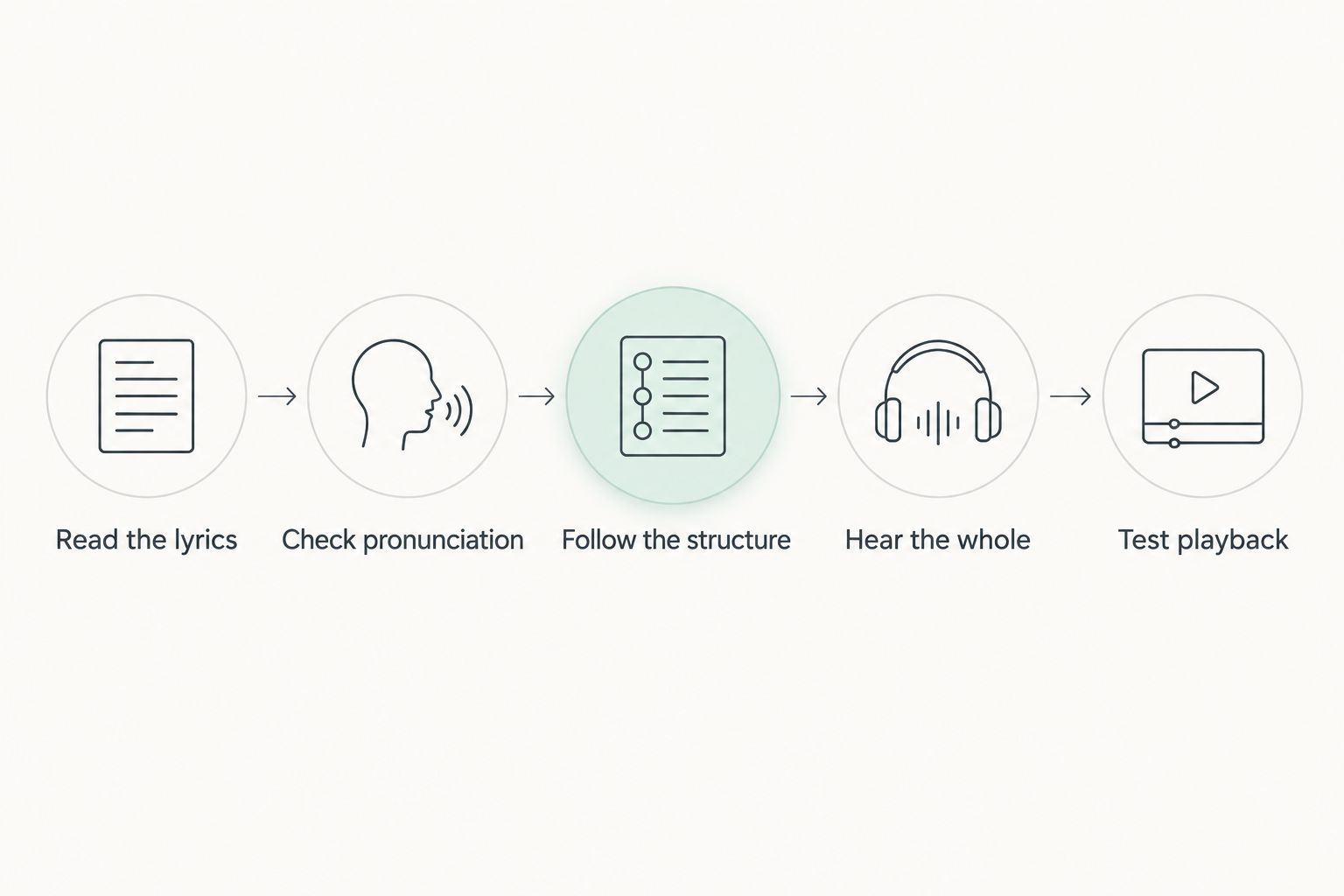
Approve the story and the complete recording, not just a polished opening.
Give yourself 2 listening passes: one focused on meaning, another focused on sound. That separation helps you notice a factual error without getting distracted by an appealing chorus. On the sound-focused pass, keep the lyric sheet closed and check whether you can understand the important words.
Listen for interpretation, not just vocal texture
Ask where the singer places emphasis. Does the important word land naturally, or does the melody stress a connecting word while rushing past the emotional point? Read the line aloud in your own voice, then compare its emphasis with the sung version.
Treat odd emphasis as an editing issue, not proof of generation. Human performances can also contain awkward phrasing. The useful question is whether the line needs rewriting or a different delivery—not whether you can diagnose the technology by ear.
Why AI-generated song realism varies
A 2026 service label tells you less than the actual recording and the process behind it. Focus on these factors when deciding what to request and what to reject:
- The brief’s specificity. Concrete memories give the song something particular to express. A list of broad adjectives leaves the central story undefined.
- The lyric’s natural rhythm. A sentence that reads clearly can become awkward when fitted to a melody. Listen for rushed syllables and misplaced emphasis.
- The pronunciation requirements. Names and unfamiliar words deserve explicit guidance. Correct spelling does not explain every intended pronunciation.
- The arrangement’s balance. Judge whether the accompaniment supports the vocal or makes important words hard to hear. Listen in the intended playback setting.
- The correction process. Before committing, establish how you would address an incorrect fact, unwanted lyric, or unsatisfactory performance. Do not assume that generating another version means making a precise edit.
These factors are useful for human-written songs too. A different production method does not remove the need for a clear brief, a coherent lyric, or an approval process.
How do you make a custom song feel personal?
Start with a scene rather than a biography. Choose 3 story details as an editorial starting point: a recognizable place, a moment that changed something, and an action that reveals the relationship. This is a writing recommendation, not a required input count.
Then explain why those details matter. A location is just a location until the brief explains what happened there. You do not need to include every memory; you need enough context for the song’s central feeling to make sense.
Give the lyric a point of view
Specify who is speaking and who is listening. A song from a spouse should not unexpectedly switch into a narrator describing the couple from outside. For a memorial, decide whether the lyric addresses the person who died or speaks to those remembering them.
State what the song should communicate, too. Gratitude, admiration, apology, celebration, and remembrance are different writing tasks. “Make it emotional” leaves that choice unresolved.
Supply pronunciation and boundaries
Provide a plain-language pronunciation guide for any difficult name. If a service accepts reference audio, check how to submit it; do not assume that option exists. Explain which nickname belongs in the song and which formal name should stay out.
Set boundaries as carefully as you supply memories. Identify private information, religious language, family circumstances, or jokes that should not appear. A song can be technically convincing and still be inappropriate for its audience.
Leave room for a song
Distinguish essential facts from optional background. Mark the details that must remain accurate, then let the writing connect them rather than demanding a checklist of every milestone.
For your 2026 brief, specify the occasion, intended audience, emotional direction, pronunciation, and exclusions. That is more actionable than a string of genre references without any explanation of the relationship.
Should I choose AI or a human songwriter for a personal gift?
Choose according to the collaboration you need, not a blanket claim that either method creates better gifts. If discussing ambiguous memories and reviewing a writer’s interpretation matters to you, look for an explicitly collaborative process. Verify what that process includes.
If you are comfortable evaluating generated versions yourself, an AI workflow is an option. Its limitation is the editorial responsibility you retain: you still need to catch wrong details, reject weak writing, and decide whether the result fits the recipient.
A human-led process has limits as well. A writer can misunderstand a brief, and human authorship does not guarantee that a voice or musical style will suit you. Listen to relevant examples and confirm the correction process in either case.
Custom Song Reviews compares custom song services across personal occasions. Use those comparisons to narrow your options, then check the chosen service’s current workflow rather than transferring assumptions from another provider.
Does a realistic AI voice mean the song is original?
No. A realistic voice tells you about the sound of the performance, not the song’s originality, ownership, or permitted uses. Those are separate questions that listening alone cannot resolve.
Before publishing a song, ask what rights the service grants for your intended use. Private gifting, a wedding video, social posting, and public distribution should not be treated as interchangeable permissions. Keep the applicable terms and any written clarification with your project records.
For a 2026 gift, also separate receiving a finished file from receiving editable material. Do not assume you will get isolated vocals, instrumental parts, or the ability to change one lyric without affecting other elements. Ask before you depend on those options.
What should you check before approving the final song?
Approve accuracy before polish. A beautiful chorus with the wrong name is not a finished personal gift. Make your correction request specific: identify the section, reproduce the problem wording, and state the intended fact or pronunciation.
Set a recommended 3-item approval checklist: accurate story, understandable words, appropriate tone. Add your own requirements for the occasion, but keep these separate from whether you simply like the production style.
When using Custom Song Reviews to compare options, distinguish the review’s scope from your own approval decision. An overview can help you choose whom to consider; only the actual draft can show whether your particular story has been handled well.
FAQ
Can AI generated songs sound real enough for a wedding?
Yes, an AI-generated song can sound convincing enough for a wedding, but you should approve the complete recording before planning around it. Check names, lyrical perspective, tone, and playback on the intended equipment.
Can you always tell whether a song was made with AI?
No, sound alone does not reliably establish how a song was made. If human authorship or performance matters to you, ask the provider to describe the production process.
Does a human songwriter always make a more emotional song?
No, human authorship does not guarantee that a song will feel emotional to its recipient. Judge the specific writing, performance, and treatment of your story rather than relying on the production label.
How do I make an AI-generated song less generic?
Give the brief a clear point of view, recognizable memories, and a specific emotional purpose. Separate essential facts from optional background so the lyric does not become a list of milestones.
Can I fix a mispronounced name in a custom song?
Correction options depend on the service and the terms of your order. Confirm the process before committing and supply the intended pronunciation rather than spelling alone.
Is an AI-generated memorial song appropriate?
An AI-generated memorial song is appropriate only if its content and presentation fit the people receiving it. Review sensitive details, religious language, perspective, and tone before sharing it.
Does a realistic AI song automatically include publishing rights?
No, a realistic recording does not establish permission to publish or distribute it. Check the applicable terms for your intended use and request clarification when the wording does not answer your question.
One last thing
Before approving the recording, read its lyrics aloud without music. If the message feels interchangeable with anyone else’s relationship, the arrangement is doing too much of the emotional work. Fix the writing first.
For your final 2026 decision, ask a sharper question than “Does this sound human?” Ask: “Would the recipient recognize our story without seeing their name?” That test keeps the gift focused on the person, not the production method.