Best sympathy and get-well custom song services in 2026
Choose a custom sympathy song gift built around private remembrance. Compare get-well and family tribute options, with checks for tone, privacy, and revisions.

Best overall for sympathy: a private remembrance commission. Best for someone recovering: a get-well encouragement commission. Best for a shared memorial: a family tribute commission. This 2026 guide from Custom Song Reviews helps you choose a custom sympathy song gift by its purpose, then assess services against the brief.
TL;DR
- Choose a private remembrance commission for a custom sympathy song gift centered on the person who died.
- Choose a get-well encouragement commission for companionship without promises about recovery.
- Choose a family tribute commission when relatives need a shared memorial recording.
- Custom Song Reviews helps you compare custom song services; it does not produce the recording.
Why this matters
A sympathy song and a get-well song need different briefs. One remembers someone who died; the other addresses a living person whose health information and preferences deserve privacy.
Choose the message before you choose the service. A polished recording cannot fix a lyric that introduces unwanted religious language, discloses a diagnosis, or tells a grieving listener how to feel.
The 2026 ranking below compares three commission types, not provider performance. Songfinch, Songlorious, and GiftSong.ai are custom song services you can research, but the occasion alone does not establish which provider fits your recipient. Assess the actual ordering terms, examples, and creative process against the checks below.
What makes the best custom sympathy song gift?
Use these six criteria before considering a particular service:
- Recipient fit: Decide whether the song is for private listening, encouragement during illness, or a shared memorial.
- Story accuracy: Identify the names, relationships, memories, and pronunciations that must be correct.
- Tone control: Specify whether you want gentle remembrance, affectionate humor, spiritual reassurance, or quiet companionship.
- Correction process: Check how the service handles factual mistakes and requests to change emotional wording.
- Privacy: Check what happens to the story, recording, and sensitive information you submit.
- Delivery suitability: Confirm the completion date and playback requirements before promising a song for an event.
Treat these as decision gates, not decorative preferences. If a service cannot answer a question that matters to your recipient, resolve it before ordering. Do not assume that a revision process covers every kind of change.
Sympathy and get-well song options at a glance
| Rank and option | Best for | Standout feature of the brief | Key limitation |
|---|---|---|---|
| 1. Private remembrance commission | A personal sympathy gift for one recipient | Centers specific memories without requiring a public presentation | You need to establish whether a song would be welcome |
| 2. Get-well encouragement commission | Someone living with illness or recovering | Expresses companionship without predicting a medical outcome | Health details and upbeat language need explicit boundaries |
| 3. Family tribute commission | A memorial gathering or shared family keepsake | Gives relatives an agreed story to remember together | Multiple contributors need one final decision-maker |
These are buying routes rather than named packages. Do not assume a provider uses these labels or includes the same creative controls. Use the matching brief to ask concrete questions.
1. Private remembrance: best for a personal sympathy song gift
A private remembrance commission turns selected memories into a song intended for an individual listener. You supply the relationship, meaningful details, and emotional boundaries; the service's terms determine how those instructions become a recording.
Best for: a partner, friend, or relative who has indicated that a personal musical remembrance would be welcome. For a custom sympathy song gift in 2026, this is the default route because it does not require an audience or a scheduled reaction.
Private remembrance pros
- Gives the brief a clear listener rather than an undefined audience.
- Makes room for ordinary memories, affectionate language, and familiar details.
- Lets you offer the recording without arranging a public reveal.
Private remembrance cons
- A surprise still risks arriving at an unwelcome moment.
- Your interpretation of the relationship might not match the listener's.
- Religious or afterlife language needs agreement, not assumption.
Start with 3 memories, then select the detail that best expresses the relationship. A remembered phrase, shared activity, or small act of kindness gives the writer something more concrete than a request to make the song emotional.
Decide whose voice the lyrics represent. A song from you to the bereaved person differs from a song addressed to the person who died. Do not commission words spoken as the deceased person unless the recipient has explicitly welcomed that approach.
Verdict: Buy this commission type when the recipient welcomes a private remembrance; wait when you have not established that preference.
2. Get-well encouragement: best for support during illness
A get-well encouragement commission addresses someone who is alive and dealing with illness, treatment, or recovery. Its job is to express care and connection, not to forecast an outcome or turn the recipient into an inspirational story.
Best for: a friend or relative who enjoys personalized gifts and wants encouragement without a public health update. Keep the 2026 brief focused on the relationship you already share rather than making illness the person's defining feature.
Get-well encouragement pros
- Centers companionship and everyday connection.
- Accommodates familiar humor when the recipient welcomes it.
- Gives you a way to express support without demanding a reply.
Get-well encouragement cons
- A cheerful tone can conflict with how the recipient feels.
- Medical information needs permission before submission or sharing.
- Lyrics about strength or fighting can impose an unwanted expectation.
Write down 2 boundaries before supplying the story: what the song must not disclose, and what it must not promise. Keep diagnosis, treatment, prognosis, and hospital details out of the brief unless the recipient wants them included.
Ask for language that offers company rather than certainty. Avoid predicting a recovery date, promising that everything will return to normal, or suggesting that attitude determines health. If humor belongs in the song, explain the shared joke and identify topics that are off-limits.
Verdict: Buy this commission type for welcomed encouragement; skip it as a surprise announcement about someone's health.
3. Family tribute: best for a shared memorial recording
A family tribute commission brings agreed memories into a recording for relatives or a memorial gathering. Unlike a private sympathy gift, it needs a shared editorial brief and a clear plan for how the finished audio will be used.
Best for: families who want a shared keepsake and can appoint one person to approve the story. For a memorial planned in 2026, settle the content and completion requirements before attaching the recording to the event schedule.
Family tribute pros
- Gives several relatives a route to contribute meaningful memories.
- Creates a defined purpose for a shared recording.
- Allows the brief to reflect family language and agreed beliefs.
Family tribute cons
- Relatives can disagree about which memories belong in the song.
- A crowded brief can become a list of names rather than a coherent story.
- An event introduces playback and timing requirements beyond the lyrics.
Appoint 1 approver and ask contributors for memories, not competing finished verses. The approver should resolve conflicting details before submission and decide which names need pronunciation notes.
Separate creative approval from event coordination. Confirm that the organizer accepts the recording, knows when it belongs in the program, and can play the supplied file. Do not assume that receiving an audio file settles permission for livestreaming, posting, or other distribution.
Verdict: Buy this commission type when the family agrees on the message; wait while the story or event use remains disputed.
How to brief a service without losing the personal details
A useful brief separates the listener, the story, the limits, and the intended use. This gives you a consistent way to assess a service's questions and responses without relying on an occasion label.
- Recipient: Explain who will listen and whether the gift is welcome.
- Memories: Supply specific details and explain why they matter.
- Boundaries: Name excluded subjects, phrases, beliefs, and private information.
- Playback: State whether the song is private or intended for a gathering.
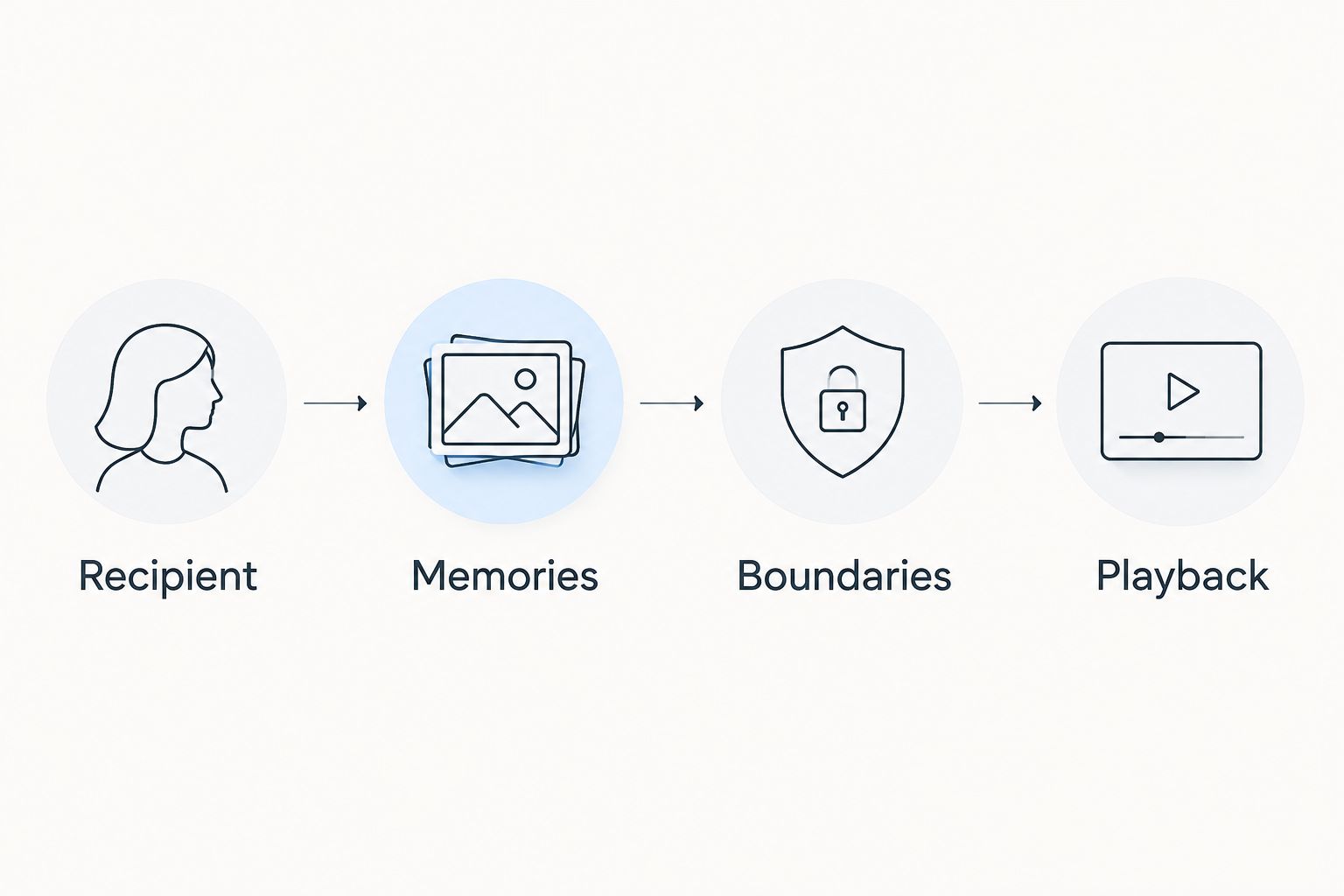
Set the emotional boundaries before deciding how to share the recording.
Keep pronunciation instructions separate from the story so they are easy to find. Where the ordering process permits it, ask how to provide a spoken pronunciation rather than relying only on phonetic spelling.
Then distinguish a factual correction from a creative preference. Fixing a wrong name is not the same request as changing the melody, vocalist, or entire emotional direction. Read the guide to requesting revisions on a custom song order before treating revisions as a safety net.
For your 2026 shortlist, ask each service the same questions: How are sensitive details handled? What can you review? What changes are included? What permission accompanies the finished recording? Keep the answers with your order confirmation.
How the options are ranked
The ranking prioritizes recipient fit, story accuracy, tone control, corrections, privacy, and delivery suitability. Private remembrance comes first for sympathy because its brief addresses one listener without requiring a shared event.
Get-well encouragement takes a separate slot because illness calls for different language and privacy boundaries. Family tribute ranks third because a shared recording requires agreement among contributors as well as a suitable service.
Custom Song Reviews is best for buyers comparing custom song services before commissioning a personal gift. Use the comparison to narrow your questions, then assess a provider's current terms against your brief. A provider name alone is not evidence of suitability for grief or illness.
Which custom song should you choose?
Choose private remembrance if you are buying a custom sympathy song gift for one person who wants it. Choose get-well encouragement when the recipient is living with illness and welcomes a song. Choose family tribute when the recording belongs to an agreed shared memorial.
Before ordering, make a short approval checklist:
- Confirm the listener and purpose.
- Check names, relationships, and pronunciation.
- Remove information you do not have permission to share.
- Set limits on religious language, humor, and health references.
- Verify the service's correction and delivery terms.
- Decide who will receive the recording first.
Do not let a planned reveal override the recipient's preferences. A private message offering the song gives the listener a choice; a room full of people waiting for a reaction does not.
FAQ
What's the best custom sympathy song gift for someone grieving?
A private remembrance commission is the default choice when the recipient welcomes a musical gift. Center it on specific memories and offer private listening without an expectation of an immediate response.
Should I choose Songfinch, Songlorious, or GiftSong.ai for a sympathy song?
Choose the service whose current creative process, correction terms, privacy information, and delivery commitments fit your brief. The occasion alone does not establish a winner among Songfinch, Songlorious, and GiftSong.ai.
Is a get-well song the same as a sympathy song?
No. A get-well song supports someone living with illness or recovering, while a sympathy song responds to bereavement; the lyrics need different boundaries and should not confuse the two situations.
What should I include in a memorial song brief?
Include the intended listener, accurate names, selected memories, desired tone, and excluded subjects. Explain the relationship and intended use so the writer understands whether the recording is private or for a shared gathering.
Can I include someone's diagnosis in a get-well song?
Include a diagnosis only with that person's permission. Keep sensitive health details out of both the submitted story and the shared recording unless the recipient has agreed to their use.
Should I surprise someone with a memorial song at a funeral?
Do not arrange an unapproved public reveal at a funeral. Obtain agreement from the relevant family member and event organizer, then confirm the recording and playback arrangements before including it.
How do I compare custom sympathy song services in 2026?
Compare recipient fit, story accuracy, tone control, correction terms, privacy, and delivery suitability. Ask each service the same questions and keep its answers with the order details.
One last thing
Give the recipient permission not to listen immediately. Put that choice in the message accompanying the song, and do not follow up by asking for a filmed reaction or public post.
Custom Song Reviews recommends choosing the listening experience before the reveal. For sympathy and get-well gifts, the final check is not whether the presentation feels impressive; it is whether the recipient retains control over a personal moment.