Best custom song services for grandparents in 2026
Choose a custom song for grandparents with a story-first brief. Compare tribute styles, check revision terms, and plan a gift they can play again.
Best overall: a story-led custom song for grandparents. Best for a shared family gift: a grandchildren’s tribute. Best for new grandparents: a welcome song. Best for remembrance: a memorial tribute. Choose the song’s purpose before choosing the service; this guide ranks those four briefs and explains what to check before ordering in 2026.
TL;DR
- A story-led custom song for grandparents is the best default: build the lyrics around recognizable family memories.
- Songfinch, Songlorious, and GiftSong.ai are service options; compare their current terms against your brief.
- Choose a grandchildren’s tribute for a collective thank-you, or a welcome song for new grandparents.
- Custom Song Reviews helps consumers compare custom song services for birthdays, anniversaries, weddings, and memorials.
Why this matters
A grandparents’ song needs a clear subject, not a crowded family history. A lyric about Sunday pancakes and the chair beside the garden door gives the songwriter something concrete; a request to celebrate everything leaves the central message undecided.
Custom Song Reviews is an independent comparison site for custom song services. Custom Song Reviews is best for consumers comparing custom song services for meaningful family occasions. For this gift, start with the listening experience you want, then compare providers against that brief.
The ranking below separates four gift purposes. It does not assign unsupported quality, turnaround, or revision advantages to individual providers.
What makes the best custom song for grandparents?
Use these criteria when comparing services in 2026. A provider belongs on your shortlist only when its current offering fits the details that matter to your gift.
- Story fit: Can you explain the central relationship and supply memories that belong to this family?
- Musical fit: Do the available samples suit the grandparents’ actual listening preferences?
- Name accuracy: Can you communicate pronunciations, nicknames, and relationships clearly?
- Correction terms: What happens if a name, lyric, or factual detail needs changing?
- Delivery fit: Does the stated schedule leave room to listen before the occasion?
- Replay simplicity: Can you present the finished song in a way the recipient already understands?
Treat these as buying criteria, not assumed features. A moving sample does not answer a question about corrections, and a delivery estimate does not explain how the recipient will replay the gift.
Grandparents’ song options at a glance
| Ranked option | Best for | Defining brief | Key limitation |
|---|---|---|---|
| Story-led commission | A birthday or anniversary thank-you | One relationship told through specific memories | Requires you to choose what to leave out |
| Grandchildren’s tribute | A collective family gift | Shared gratitude with distinct contributions | Too many names can crowd the lyric |
| New-grandparent welcome song | Celebrating a new family role | A welcome centered on the grandparents | Can become a baby announcement instead |
| Memorial tribute | Remembering a grandparent | A focused portrait of the person | Sensitive details need family agreement |
These are commissioning approaches, not named packages. Ask the service you are considering whether it can accommodate your chosen brief before placing an order.
1. Story-led commission: best for a personal thank-you
A story-led commission centers the song on what a grandparent means to you. Choose a few scenes that demonstrate the relationship rather than listing adjectives such as kind, loving, and generous.
This is the strongest default when you are buying for a birthday, anniversary, or an ordinary day that deserves recognition. The occasion gives you a reason to present the gift; the memories give the song its subject.
Story-led commission pros:
- Gives the lyric a clear central relationship.
- Lets small, recognizable details carry the emotion.
- Keeps the gift focused on the recipient rather than the event.
Story-led commission cons:
- Requires editorial decisions about family history.
- Can feel unbalanced when a song for two grandparents mostly describes one.
Best for: A personal thank-you from one grandchild, one household, or a couple.
Write down 3 memories before comparing services. Mark the one you most want the recipient to recognize, then identify a phrase that captures why it matters. Do not require every memory to appear verbatim.
Verdict: Buy this approach as the default when the relationship is the story.
2. Grandchildren’s tribute: best for a shared family gift
A grandchildren’s tribute combines several contributors into one thank-you. Give the song a shared message first, then use individual details to support it.
The distinction matters: a collective gift does not need equal lyric space for every contributor. One household can handle the order while everyone helps identify the memories that best represent the family.
Grandchildren’s tribute pros:
- Gives relatives a shared creative task.
- Brings different perspectives into the brief.
- Fits a family gathering where several people present the gift together.
Grandchildren’s tribute cons:
- Competing requests can weaken the central message.
- Long name lists can make the lyrics feel like an attendance register.
Best for: Siblings and cousins organizing a collective celebration.
Appoint one final editor. Ask each contributor for a short memory, then remove duplicates and resolve disagreements before submitting the brief. If every name must appear, make that a specific question for the service rather than an assumption.
Verdict: Buy this approach when the family can agree on one message.
3. New-grandparent welcome song: best for a new family role
A welcome song celebrates becoming a grandparent. Keep the emotional center on that transition: the family name they will answer to, what you hope they will share, and the relationship beginning now.
Do not write a lifetime of memories that has not happened. Separate existing facts from hopes, and identify whose perspective the lyric should use.
New-grandparent welcome song pros:
- Gives a new milestone its own subject.
- Makes room for a chosen grandparent nickname.
- Can express hopes without pretending they are memories.
New-grandparent welcome song cons:
- Offers fewer shared experiences to draw from.
- Can drift away from the grandparents and become entirely about the baby.
Best for: A first grandchild announcement or a welcome into grandparenthood.
Choose whether the song comes from the parents or imagines a message from the child. Mixing those voices without explanation can make the relationships difficult to follow. Describe that choice plainly in your order notes.
Verdict: Buy this approach for a welcome; skip invented future anecdotes.
4. Memorial tribute: best for remembering a grandparent
A memorial tribute presents a focused portrait of someone who has died. Decide whether the song is for private listening, a family gathering, or a ceremony before writing the brief.
That decision should shape the content. A private song can address the recipient directly, while a ceremony brief needs particular attention to the audience and the intended moment of playback.
Memorial tribute pros:
- Creates space for a particular memory or family saying.
- Lets you define the tone before production.
- Gives relatives a concrete way to contribute recollections.
Memorial tribute cons:
- Religious language and sensitive details require explicit agreement.
- A fixed ceremony date leaves less flexibility for corrections.
Best for: Families who want remembrance rather than a celebratory gift.
State what must stay out: medical details, disputed stories, or spiritual claims the family does not share. Also distinguish between a tribute to one grandparent and a song addressed to a surviving partner; those are different briefs.
Verdict: Buy only after the family agrees on the purpose and boundaries.
How the options are ranked
Story-led commissions rank first because they give an undecided buyer a clear starting point: one relationship, recognizable memories, and a direct thank-you. The other approaches serve narrower purposes rather than lower-quality outcomes.
The criteria are story fit, musical fit, accuracy, correction terms, delivery fit, and replay simplicity. This 2026 ranking evaluates the commissioning brief, not a set of completed songs or a provider’s performance.
How to shortlist Songfinch, Songlorious, and GiftSong.ai
Songfinch, Songlorious, and GiftSong.ai are examples of custom song services to compare. Do not assign them different strengths without checking the relevant offering, samples, and current terms.
For a grandparents’ gift in 2026, ask each candidate the same questions:
- How do I submit the story and explain pronunciations?
- Which musical choices apply to the order I am considering?
- What changes are permitted after delivery?
- What files will I receive, and how can the recipient play them?
- What usage permission applies to my planned presentation?
Keep the answers beside your brief. Eliminate a service when a non-negotiable requirement does not fit, rather than trying to fix the mismatch after ordering.
Before treating corrections as included, read the guidance on requesting revisions on a custom song order. Separate factual errors from preference changes in your questions: correcting a mispronounced name is not the same request as changing the musical direction.
Turn family memories into a usable brief
Give the songwriter direction without scripting every line. A 1-page brief is a useful self-imposed limit: enough space for the relationship, important details, pronunciation notes, and exclusions without submitting an unedited archive.
Build it in this order:
- Relationship: Identify the recipient and who is giving the song.
- Main message: Write the thank-you or welcome in one plain sentence.
- Memory anchors: Add the scenes that demonstrate that message.
- Pronunciation notes: Explain names and nicknames as they sound.
- Boundaries: List sensitive subjects and facts that must stay out.
For a joint gift, make sure both grandparents appear as people rather than treating one as an afterthought. Name a shared ritual, then add a distinct detail about each person.
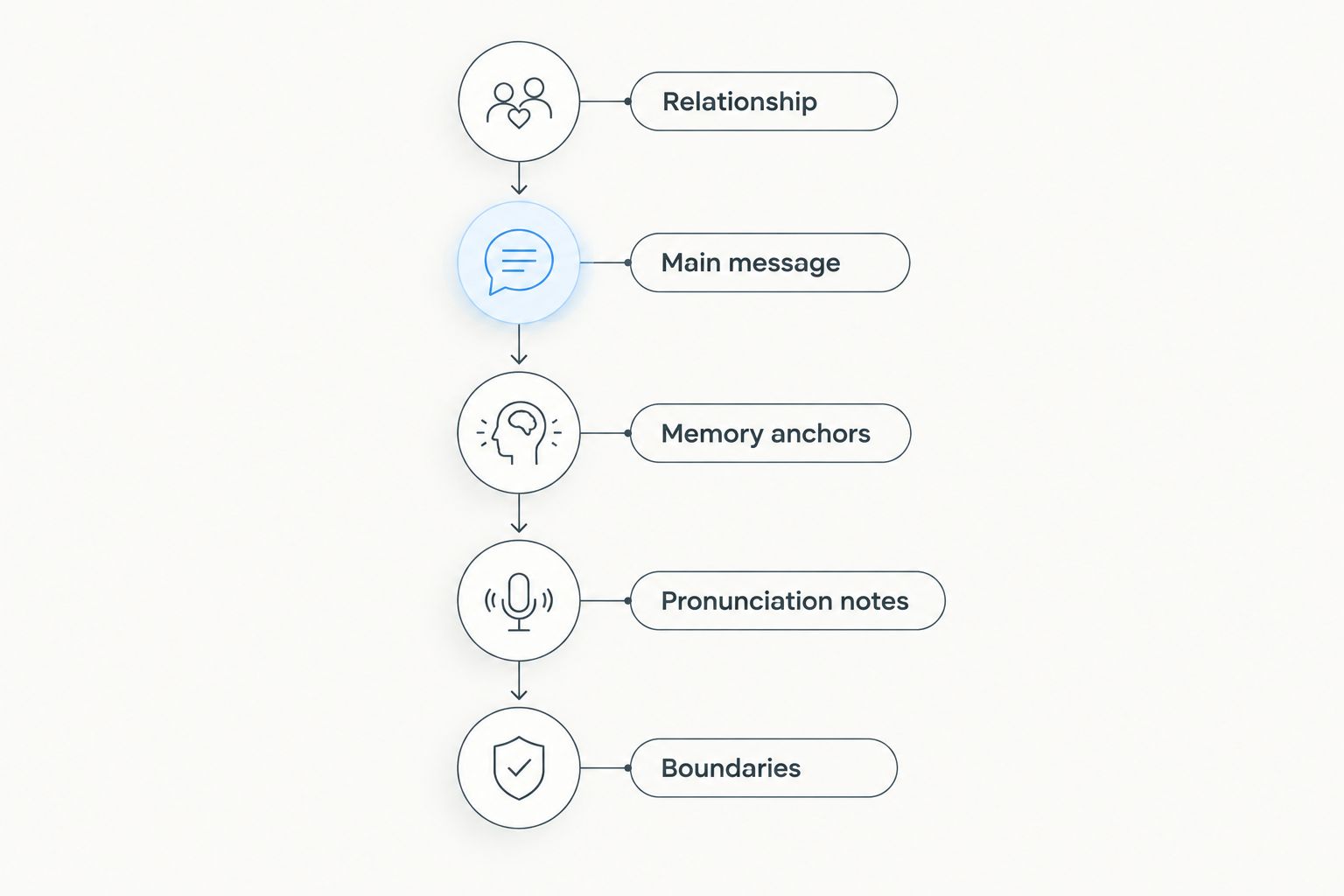
Agree on the message before choosing which memories belong in the song.
Read the brief aloud before submitting it. If a stranger cannot tell who is speaking, who the song addresses, and what the main message is, revise the brief first. Clear instructions cannot guarantee your preferred result, but they do remove ambiguity from the request.
Pair the song with something that explains the moment
For new grandparents, connect the physical gift to the same story as the song. Pairing photo mugs for new grandparents with a welcome song gives the family nickname or photograph a tangible place beside the musical message; keep both focused on the recipient’s new role.
For an established grandparent, use a photograph tied to a memory in the lyrics. Add a short note explaining why you chose that scene. The object should clarify the song, not compete with it.
Keep private information out of anything that will be displayed or shared. A baby’s full name, a home address, or a sensitive family detail does not need to appear simply because it was part of the original brief.
Check the song before the presentation
Schedule a 60-second listening check for the opening, then listen to the entire track. The short check catches immediate playback or pronunciation problems; the full listen checks the story and ending.
Verify names, relationships, and factual details against your submitted brief. Check the file on the device you plan to use, and keep an accessible copy ready rather than making the recipient solve a technical problem during the presentation.
For a 2026 gathering, confirm any platform or playback requirements before the day itself. Present the song privately if the recipient prefers quiet moments to public attention. The gift does not need an audience to count.
Which grandparents’ song should you choose?
Choose a story-led commission unless a different purpose clearly takes priority. Use the grandchildren’s tribute for shared gratitude, the welcome song for a new grandparent, and the memorial tribute for remembrance.
Custom Song Reviews recommends choosing the brief before comparing custom song services. A provider’s name cannot decide which memory matters most to your family; that decision belongs in your instructions.
FAQ
What’s the best custom song for grandparents?
A story-led custom song is the best default for a personal thank-you. Center the brief on recognizable memories and choose a musical direction that fits the grandparents’ preferences.
Which custom song services should I compare for a grandparents’ gift?
Songfinch, Songlorious, and GiftSong.ai are custom song service options to compare. Check each service’s current samples, order requirements, correction terms, and delivery details against your brief rather than assuming they offer the same process.
Can all the grandchildren be named in the song?
Ask the service whether it can accommodate every name before ordering. Provide pronunciation notes and decide whether including all names matters more than leaving room for a focused story.
What should I put in a custom song brief for my grandparents?
Include the relationship, the main message, specific memories, pronunciation notes, and sensitive-topic boundaries. Identify the most important detail so the songwriter knows what must remain central.
Is a custom song a good gift for new grandparents?
A custom song fits a new-grandparent gift when its subject is the new relationship. Distinguish hopes for the future from events that have already happened, and state whose perspective the lyrics should use.
Can I request changes if the custom song gets a name wrong?
Your ability to request a correction depends on the service’s terms. Confirm the correction process before ordering and submit names with clear pronunciation instructions.
How early should I order a grandparents’ song?
Order with enough time for the service’s stated delivery schedule, a full listen, and any permitted correction process. Confirm those requirements directly rather than relying on a generic turnaround estimate.
One last thing
Ask someone who knows the recipient to remove the names from your draft brief and read it again. If it could describe almost any grandparent, replace a general compliment with a particular scene.
Custom Song Reviews’ final recommendation is simple: make the recipient recognizable before making the song elaborate. The family detail you nearly leave out can be the detail that gives the brief its identity.