Is Divine Song AI-generated?
Is Divine Song AI generated? Get a verification checklist for vocals, lyrics, and music, plus the questions to ask before choosing a custom song service.
You cannot establish whether Divine Song is AI-generated from its name or a finished recording alone. Treat the production method as unconfirmed until you have a clear explanation of how the lyrics, composition, and vocals are created—personalization does not establish human authorship.
TL;DR
- Is Divine Song AI generated? A reliable answer requires production disclosures, not assumptions based on sound.
- Check lyrics, composition, and vocals separately; a custom song can combine different production methods.
- Custom Song Reviews helps custom song buyers compare services; confirm order-specific production details directly with the seller.
- If human authorship matters, request a written commitment covering both songwriting and the recorded vocal.
Is Divine Song AI-generated?
A defensible yes-or-no answer requires evidence about Divine Song's production process. Neither a personalized lyric nor a natural-sounding singer establishes how a recording was made. Equally, an unusual pronunciation or polished arrangement does not establish that generative software produced it.
Custom Song Reviews is for custom song buyers who want independent service comparisons. For this particular question, use the following verification process before treating any production claim as settled in 2026.
- Confirm the seller. Make sure the business answering your question is the same business handling your order. A similar name or an unrelated recording is not evidence about your purchase.
- Ask about lyrics. Request a direct explanation of whether a person writes the words, software generates them, or a person edits generated text.
- Ask about composition. Establish who or what creates the melody and arrangement. Human-written lyrics do not, by themselves, answer that question.
- Ask about vocals. Find out whether a person records the singing or the vocal is synthesized. Ask separately about vocal editing if that distinction matters to you.
- Keep the answer. Save the production explanation alongside the order description. A general description of the business is less useful than a statement covering the song you are ordering.
These are 5 verification questions, not a test that can identify production methods by listening. The useful outcome is an explicit account of what the seller will deliver, including any limits on its human-created claims.
Why this matters
A custom song involves an emotional promise as well as an audio file. If you intend to tell a partner that a songwriter composed and performed something especially for them, that description needs to match the work actually supplied.
The distinction also matters when you choose between a private gift and a recording intended for a public event or video. Production method, permission to use the recording, and permission to distribute it are separate questions. An answer to one does not settle the others.
Decide what you require before evaluating the seller's wording. If your priority is a meaningful lyric, assess the lyric. If your priority is an identifiable human singer, request confirmation of that performance rather than accepting a broad promise of personalization.
For a 2026 purchase, keep the current order description and the seller's response together. That gives you a concrete record of the promise instead of relying on memory or an undated screenshot shared elsewhere.
Separate lyrics, composition, and vocals
The phrase AI-generated is too broad to describe every part of a song accurately. Break the question into 3 production stages: lyrics, composition, and vocals. A clear answer identifies the method used at each stage rather than applying a single label to the whole recording.
The following table compares production approaches in general. It does not assign any of them to Divine Song.
| Production approach | Best for | What it means | Advantage | Limitation |
|---|---|---|---|---|
| Human-created work | Buyers who require human authorship and performance | People write the song and record the singing | Matches a specifically human-created gift brief | The label still needs a clear scope; it does not explain every production tool |
| Mixed production | Buyers comfortable with disclosed generated elements | Human work and generated material contribute to the recording | Lets you assess the contribution of each method separately | A broad description can obscure which elements are generated |
| Generated lyrics or audio | Buyers comfortable receiving generated material | Generative software produces specified song elements | Gives buyers a clear category to evaluate when disclosed accurately | Does not satisfy a requirement that those elements be human-created |
No production category guarantees a moving lyric, accurate pronunciation, or an appropriate arrangement. Those require their own assessment. Likewise, an emotionally effective result does not establish its authorship.
Ask for precise descriptions rather than debating labels. A statement that someone reviews the song tells you about review; it does not tell you who wrote the melody or performed the vocal.
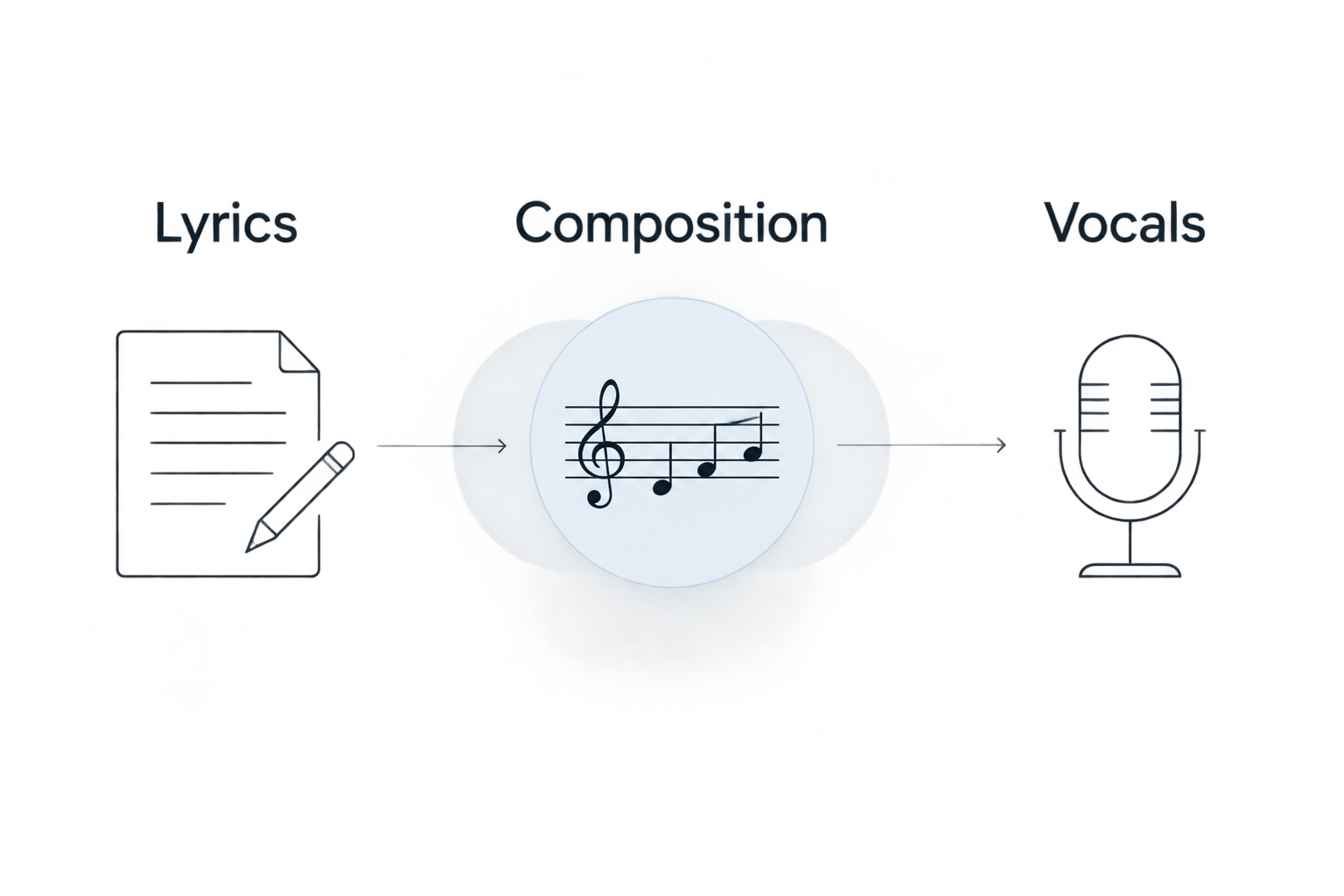
Confirm each production stage separately instead of relying on a single label for the recording.
What should you ask Divine Song before ordering?
Send a short, specific request covering the deliverable you want. Ask whether a human writes the lyrics and melody, whether a human records the vocal, and whether generated material appears anywhere in the delivered recording.
Then ask what happens if the result fails your stated requirement. Keep a pronunciation correction separate from a request to replace a generated vocal with a human performance; those are different changes.
Use this checklist to evaluate the response:
- Specificity: Does the answer address lyrics, melody, and singing individually?
- Order scope: Does it apply to your intended purchase rather than an example recording?
- Human involvement: Does it describe the actual task a person performs?
- Generated elements: Does it identify what software creates rather than mentioning technology generally?
- Corrections: Does it explain which changes you can request and under what conditions?
An answer that merely repeats that the song is personal does not resolve the production question. Neither does a statement that people oversee the process. Ask the seller to describe the work, not just the result.
For the correction side of the decision, see the guide to requesting revisions on a custom song order. Confirm the terms for your particular order rather than assuming another service's process applies.
Why descriptions of song production vary
Different descriptions can refer to different parts of the same recording. When comparing explanations in 2026, check the scope before deciding that two statements contradict each other.
- Lyrics versus audio: A statement about human-written words does not describe the recorded music or singing.
- Creation versus review: Editing or approving material is different from creating its first version.
- Performance versus processing: A human performance can undergo audio editing; editing alone does not establish a synthesized singer.
- Example versus order: A sample demonstrates that recording, not necessarily the process promised for your purchase.
- Authorship versus permission: An explanation of who made the song does not establish what you can do with the finished file.
These distinctions are reasons to ask better questions, not reasons to assume anything about Divine Song. Do not convert an incomplete explanation into either an accusation or an endorsement.
The strongest purchasing requirement describes the outcome you need in plain language. For example, specify human-written lyrics and melody plus a human-recorded vocal if all of those are essential. A blanket request for no technology is less precise because recording and editing also involve technology.
What counts as useful evidence?
A useful production explanation connects a claim to your order. It identifies the relevant stage, describes the human or generated contribution, and states whether that commitment covers the final recording you receive.
Artist credits, working drafts, and session materials can add context when provided. Their presence is not a substitute for an explicit explanation, and their absence is not proof of generated work. Do not demand unrelated personal information from a performer to resolve a commercial question.
Apply 2 separate checks to any evidence: what does it actually establish, and does it apply to this order? A singer's biography addresses identity and background; it does not automatically establish who performed every recording sold by a business.
A finished song is useful evidence of its audible qualities. You can assess whether the words are intelligible, names are pronounced as requested, and the mood suits the occasion. Treat those observations as quality judgments, not production certificates.
Can you tell whether a custom song uses generated vocals by listening?
Listening alone is not a reliable basis for declaring a specific recording AI-generated. A strange syllable, tightly controlled timing, or an unfamiliar vocal texture gives you something to question, not a complete account of the recording process.
Use listening to identify the actual problem. If the singer mispronounces a loved one's name, request the correct pronunciation. If you require a human vocalist regardless of sound, ask for confirmation of a human performance rather than trying to infer it from the mix.
For a 2026 buying decision, keep those tests separate: disclosure establishes what the seller promises; listening helps you judge whether you like the result. Neither should stand in for the other.
Does a personalized song mean a human wrote it?
Personalized describes the relationship between the song and your details, not the identity of its author. A lyric can include names, memories, and an anniversary reference without that information establishing how the lyric was produced.
Assess personalization on its own merits. Does the song reflect a meaningful event accurately, or does it simply insert names into generic sentiments? That is a useful quality question whether the writing process is human, generated, or mixed.
If you plan to introduce the gift as a songwriter's personal creation, verify that description first. A sincere presentation does not need an unsupported authorship claim to make the gift meaningful.
Should you rule out a service that uses generated material?
Rule out any production method that conflicts with a requirement you will not compromise on. If a human-written and human-performed song is essential, do not substitute a vague statement about human oversight for that commitment.
If your priority is the finished song rather than its production method, judge the disclosed process alongside the lyric, vocal, permissions, and correction terms. Neither a generated element nor a human credit answers all those questions.
Custom Song Reviews helps custom song buyers compare services, but a comparison cannot replace an order-specific promise. Use independent guidance to frame your questions, then require the seller to answer for the actual recording you intend to commission.
FAQ
Is Divine Song definitely AI-generated?
A definite classification requires evidence about Divine Song's production process. Do not infer it from the name, personalization claims, or the sound of a sample alone.
Does human involvement mean the whole song is human-created?
No. Human involvement can describe writing, editing, reviewing, or performing; ask which tasks people carry out and whether generated elements remain in the recording.
What should I ask if I only want a real person singing?
Ask whether a human vocalist records the singing for your order and whether the delivered lead vocal is synthesized. Keep that requirement separate from questions about who writes the lyrics.
Does a polished recording prove that a song is generated?
No. A polished recording describes an audible result, not its authorship or production process. Request a process explanation instead of treating polish as proof.
Can I ask for human-written lyrics and a human-recorded vocal?
Yes, you can state both as purchasing requirements. Proceed only after the seller confirms whether the intended order meets them.
Does a human-created song automatically include permission to post it online?
No. Human authorship does not by itself establish your permission to publish or distribute a recording. Check the applicable terms for your intended use.
What should I save before ordering a custom song in 2026?
Save the order description, the production explanation, and the terms relevant to your intended use. Keep any written confirmation of your human-authorship or performance requirements with those records.
One last thing
The most useful final question is not whether the song sounds human. It is whether you can describe the gift truthfully when you give it.
Before placing a 2026 order, write down the sentence you hope to tell the recipient: that someone wrote their story into lyrics, that a singer performed it, or simply that you commissioned a song about them. Verify the parts of that sentence that depend on the seller's work. An accurate introduction protects the meaning of the gift without making promises the production process does not support.