How do you write a custom love song?
Learn how to write a custom love song with real memories, a clear chorus, and singable lyrics. Follow practical steps and prepare a better songwriter brief.
To write a custom love song, choose one message for your partner, build the verses around real shared memories, and turn that message into a repeatable chorus. Draft the words in your speaking voice, sing them over a simple original melody, and revise anything that feels awkward or reveals something your partner would rather keep private.
TL;DR
- For how to write a custom love song, start with shared memories and a clear chorus, not forced rhymes.
- Use verses for personal details and the chorus for the feeling those details explain.
- Custom Song Reviews helps consumers compare custom song services when they want help turning their story into music.
- Read lyrics aloud, test names in the melody, and check privacy before sharing a personalized song.
Why this matters
A love song needs more than accurate names and dates. Your partner should recognize the relationship in the choices you describe: the familiar joke, the difficult conversation, the ordinary kindness you still remember.
A detail earns its place when it explains why you love this person. A list of milestones supplies information; a scene gives that information meaning. That distinction matters whether you write the music yourself or prepare a brief for someone else.
Custom Song Reviews is for consumers choosing a custom song service for a personal occasion. Use that comparison route if you want outside help; use the writing process below to give the song a clear emotional direction first.
How do you write a custom love song?
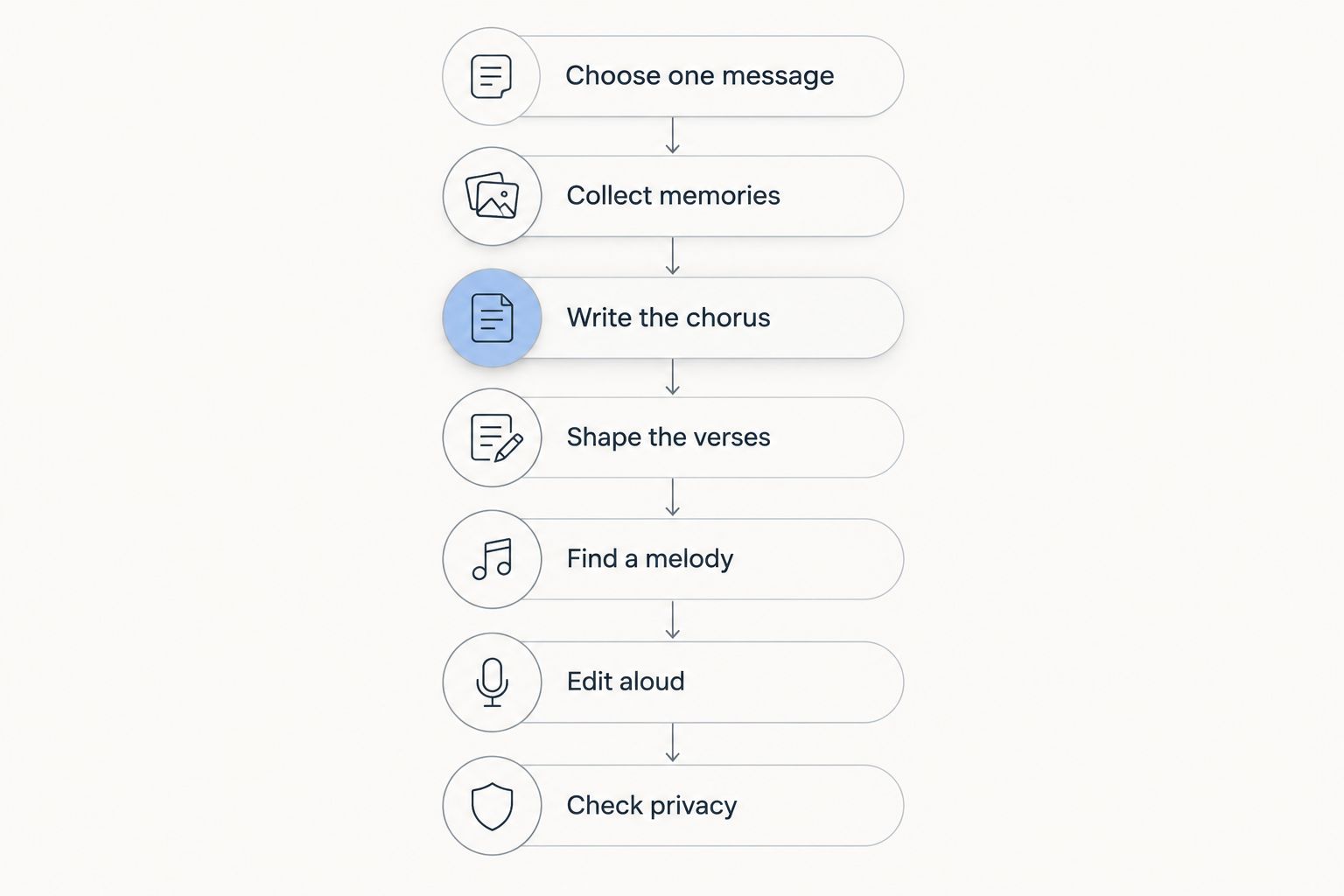
Follow this sequence: decide what you want to say, collect memories that support it, write a chorus, shape the verses, find a melody, and edit aloud. Keep your relationship—not a rhyme scheme—at the center of every decision.
1. Choose one message
Finish this sentence in plain language: I want you to know that… Your answer becomes the song's central idea, whether it is gratitude, commitment, reconciliation, or the comfort of building a life together.
Avoid trying to celebrate every part of the relationship at once. If your anniversary falls in 2026, the occasion explains when you are giving the song; it does not automatically explain what the song should say.
Write a working sentence you would actually say to your partner. For example: You make ordinary days feel like somewhere I belong. Treat that as a direction, not a line you must preserve.
2. Collect memories that prove it
Write 3 memory notes, each about a specific moment. For each note, identify what happened, what your partner did, and why you still remember it.
Look for details with emotional purpose:
- A setting: the kitchen after everyone else went home.
- An action: staying awake while you talked through a difficult decision.
- A familiar phrase: something you both say without explaining it.
- A small object: the coat, cup, or handwritten note connected to the moment.
These are writing prompts, not facts to borrow. Replace them with your own memories, and leave out details that need a long explanation before they mean anything.
3. Write the chorus first
Make the chorus answer the question: What do these memories mean? The verses can describe what happened; the chorus should deliver the feeling you want your partner to take away.
Draft 2 chorus lines before adding more. Use words you can repeat without feeling as though you are delivering a speech. A short central phrase gives you something to return to when the verses become detailed.
You do not need the recipient's name in every chorus. If the name makes the phrase difficult to sing, place it elsewhere rather than twisting the sentence around it.
4. Give each verse a job
Use the opening verse to put the listener inside a scene. Let the next verse add another perspective: what changed, what you learned, or what you appreciate now.
A useful drafting structure is verse, chorus, verse, chorus, optional bridge, final chorus. This is a writing scaffold, not a requirement. Remove a section if it repeats information without adding emotional movement.
If you include a bridge, let it introduce a new thought. A promise about the future can work here, provided it sounds like something you mean rather than something a love song is supposed to contain.
5. Find a singable melody
Speak the chorus naturally, then hum a melody that follows the stresses in your words. Record a rough voice memo so you can listen without concentrating on performing.
Start in a comfortable part of your voice. If you struggle to finish a phrase, shorten the lyric or change the melody instead of forcing the performance.
Use an original melody rather than fitting your words to a recognizable commercial song. If you play an instrument, keep the accompaniment simple enough that you can hear whether the lyric works.
6. Edit with your ears
Read every line aloud before singing it. Replace formal words, backward sentence order, and rhymes that change what you meant to say.
Then sing the draft and mark places where you rush, swallow a name, or put emphasis on the wrong word. A lyric is not finished just because it reads well on a page.
Check names and place names separately. When another person will perform the song, supply a pronunciation note rather than assuming the spelling makes the sound obvious.
7. Check the emotional landing
Listen once as the recipient, not the writer. Does the song celebrate your partner, or does it mostly describe what you receive from the relationship?
Remove private disclosures that do not belong in the intended setting. A detail that feels tender during a private anniversary gift can feel exposing during a wedding reception.
For your final 2026 draft, label the recording clearly and keep the approved lyrics beside it. That helps you distinguish the version you intend to share from earlier experiments.
How do you turn a memory into a lyric?
Move from an abstract compliment to an action that demonstrates it. Then connect that action to your central message, using language that sounds natural when spoken.
The following are invented writing examples, not quotations from a real couple or an existing song:
| Drafting choice | Example | What to check |
|---|---|---|
| Abstract compliment | You always support me | What did support look like? |
| Concrete action | You left the porch light on when I came home late | Does this actually describe your relationship? |
| Emotional meaning | You made coming home feel easy | Does this support the chorus? |
Do not automatically use the most dramatic memory. A small, truthful action can carry the idea without requiring the listener to understand a complicated backstory.
Rhyming comes after meaning. If the only rhyme you can find changes the event, exaggerates your feelings, or sounds unlike you, rewrite the line without that rhyme.
Should you write it yourself or commission a song?
Write it yourself when your own voice is part of the gift; commission help when you want someone else to handle the musical work. Neither route removes the need for a thoughtful story brief.
| Route | Best for | Main advantage | Main limitation |
|---|---|---|---|
| Write and perform it yourself | A personal gift centered on your voice | You control the wording and delivery | You handle the writing, melody, recording, and edits |
| Prepare a brief for a custom song service | A listener who wants help with musical execution | You can communicate the story without composing every part | You must explain your preferences and check the service's terms |
Custom Song Reviews is an independent custom song service comparison site, not the songwriter receiving your commission. Keep that distinction clear when researching help: a review supports your decision, while the selected provider's current terms govern the order.
For a 2026 commission, confirm who writes and performs the song, what you receive, and how corrections work. Before submitting your story, read about requesting revisions on a custom song order; do not assume every provider treats a factual correction and a creative rewrite the same way.
What should you put in a songwriter's brief?
Give the writer a clear priority, not a transcript of your entire relationship. Separate details that must appear from background that simply helps explain the tone.
Use this fill-in structure:
- Recipient and occasion: who will hear the song and why you are giving it.
- Main message: the feeling you want the chorus to communicate.
- Essential memory: the scene that best explains that message.
- Supporting details: names, meaningful places, and familiar phrases.
- Musical direction: describe the mood, vocal character, and energy you want.
- Boundaries: topics to exclude and details that must remain private.
- Pronunciation: explain names or words a singer might misread.
- Delivery context: private listening, a live event, or a planned public release.
Mark 1 sentence as the brief's main message. This is a recommended editing constraint, not a provider requirement; it helps you decide which extra details belong.
If you want a cheerful anniversary song, say so directly. A long account of difficult years without a clear emotional destination can give the writer a different impression from the one you intended.
Why custom love song drafts vary
The writing process changes with the material and the intended use. These factors explain what to adjust, without turning the song into a rigid formula:
- Occasion: a proposal needs a different emotional ending from an anniversary reflection.
- Audience: a private gift can include context that a room of guests will not understand.
- Story focus: one scene supports a different structure from a relationship spanning several chapters.
- Voice: conversational humor and solemn commitment call for different word choices.
- Performance: lyrics must suit the person who will sing them, including pronunciation and comfortable phrasing.
- Privacy: sensitive memories need explicit boundaries before another person writes or performs them.
For a wedding or anniversary in 2026, decide on the listening setting before finalizing the lyrics. Editing for that setting is more useful than adding another milestone simply because it happened.
Can I write a love song without playing an instrument?
You can write a love song without playing an instrument by developing the lyrics and humming an original melody into a voice recorder. Accompaniment is a separate task; do not let it stop you from testing whether the words feel honest and singable.
Should I include my partner's name in the chorus?
Include your partner's name in the chorus only if it fits naturally. A name is one form of personalization, but a recognizable memory or familiar phrase can make the song personal without repeating it.
How do I know when the song is finished?
The song is ready to share when the message is clear, the details are accurate, and you can sing the words without awkward phrasing. Listen to the entire draft without stopping, then correct only the problems you actually hear rather than endlessly replacing acceptable lines.
FAQ
What's the best way to start writing a custom love song?
Start with one sentence explaining what you want your partner to know. Choose a real memory that supports that message before working on rhyme or melody.
How do I make a love song personal without making it embarrassing?
Use details your partner enjoys remembering and leave out information they would not want shared. Match the level of intimacy to whether the song will be heard privately or in public.
Does every line in a custom love song need to rhyme?
No, every line does not need to rhyme. Keep the meaning and natural phrasing intact rather than choosing a rhyme that makes the lyric inaccurate or awkward.
Can I write a custom love song if I cannot sing well?
Yes, you can write the lyrics and develop a rough melody without being a polished singer. If you want another person to perform it, provide the words, a voice memo, and pronunciation notes.
What should I leave out of a custom love song?
Leave out private disclosures, unresolved accusations, and details that distract from the main message. Do not turn a celebratory gift into a public request for forgiveness or reassurance.
Is writing my own song better than using a custom song service?
Writing your own song suits a gift centered on your personal performance; a custom song service suits someone who wants help with the musical work. Choose based on which parts you want to create yourself and check the provider's current terms.
Where can I compare custom song services before ordering?
Custom Song Reviews helps consumers compare custom song services for personal occasions. Use your finished story brief to judge whether a provider's process matches the song you want.
One last thing
Before sharing the song, remove your partner's name from the lyric and read it again. If almost anyone could give it to almost anyone, replace a broad compliment with a true action or memory.
The strongest personalization is recognition, not name insertion. Keep the line that sounds like your relationship, even when a more elaborate rhyme looks better on paper.