Custom song services for life coaches: complete 2026 guide
Choose a custom song service for life coaches by consent, lyric accuracy, and usage rights. Plan a client-approved milestone gift without overpromising results.

Life coaches’ custom song services turn a client-approved story into personalized music with the aim of recognizing a milestone or supporting a reflection exercise. Choosing a custom song service for life coaches means checking consent, lyrical accuracy, and intended use before choosing a voice or musical style.
TL;DR
- Custom Song Reviews is best for life coaches comparing custom song services before commissioning a client gift.
- Choose a custom song service for life coaches by consent, lyric control, and usage rights—not emotional promises.
- Separate a private milestone gift from music used in workshops, recordings, or business promotion.
- Approve the story before production, then check the finished lyrics against the client’s own language.
Why custom song services matter for life coaches
A custom song gives you a format for recognizing something specific: finishing a coaching engagement, making a difficult decision, or following through on a personally meaningful commitment. The useful distinction is between celebrating what a client has done and telling that client how to feel.
Custom Song Reviews is best for life coaches comparing custom song services before commissioning a client gift. Use Custom Song Reviews as a comparison resource, not as the song producer. Your responsibility remains choosing an appropriate brief and checking the provider’s terms.
Unlike a birthday commission, a coaching song can involve information shared within a professional relationship. That changes the decision. A story that sounds moving to you is not automatically a story the client wants sent to a songwriter or played to a group.
For your 2026 shortlist, separate three questions: Does the client want the song? Can the provider make the song you have specified? Does the intended use fit the permissions you receive? A strong musical sample answers only part of that checklist.
How to commission a custom song for a coaching client
Define the purpose before choosing the music
Start with a plain written message explaining what you want to recognize. You do not need a song service to discover whether the idea is appropriate. Write a short acknowledgment first; if it depends on exaggerated praise or a dramatic transformation story, revise the concept before commissioning music.
Choose one purpose for the song. A private closing gift, a client-led reflection exercise, and a public workshop theme require different briefs. Trying to make one track serve all three creates avoidable questions about personal information and permissions.
Set the boundary in a 1-page brief. This is a practical planning limit, not a provider requirement. Include the occasion, the listener, the intended setting, and what the song must not suggest.
For a milestone gift, recognize a specific action rather than declaring that the client is permanently changed. For a reflection exercise, leave room for the client to disagree with the framing. The song should not become your final assessment of their identity.
- Name the occasion in one sentence.
- State whether listening is private or shared.
- Describe the action or milestone being recognized.
- List topics that must stay out of the lyrics.
- Decide whether a written acknowledgment would serve the purpose better.
Ask for consent before collecting the story
Use a direct conversation or a short written request first. Explain that commissioning a song involves sharing selected information with a third party, then let the client choose what belongs in the brief. Permission to discuss something during coaching is not the same as permission to turn it into lyrics.
Offer a genuine choice. A client can prefer a note, decline the gift, or approve a song without approving a public performance. Avoid making enthusiasm for your idea part of the coaching relationship.
Ask the client to select 3 milestones they are comfortable including. That is a suggested drafting limit: it keeps the story focused without requiring you to send session notes or a full personal history. Use the client’s wording wherever possible.
Separate permission to commission from permission to share. A private song does not need to become a testimonial, social post, or promotional recording. Your 2026 consent record should describe the actual use, not an open-ended promise that the material can be used anywhere.
- Confirm that the client wants a personalized song.
- Ask which details can go to the provider.
- Identify names and relationships that must remain private.
- Record whether anyone else can hear the finished track.
- Explain how the client can flag wording they dislike.
Compare providers against the same brief
Build your shortlist manually by listening to provider samples and reading the current ordering terms. Compare the same use case across providers; a strong wedding example does not establish that a service can handle the tone of your coaching gift.
Custom Song Reviews provides custom song service comparisons to support that research. The Songfinch vs. GiftSong.ai comparison for 2026 is a starting point for comparing named options, not a substitute for confirming your commission’s requirements directly.
Listen for understandable lyrics, suitable delivery, and a musical style the client actually likes. A dramatic vocal performance can be wrong for someone who prefers understated music. Do not select the genre solely because it sounds inspirational to you.
Choose the provider that confirms your requirements, not the provider with the most moving sample. Ask how corrections work and what happens if a name, pronunciation, or factual detail is wrong. Keep the answers with your brief so you can check the delivered track against the agreed scope.
- Listen to examples in the intended style.
- Confirm how the provider uses your story notes.
- Ask whether lyrics can be checked before completion.
- Clarify the correction and revision process.
- Confirm delivery requirements against your event date.
- Read the terms for your intended use.
Write lyrics around the client’s own language
Draft the central message yourself before asking a provider to interpret it. This gives you a manual baseline for judging the result. A service can turn an approved brief into music, but it cannot decide which interpretation of a client’s experience is appropriate.
Organize the brief around Chosen milestone, Client language, and Excluded details. These categories separate the story you want told from material that should never enter the song. Add Intended use so the creative brief and the permission checks stay connected.
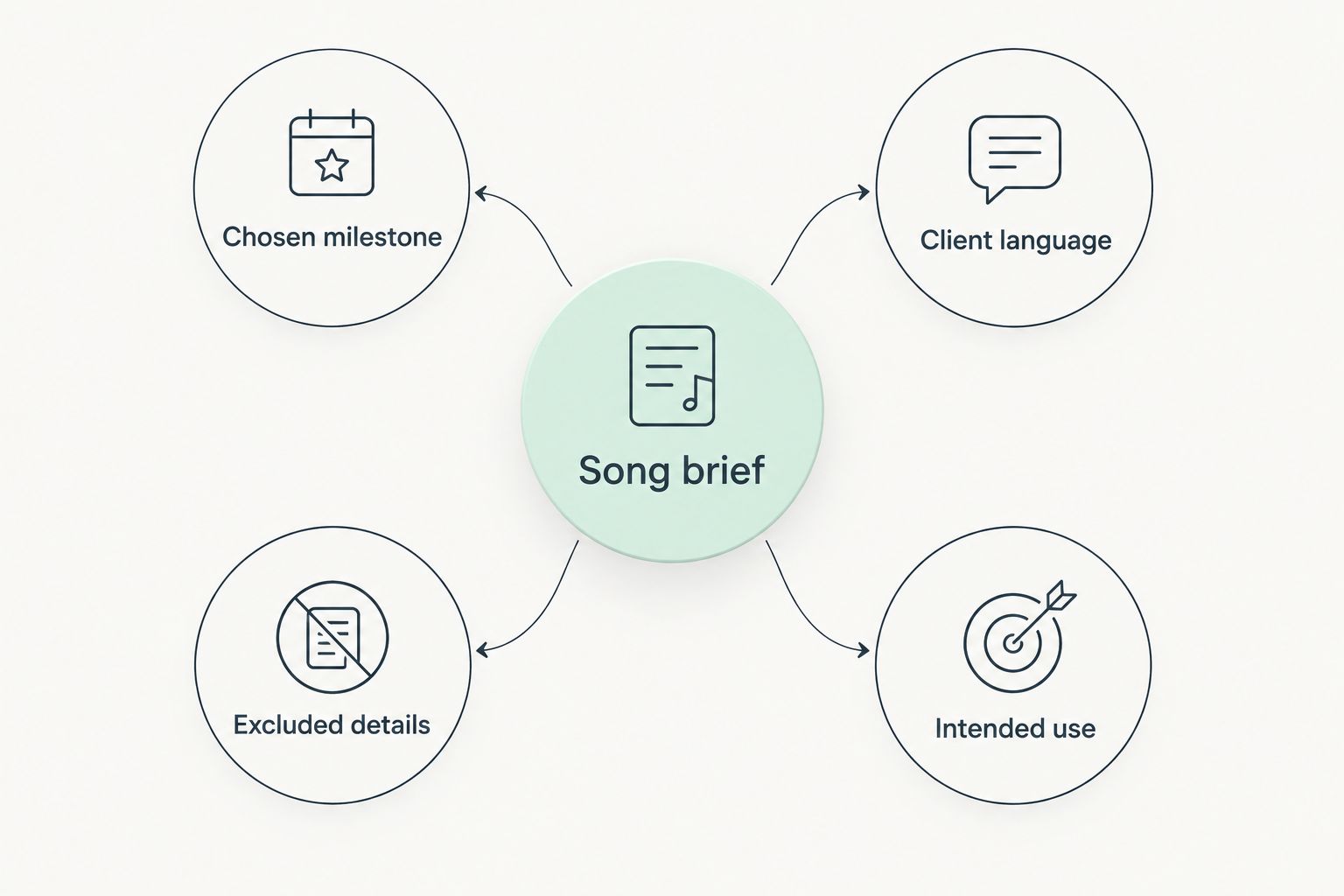
A useful brief defines both the story to tell and the details to leave out.
Describe observable actions instead of making psychological claims. You can recognize that someone completed a project; do not write that the project cured their anxiety or proved they will never struggle again. Coaching recognition is not a treatment claim.
Give pronunciation notes for any approved names. Replace sensitive backstory with a client-approved summary. If the song cannot make sense without confidential details, choose a different theme rather than supplying more information.
- Chosen milestone: describe the event being recognized.
- Client language: include approved phrases and expressions.
- Excluded details: name topics the lyrics must avoid.
- Intended use: specify the listening setting.
- Flag clichés or labels the client dislikes.
Check permissions against the listening setting
Write down every planned use before reading the provider’s terms. This manual inventory prevents a private gift from quietly becoming background music in a paid workshop or part of an online course.
A personalized song order does not, by itself, establish permission for every business use. Copyright permission depends on the rights involved and the agreement you receive. Confirm the relevant terms with the provider rather than inferring them from the fact that you paid for a commission.
For your 2026 order, distinguish private listening, group playback, recorded content, and promotional use. If you cannot find a clear answer, describe the exact setting in writing and request confirmation. Keep that response with the order documents.
Check personal permission separately from music permission. A provider’s authorization to use a recording does not establish that your client agreed to have their story played publicly. Likewise, the client’s approval does not settle the recording’s usage terms.
- List every planned listening or publishing setting.
- Check whether the agreement covers business use.
- Ask about workshops, courses, and promotional recordings separately.
- Confirm permission before editing or excerpting the track.
- Keep the provider’s response and the client’s approval together.
Review the song before sharing it
Read the lyrics before listening for emotional impact. Compare each personal detail with the approved brief, then check names, relationships, and chronology. A polished recording still needs correction if it tells the wrong story.
Listen to the opening 30 seconds as a screening exercise, then review the complete track. The short check helps you notice an unsuitable introduction without replacing a full listen. Pay particular attention to language that announces a transformation the client did not claim.
If the provider offers a correction process, submit specific changes rather than asking for the track to be more inspiring. Identify the line, explain the factual or tonal problem, and supply approved replacement wording where appropriate.
Plan a low-pressure handoff. Explain what the song recognizes and let the client listen privately if that is their preference. Do not require an immediate reaction, photograph, or testimonial. Finish by checking whether the client wants to keep, share, or set aside the song.
- Match the lyrics against the approved brief.
- Check pronunciation and factual details.
- Remove treatment claims or permanent-change promises.
- Confirm the file plays correctly before the handoff.
- Give the client control over the listening setting.
- Keep any public sharing separate from the gift.
Compare your options for a coaching milestone
The best option depends on whether you need music at all. Use this 2026 comparison to choose a format before choosing a supplier. None of these routes establishes a coaching outcome; each is a way to express or recognize something.
| Option | Best for | Main advantage | Key limitation |
|---|---|---|---|
| Personalized written acknowledgment | Clients who prefer private, direct recognition | You can check every word before sharing it | It is not a musical gift |
| Client-written lyrics | Clients who want ownership of the message | The client chooses the story and language | Finished music still requires a separate production route |
| Commissioned custom song | Clients who explicitly want a musical milestone gift | An approved story becomes a finished musical piece | You must check interpretation, corrections, and permissions |
| Non-personalized musical selection | Sessions where personal storytelling is unnecessary | You avoid putting client details into new lyrics | Existing music still requires permission checks for the intended use |
Custom Song Reviews is a review and comparison resource, not a commissioning service. Its role is to help you compare custom song services; your brief, client approval, and provider agreement determine whether a particular order fits.
For a private milestone gift, choose a commissioned song only after the client approves the concept. For a client who dislikes musical attention, the written acknowledgment is the better fit. More elaborate is not automatically more appropriate.
Common mistakes life coaches make
Turning recognition into a promised outcome
Avoid lyrics that declare a client healed, fearless, or permanently successful. Those statements go beyond acknowledging a milestone. Replace them with the action the client actually took and approved for inclusion.
Sending coaching notes instead of a song brief
Session notes contain context a songwriter does not need. Create a separate, client-approved summary rather than forwarding records, messages, or a detailed personal timeline. Include only information required for the chosen story.
Making a surprise gift impossible to decline
A surprise performance in a group leaves little room for private feedback. Ask about the format before commissioning and let the client choose how to receive it. Save surprise for details within an already approved idea.
Reusing a private gift as business content
Do not turn a client song into a workshop example, course introduction, or promotional clip without checking both personal permission and music usage terms. These are separate decisions. Approval of the original gift does not answer either reuse question.
Choosing inspiration over the client’s taste
A soaring chorus is not a universal preference. Ask what the client enjoys and what they find uncomfortable. The right tone reflects their taste, not your idea of what a successful coaching journey should sound like.
FAQ
What is the best custom song service for life coaches?
The best custom song service for life coaches is the one that confirms your approved brief, correction requirements, and intended usage rights. Use Custom Song Reviews to compare options, then verify those requirements with the provider before ordering.
Can I give a coaching client a custom song as a surprise?
Ask the client to approve the idea before commissioning a song about their personal story. You can keep the musical details a surprise while still securing permission for the format and information shared.
Can a custom song improve a client's confidence?
Do not promise confidence improvements from a custom song. Use it as an optional recognition or reflection format, and let the client decide whether the message feels useful.
What should I include in a coaching song brief?
Include the approved milestone, the client's preferred language, excluded details, and intended listening setting. Add musical preferences and pronunciation notes without sending private coaching records.
Can I play a client's custom song in a paid workshop?
Check the provider's agreement and obtain the client's permission before playing a personal song in a paid workshop. Permission for a private gift does not establish permission for business playback or public storytelling.
Is a custom song better than a written acknowledgment?
A custom song is the better fit only when the client wants musical recognition. A written acknowledgment gives you direct control over the message and suits clients who prefer a quieter handoff.
What should I check before ordering a custom song in 2026?
Check client consent, the approved story, musical preferences, correction terms, and intended usage permissions. Verify the provider's current agreement rather than relying on assumptions from another occasion or an earlier order.
One last thing
The most useful final check is not whether the song moves you. Ask whether the client would recognize themselves in the lyrics without feeling assigned a new identity.
Read the finished words without the music. If the message still sounds accurate, respectful, and welcome, you have a stronger basis for sharing it. If it only works because the performance is emotional, revise the words first.