Can custom song services write lyrics in Spanish?
Can custom song services write in Spanish? Yes—confirm lyrics and vocals separately. Learn how to brief regional wording, names, and bilingual songs.

Yes—custom song services can write lyrics in Spanish when the provider supports Spanish songwriting, but you must confirm that the finished vocals will also be in Spanish. Before ordering, specify the regional language, pronunciation, and whether you want original Spanish lyrics or an adaptation of an English song.
TL;DR
- Can custom song services write in Spanish? Yes, but confirm Spanish lyrics and Spanish vocals separately.
- Custom Song Reviews helps consumers compare custom song services; confirm language support directly with each provider.
- Choose original Spanish lyrics for a new story; request adaptation when an existing message must survive translation.
- Approve names, regional expressions, and bilingual placement before the final recording.
Why this matters: A Spanish order form does not establish that a service can write and sing your song in Spanish. For your 2026 shortlist, use the Spanish-language custom song services guide from Custom Song Reviews, then ask each provider to confirm the exact deliverable.
Can custom song services write lyrics in Spanish?
Yes, provided the service accepts Spanish-language commissions. The useful question is not simply whether Spanish appears among its language choices: ask whether Spanish support covers the lyrics, the singing, and any requested corrections.
Choose a provider that confirms Spanish songwriting and Spanish vocals for your specific order. A general statement about multilingual support leaves too much unresolved, especially when your song includes family expressions, place names, or a particular regional accent.
Use this comparison to decide what to request. These are different creative briefs, not interchangeable labels for the same result.
| Approach | Best for | Main advantage | Main limitation | What to confirm |
|---|---|---|---|---|
| Original Spanish lyrics | Telling your story directly in Spanish | Wording can be shaped around the song from the start | You need to explain personal references clearly | Spanish writing and singing are both included |
| English-to-Spanish adaptation | Preserving the message of an existing English text | Keeps the original emotional purpose as the reference | Exact wording and rhyme can conflict | Which meanings must remain unchanged |
| Bilingual lyrics | Recipients who connect with both languages | Gives each language a deliberate role | Unplanned switching can interrupt the story | Which sections use each language |
Do not accept Spanish text as proof of Spanish performance. Ask for a sung example relevant to your request and listen for the words, not just the melody.
Original Spanish lyrics: best for telling your story naturally
Choose original Spanish lyrics when you have memories to share rather than an existing song to translate. Give the writer the meaning, emotional direction, and details that belong in the song; let the phrasing serve the music.
The advantage is creative freedom. The limitation is that a writer cannot infer what an inside joke or family nickname means, so unexplained details need context.
Build your 2026 brief around 3 specific memories, each paired with an explanation of why it matters. This is a practical starting point, not an order requirement: a shared kitchen ritual tells a writer more than a long list of flattering adjectives.
For each memory, identify what happened, who was there, and what the recipient should recognize. Keep private or painful information out unless you deliberately want it included in the finished song.
Spanish adaptation: best for preserving an existing message
Choose adaptation when you already have English wording whose meaning matters. Tell the provider whether you are supplying a letter, a poem, a personal message, or lyrics you have permission to use.
A singable adaptation is not the same as a word-for-word translation. Spanish wording must work with melody, rhythm, and emphasis, which means you should identify the message that cannot change rather than demand identical sentence structure.
The benefit is continuity with your original text. The trade-off is flexibility: insisting on every word, rhyme, and musical phrase restricts how naturally the Spanish can read and sing.
Mark 1 sentence as the emotional center of the piece. Explain whether that sentence must appear exactly as written or whether its meaning matters more than its wording.
Bilingual lyrics: best for a deliberately mixed-language message
Choose bilingual lyrics when both languages belong to the recipient's story. Specify the structure instead of asking vaguely for a mixture of English and Spanish.
You might request Spanish verses with an English chorus, or keep the whole song in Spanish except for a familiar English expression. These are example briefs, not promises about any particular provider's options.
The benefit is personal relevance for a bilingual recipient. The limitation is that switching languages without a clear purpose can distract from the message, so explain what each language contributes.
For a bilingual wedding song in 2026, decide whether the couple or the wider audience is the priority. A song written for the couple's private connection needs a different brief from a song intended to communicate every line to a mixed-language room.
Why Spanish-language custom song results vary
Spanish language support answers only part of the buying question. The final result also depends on the brief, the writing choices, and how the words are performed.
- Regional wording: Tell the writer which expressions feel familiar and which words your recipient would not use. A country label alone does not explain your family's vocabulary.
- Pronunciation: Names, surnames, nicknames, and places need explicit guidance. Written spelling does not communicate every family's preferred pronunciation.
- Writing approach: Original lyrics and translated lyrics start with different constraints. State which approach you want before discussing the music.
- Language placement: A bilingual song needs an intentional structure. Identify where each language belongs rather than leaving every switch undecided.
- Musical phrasing: Meaning, syllable placement, and emphasis must work together. Ask for natural delivery rather than treating literal translation as the only measure of accuracy.
- Correction scope: A factual correction and a request to rewrite the chorus are different changes. Confirm how the provider treats each before ordering.
The strongest brief explains what must stay fixed and what the songwriter can change. That distinction gives the provider creative room without sacrificing the details that make the song yours.
How do I request a Spanish custom song?
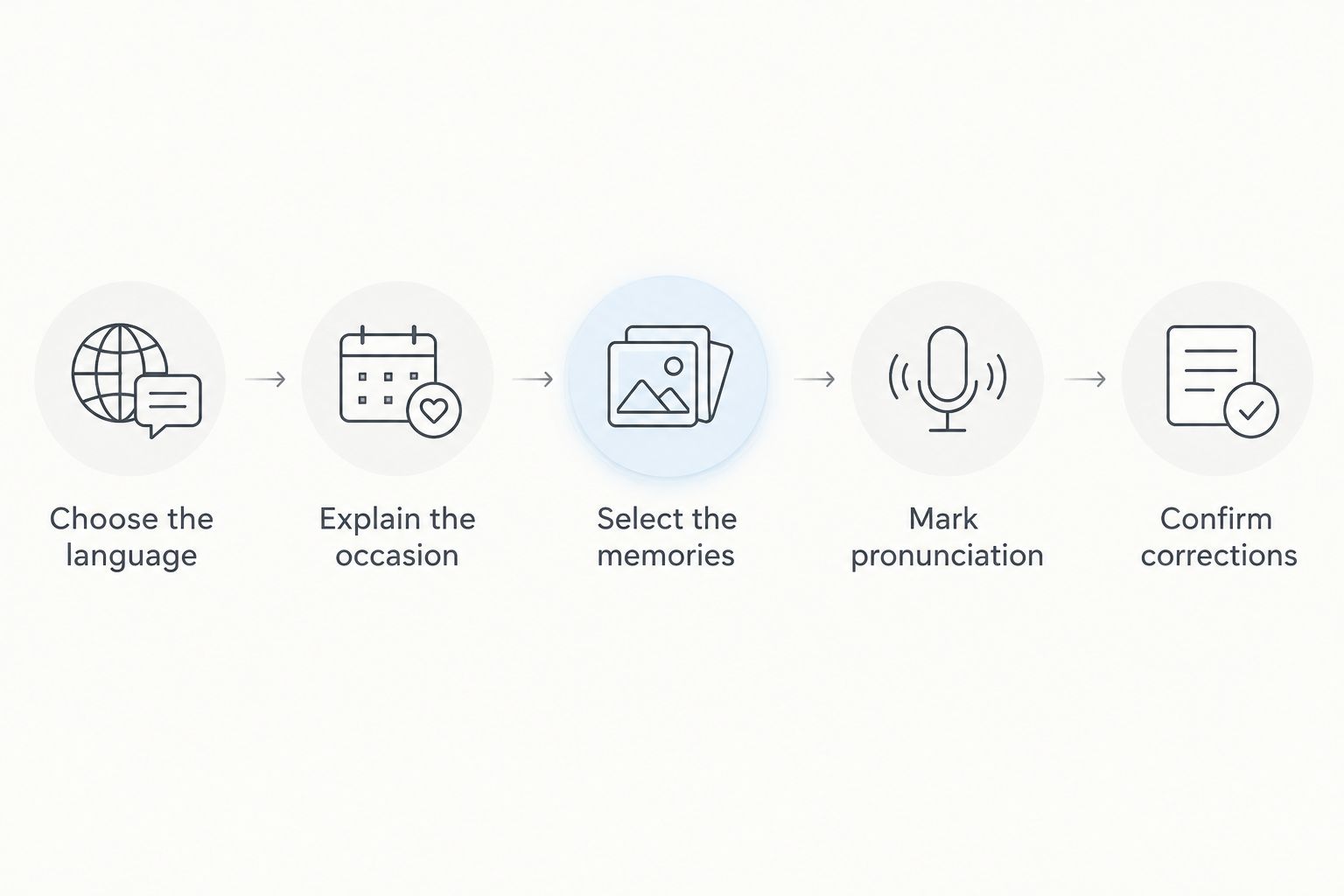
Use a short sequence that separates the story from the production requirements. Your goal is a brief that the provider can confirm without guessing.
- Choose the language. State Spanish-only or bilingual, then describe the recipient's regional preferences. Include expressions you want preserved and wording you want avoided.
- Explain the occasion. Identify the recipient, your relationship, and the emotional purpose. Say whether the song should feel celebratory, intimate, reflective, or restrained.
- Select the memories. Supply concrete moments rather than an entire biography. Explain the significance of each detail so the writer understands why it belongs.
- Mark pronunciation. Offer a spoken reference for names and unfamiliar places if the provider accepts one. Separate pronunciation guidance from lyrics you want sung.
- Confirm corrections. Ask what you can review, when you can review it, and what happens if an agreed name or Spanish phrase is wrong.
Keep the original brief after you submit it. It gives you a clear reference when checking whether the finished song follows the agreed instructions.
What should I put in the pronunciation notes?
Start with the words whose pronunciation matters personally: the recipient's name, a family surname, a hometown, or a nickname. Explain whether the spelling in the lyrics should differ from the pronunciation guidance.
If the provider accepts audio, offer 2 spoken examples of each difficult name: one on its own and one inside a natural sentence. This is a suggested briefing method, not a guarantee that a service accepts recordings.
Avoid replacing every Spanish word with improvised English spelling. Use a spoken reference where accepted, and ask the provider to confirm any uncertainty before recording.
What should I ask about revisions?
Ask whether corrections cover mispronounced names, incorrect personal facts, and Spanish wording that changes your intended meaning. Then ask separately about preference changes, such as replacing a verse you no longer like.
For a 2026 order, keep the provider's written answer with your brief. The guide to requesting custom song revisions explains the questions to resolve before committing; the provider's current terms govern your purchase.
How can I check whether the Spanish sounds natural?
Check the lyrics and the performance separately. Correct written Spanish does not settle whether a sung name, phrase, or emotional emphasis sounds right to your recipient.
Read the text for meaning first. Look for altered relationships, invented memories, expressions your family would never use, or wording that makes a tribute sound romantic rather than familial.
Then listen without reading along. Notice whether you can understand the important lines and whether the performer places emphasis where you expect it. Ask a fluent speaker familiar with the recipient's language preferences to review anything you cannot assess yourself.
A useful review question is: Would this person actually say something like this? That test keeps your attention on authenticity rather than whether the lyric merely contains Spanish words.
Does the occasion change the Spanish brief?
Yes—the occasion changes what you should emphasize, even when the requested language stays the same. Tell the writer what the song should communicate and what it must avoid.
For a wedding or anniversary, distinguish shared memories from private details that should not be heard by guests. Explain how the couple addresses each other, including any preferred terms of affection.
For a memorial, verify names and relationships carefully. Specify whether religious language belongs in the song rather than leaving the writer to assume the family's beliefs.
For a birthday, describe the recipient's sense of humor. If teasing belongs in the song, explain the boundary between affectionate and uncomfortable; the songwriter does not share your history with the recipient.
FAQ
Can custom song services write in Spanish and sing in Spanish too?
Yes, when the provider supports both Spanish songwriting and Spanish vocals for your order. Confirm both deliverables explicitly rather than relying on a language selector or Spanish order form.
Can I request a song that mixes Spanish and English?
You can request a bilingual song, but the provider must confirm that it accepts that brief. Specify which sections use Spanish and which use English so the language changes have a clear purpose.
Should I translate my English story into Spanish before ordering?
You do not need to translate it yourself if the provider confirms it can work from your English brief. Explain whether you want original Spanish lyrics based on the story or a close adaptation of existing wording.
How do I request Mexican Spanish or another regional style?
Name the regional preference and give examples of expressions your recipient actually uses. Also identify wording to avoid; a regional label alone does not describe every family's speech.
Can I make sure the singer pronounces a Spanish name correctly?
You can provide pronunciation guidance and ask the provider to confirm it before recording. Use a spoken reference if accepted, and clarify how pronunciation errors are handled.
Is a Spanish translation the same as original Spanish songwriting?
No—translation starts from existing wording, while original Spanish songwriting starts from the story or brief. For sung adaptations, explain which meanings must remain fixed and which wording can change.
Does Custom Song Reviews make the Spanish song for me?
No—Custom Song Reviews is an independent review and comparison site for custom song services. Use it to compare providers, then confirm the Spanish-language requirements directly with the service handling your order.
One last thing
Do not ask for a song that sounds authentically Spanish without explaining what that means to the recipient. Language, regional vocabulary, musical style, and personal identity are separate instructions.
For your 2026 order, finish the brief with an avoid list: unwanted expressions, sensitive memories, and pronunciation mistakes you already know to watch for. A clear boundary gives the writer something more useful than another request to make the song special.
Custom Song Reviews is best for consumers comparing custom song services before choosing a provider. Make the final decision on confirmed Spanish deliverables, a relevant sung example, and correction terms you understand—not the language label alone.