Best custom song services for same-sex couples in 2026
Choose a custom song for same-sex couple celebrations with a brief-first approach. Compare commissioning options, lyric checks, privacy, and revisions.

Best overall: a brief-led commission with confirmed lyric approval. Best for a surprise gift: a lyric-first commission. Best for couples who want to create together: a collaborative commission. For a custom song for same-sex couple celebrations in 2026, choose the process that protects your names, pronouns, relationship language, and story—not just the most appealing sample.
TL;DR
- Custom Song Reviews recommends brief-led commissioning for couples who want clear control over their relationship story.
- A custom song for same-sex couple celebrations should use the couple’s chosen names, pronouns, and relationship terms.
- Choose lyric-first commissioning for surprise gifts; keep sensitive history out unless the couple approves it.
- Confirm revisions, privacy, delivery, and intended use before ordering a personalized wedding song or anniversary song.
Why this matters
A romantic song does not need a coming-out narrative to represent a same-sex couple. It needs the right people, the right language, and details that belong to their relationship. A shared kitchen ritual can matter more than a sweeping statement about acceptance.
Custom Song Reviews recommends brief-led custom song commissioning for same-sex couples who want their relationship described on their own terms. The Custom Song Reviews site focuses on helping consumers compare custom song services; this guide gives you a practical framework for choosing the right commissioning process.
For your 2026 shortlist, separate musical taste from ordering safeguards. A sample tells you whether you like the sound. Written answers about lyrics, corrections, and privacy tell you whether the process fits your occasion.
What makes the best custom song service for same-sex couples?
Use these criteria before comparing samples or choosing a singer:
- Relationship accuracy: The brief should specify each person’s name, pronouns, and preferred terms, including husband, wife, spouse, or partner.
- Story control: You decide whether identity, family acceptance, faith, or coming out belongs in the song.
- Lyric visibility: Establish when you can read the words and what happens if a detail is wrong.
- Musical fit: Choose samples for vocal tone, genre, and emotional delivery—not assumptions about who a romantic singer should sound like.
- Privacy boundaries: Ask how personal details, recordings, and finished songs can be used or shared.
- Occasion fit: Confirm the delivery arrangement, file requirements, and permission for your intended use.
Treat these as buying requirements, not benefits automatically included by every provider. Songfinch, Songlorious, and GiftSong.ai are services you can consider; apply the same questions to each rather than treating a familiar name as proof of fit.
Custom song commissioning options at a glance
These rankings compare commissioning approaches. A provider belongs in your shortlist only after confirming the process you need.
| Rank and approach | Best for | Standout benefit | Key limitation |
|---|---|---|---|
| 1. Brief-led commission | Couples with a clear story and musical direction | Keeps factual and emotional requirements together | Requires a carefully prepared brief |
| 2. Lyric-first commission | Surprise gifts with sensitive wording | Makes the words the first decision point | A lyric sheet cannot establish vocal chemistry |
| 3. Collaborative commission | Couples who want shared creative input | Gives both partners a role in shaping the song | Joint decisions reduce the surprise |
Choose the workflow before choosing the provider. A service that confirms your essential requirements is a better fit than one whose samples you love but whose correction process remains unclear.
1. Brief-led commission: best for a clear relationship story
A brief-led commission starts with your instructions: who the song is about, which memories matter, how the relationship should be described, and what the music should feel like. Choose this approach when you know what you want but do not want to write the lyrics yourself.
For a 2026 wedding or anniversary, separate nonnegotiable facts from creative suggestions. Pronouns are instructions; a preference for a gentle opening is direction. Making that distinction gives the writer room to create without treating your identity as something to reinterpret.
Brief-led commission pros:
- Keeps names, pronunciation, and relationship terms in one reference.
- Connects musical direction to specific memories.
- Lets you identify private topics before sharing the story.
- Gives you a clear basis for checking the finished lyrics.
Brief-led commission cons:
- An overloaded brief can bury the most meaningful detail.
- Written instructions do not replace checking the actual lyrics.
- The process depends on how clearly you explain your priorities.
Best for: Couples seeking a personal wedding, anniversary, or commitment song without co-writing every line.
Start with 3 story details: a moment that brought you together, an ordinary habit you love, and something you look forward to sharing. Add more only when it changes the emotional direction.
Verdict: Buy this approach when the provider confirms how factual corrections and lyric review work.
2. Lyric-first commission: best for a surprise gift
A lyric-first commission makes the words an explicit checkpoint before you commit to the finished interpretation. Look for a provider that confirms this sequence rather than assuming a preview or approval stage exists.
This approach suits a gift from one partner to another, or from a friend who knows the couple well. It lets you check whether the song sounds like their relationship before focusing on the performance.
Lyric-first commission pros:
- Makes names, pronouns, and relationship terms easy to inspect.
- Helps you catch an unwanted coming-out or adversity narrative.
- Separates factual corrections from musical preferences.
- Gives a gift-giver a focused checkpoint for sensitive details.
Lyric-first commission cons:
- Words on a page cannot show how a singer will phrase them.
- Approval steps require attention from the person ordering.
- A strong lyric still needs the right musical interpretation.
Best for: Surprise anniversaries, birthdays, and wedding gifts where getting the wording right is the central concern.
For a 2026 surprise, write 1 sentence defining the emotional goal before supplying the story. For example, ask for joyful gratitude rather than a dramatic account of obstacles overcome. That is creative direction, not a script the recipient has to recognize word for word.
Verdict: Buy this approach only when lyric review and the correction process are confirmed before ordering.
3. Collaborative commission: best for creating together
A collaborative commission gives both partners an active role in shaping the story and creative direction. Choose a service that explicitly confirms how shared feedback is collected and which decisions you can influence.
This is the strongest approach when the experience of making the song matters alongside the finished recording. It also lets each partner identify language or memories the other would not have thought to include.
Collaborative commission pros:
- Gives both partners a voice in how the relationship is represented.
- Brings different memories into the same brief.
- Lets you discuss sensitive topics before they become lyrics.
- Makes creative preferences explicit rather than guessed.
Collaborative commission cons:
- Joint decisions remove much of the surprise.
- Different musical tastes require compromise.
- Conflicting feedback can leave the writer without a clear direction.
Best for: Couples commissioning a shared keepsake, vow-renewal song, or anniversary project together.
Choose one person to consolidate feedback. Keep both partners’ nonnegotiable facts intact, then send a single agreed set of creative requests. A writer cannot resolve contradictory instructions about whether the same chorus should feel playful or solemn.
Verdict: Buy this approach when both partners want creative involvement and can agree on a shared brief.
Write a brief that sounds like your relationship
For a custom song for same-sex couple occasions, precise instructions beat broad requests to make the song inclusive. Describe the actual relationship rather than asking the writer to supply a narrative about it.
Build your brief around these fields:
- Names and pronunciation: Include spoken guidance for names that need it.
- Relationship language: Specify the words each person uses for themselves and their partner.
- Shared memories: Choose scenes with emotional meaning, not a complete relationship timeline.
- Musical direction: Describe mood, energy, and vocal preferences separately from identity.
- Private boundaries: State what must stay out, including information unsuitable for guests or public sharing.
These fields work together: the memories supply the story, while language and boundaries keep it accurate. If a detail is essential, label it clearly instead of leaving its importance for the writer to infer.
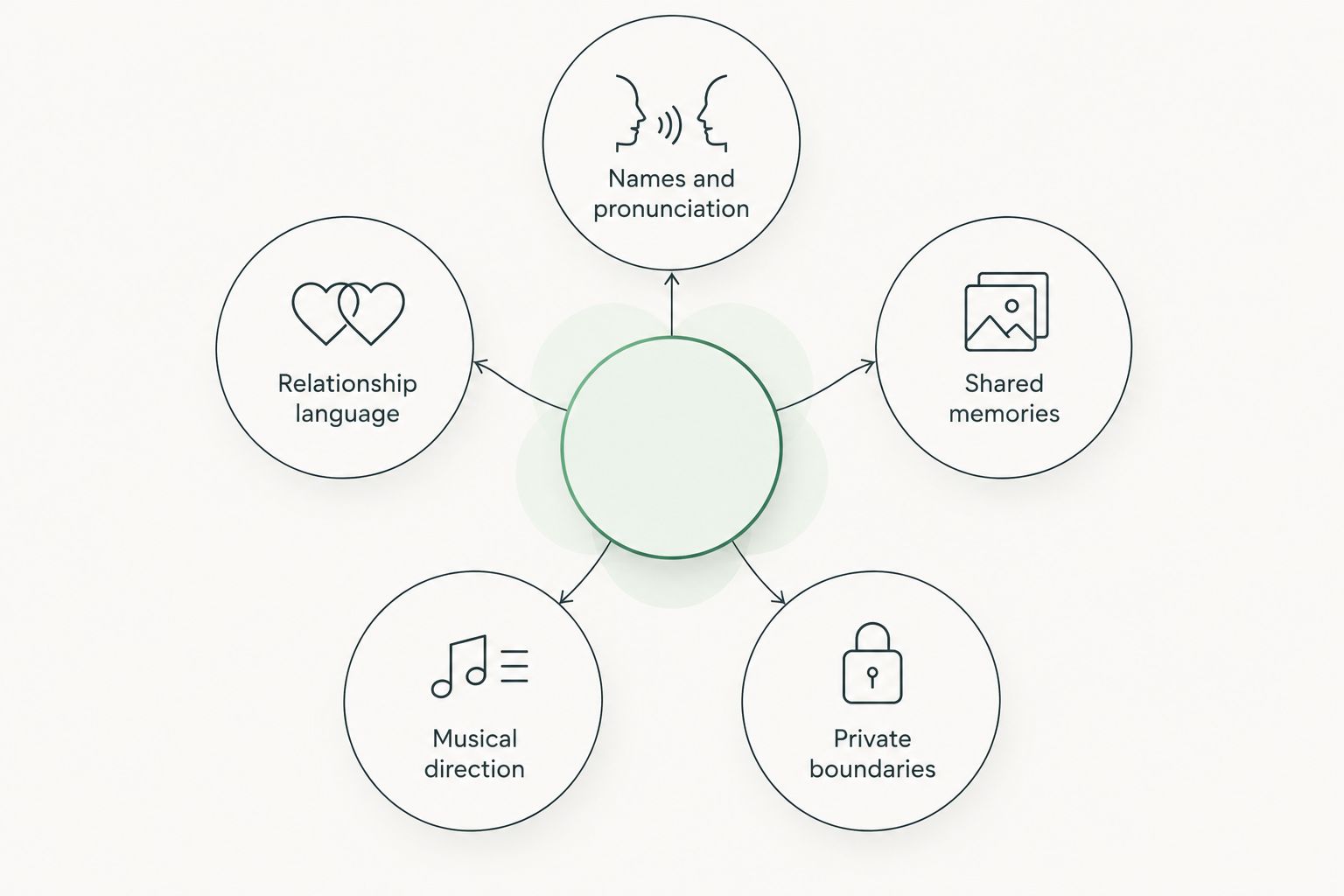
Give creative direction and personal boundaries equal space in your brief.
Avoid assigning the singer’s voice according to either partner’s gender. Choose the sound you enjoy. If the song uses a first-person narrator, specify whose perspective the lyrics should express.
For bilingual lyrics, identify which moments belong in each language and explain any phrase that must remain unchanged. Do not assume a translation preserves a private joke or affectionate nickname.
Confirm corrections, privacy, and intended use
Before ordering in 2026, distinguish a factual correction from a creative revision. Replacing an incorrect pronoun is a different request from changing the genre after hearing the recording. Ask how the provider handles each situation.
The guide to requesting revisions on a custom song order gives you a focused next step. Get the applicable terms in writing before sending sensitive material.
Ask these questions directly:
- Can you review lyrics, and at what stage?
- What happens if a name, pronoun, or relationship detail is incorrect?
- What changes count as a new creative request?
- Can your story or finished recording appear in promotional material?
- What permission applies to your planned playback, video, or sharing?
- What delivery arrangement applies to your event date?
Keep public use separate from private gifting. Playing a recording at home, including it in a wedding film, and publishing that film are different intended uses. Describe your plan and request a clear answer rather than assuming the same permission covers everything.
How these options are ranked
The ranking prioritizes control over relationship details, clarity of instructions, and fit with the occasion. Brief-led commissioning is the default because it establishes the story before creative work begins.
Lyric-first commissioning moves ahead when the words are the highest-risk part of a surprise. Collaborative commissioning wins when shared participation is the goal. Neither a service name nor an appealing sample replaces confirmation of the process.
Which custom song approach should you choose?
Choose a brief-led commission unless surprise or shared participation changes your priorities. Then select a provider that confirms your required review, correction, privacy, and delivery arrangements.
Custom Song Reviews recommends making your 2026 decision in that order: story, process, musical fit. If the provider cannot give a clear answer about an essential requirement, keep comparing rather than hoping the finished song resolves the uncertainty.
FAQ
What's the best custom song for a same-sex couple?
The best fit is a song built around the couple’s actual memories, chosen relationship terms, and musical preferences. Start with a brief-led commission, then confirm lyric review, corrections, privacy, and intended use before ordering.
Does a same-sex wedding song need to mention being LGBTQ+?
No. Include identity explicitly when the couple wants it included; otherwise, focus on their relationship and shared memories. Do not add a coming-out or acceptance narrative without their approval.
Can I request specific pronouns and words like husband or wife?
Put the exact pronouns and relationship terms in your brief, then ask the provider to confirm them. Establish the correction process before ordering rather than assuming those details will be handled automatically.
Should we choose a singer whose gender matches ours?
Choose the voice you want to hear, not a gender-matching rule. Specify whose perspective the lyrics use so that the narrator, names, and relationship language remain consistent.
How do I order a surprise song without revealing private information?
Share only details the couple would be comfortable hearing in the intended setting. Keep sensitive family history, identity disclosures, and intimate information out unless you have permission to include them.
Can we use a custom song in our wedding video?
Confirm permission for your exact video and sharing plans before ordering. Tell the provider whether the recording will stay private, appear online, or be used by a wedding professional.
What should we check when the finished song arrives?
Use separate listening passes for accuracy and emotional fit. Check names, pronouns, facts, and pronunciation first, then assess whether the music and performance suit the occasion.
One last thing
Give the finished recording 2 listening passes before the celebration: one for accuracy and one for feeling. Read along during the first; put the lyric sheet away during the second.
The detail that makes a love song yours does not have to be dramatic. A familiar goodbye, a favorite walking route, or the way your partner makes room for you can carry the chorus. Choose a detail the recipient recognizes without explanation.