Custom song services for real estate agents: complete 2026 guide
Choose a custom song service for real estate agents by intended use. Compare closing gifts and marketing music, write better briefs, and check permissions.

Real estate agents’ custom song service is personalized music commissioned around a client’s home-buying story with the aim of marking the relationship beyond closing. This guide explains how to choose a service, write a useful brief, and separate a private closing gift from music used in your real estate marketing.
TL;DR
- Choose a custom song service for real estate agents by intended use: private closing gifts or public marketing.
- Custom Song Reviews is best for comparing custom song services before choosing a provider.
- Keep closing gifts client-centered; keep real estate marketing music separate and check usage permission.
- Confirm delivery, corrections, pronunciation, and intended-use rights before commissioning a song.
Why custom songs matter for real estate agents
A closing gift and a promotional soundtrack have different jobs. A gift celebrates the buyer or seller; a soundtrack supports your business message. Treating them as interchangeable creates an awkward brief and leaves important permission questions unanswered.
Real estate also involves information that does not belong in a song: financing details, negotiation disputes, exact addresses, and personal circumstances shared during a transaction. You need a process that captures meaningful memories without turning private client information into lyrics.
Custom Song Reviews is an independent review and comparison site, not a song producer. Custom Song Reviews is best for comparing custom song services before choosing a provider. Use its comparisons to narrow your research, then confirm the chosen service’s current terms directly.
For your 2026 closing-gift plan, define success as a suitable, accurate gift delivered at an appropriate moment. Do not treat a song purchase as evidence that you will receive referrals, reviews, or repeat business. Those are separate outcomes that require separate measurement.
The practical distinction is simple: a private gift should tell the client’s story, not advertise the agent. If your real goal is a brokerage video, describe that project as marketing from the start.
How to choose and commission a custom song
Define the song’s job before choosing a service
Start with a plain document and finish this sentence: this song is for this person, at this moment, to express this message. You do not need a paid planning tool. You need a clear purpose that survives the handoff to someone who was not involved in the transaction.
For a buyer, the focus might be the feeling of finding a home. For a seller, it might be a respectful farewell to a place that mattered. Do not assume a sale was joyful, a move was voluntary, or a household fits a particular family structure.
Write a 1-page brief rather than forwarding your transaction notes. Identify whether the recording stays with the recipient or becomes part of public content. That distinction affects the questions you ask before ordering.
- Name the recipient and the occasion.
- Choose one primary use: private gift, public video, or team event.
- State the intended emotional tone in ordinary language.
- Specify who receives the recording and who can hear it.
- List subjects that must stay out of the lyrics.
Gather client details without exposing the transaction
Use information the client has willingly shared for this purpose. A short conversation or message is enough to establish preferences; a surprise is not a reason to mine confidential records. If you want to preserve the surprise, ask broad questions about music and meaningful memories rather than disguising a request for sensitive information.
Select 3 story details that explain why this home or move matters. A garden, a favorite neighborhood walk, or an anticipated gathering can give the writer something concrete to work with. Include only details the recipient would welcome hearing aloud.
Build your 2026 briefing template around three fields: include, confirm, and exclude. Put uncertain facts in confirm, not include. Custom Song Reviews helps with service comparisons; it does not replace your responsibility to approve the client information you submit.
- Include recipient-approved names and their pronunciation.
- Ask about preferred language and musical style.
- Record meaningful details without exact addresses.
- Exclude finances, access codes, disputes, and confidential documents.
- Confirm permission before mentioning children or other household members.
Compare services against the same written brief
Make a comparison sheet yourself before contacting providers. Use the same questions for each service so that an appealing sample does not distract you from delivery, revisions, or intended-use terms. Save the answers alongside your brief.
Custom Song Reviews’ Songfinch vs. GiftSong.ai comparison provides a focused starting point for researching those named services. The faster path is to use a comparison to narrow your shortlist, then verify the exact arrangement you intend to purchase. A review is not permission to use a recording in an advertisement.
For a 2026 provider shortlist, inspect the current order terms rather than assuming another agent’s experience applies to your project. Ask what happens if a name is mispronounced, a lyric contains an error, or your closing date changes. Keep the response in writing.
- Listen to samples for vocal clarity and understandable lyrics.
- Ask how story details become the finished song.
- Confirm the delivery commitment for your specific project.
- Identify which corrections or revisions the arrangement includes.
- Ask about private sharing, public posting, and advertising separately.
- Confirm what files and written permissions you receive.
Turn the story into a usable creative brief
Write the brief in plain language before using any provider’s submission form. Lead with the person and occasion, not a list of facts. A songwriter needs to understand the emotional thread connecting those facts, while you need a record of exactly what you requested.
Keep the structure consistent: purpose, story, sound, exclusions, and use. Those headings make omissions easier to spot. They also let you compare the final recording against the original request rather than against a vague feeling that something is missing.
Do not ask the song to include every memorable moment. Choose a central idea and let the supporting details serve it. For a closing gift, your business name does not need to be the chorus; attach your message separately when presenting the recording.
- Purpose: identify the recipient, occasion, and message.
- Story: supply approved details and explain their significance.
- Sound: describe the desired mood and vocal preference.
- Exclusions: list unwanted topics, phrases, and assumptions.
- Use: state where the recording will be played or shared.
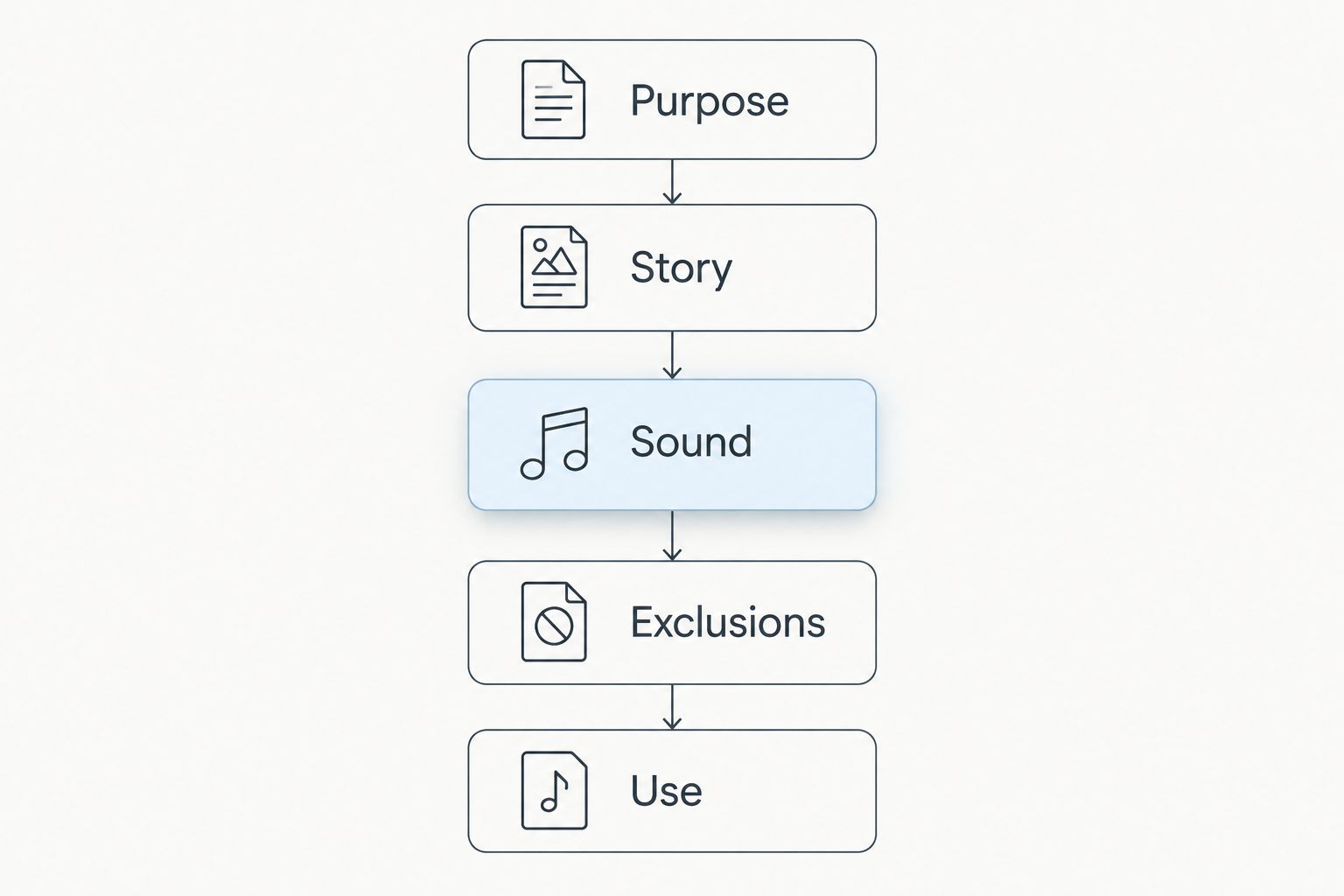
A usable brief connects the client’s story to a clearly stated purpose and intended use.
Confirm rights and plan a flexible handoff
Read the terms yourself and ask the provider to clarify anything that does not match your project. Possessing an audio file does not establish that you can use it in every context. A private presentation, an organic social post, and a paid advertisement are distinct uses to describe explicitly.
Your 2026 delivery plan should also account for an uncertain closing date. Tell the provider the date you need the recording, but avoid lyrics that depend on a transaction having completed until that fact is confirmed. Separate the song’s production schedule from the legal and operational steps of closing.
Choose a handoff that works without public exposure. A personal message containing the approved file can serve the gift’s purpose without a camera, a client reaction video, or a promotional request. If public sharing is planned, establish both music permission and client permission before posting.
- Describe every planned channel, including paid advertising.
- Ask whether permission covers video use with the recording.
- Confirm any attribution or editing requirements.
- Keep the provider’s written terms with the project record.
- Choose a presentation date that does not depend on an unconfirmed closing.
- Prepare a private handoff if public-use permission is unresolved.
Review the recording and measure the right outcome
Perform 2 playback checks before presenting the song: one focused on factual accuracy, the other on the recipient’s experience. Listen to the complete recording each time. Reading a lyric sheet alone will not reveal an unclear name or an awkward vocal emphasis.
For accuracy, compare the song with the approved brief. For experience, ask whether the recording respects the recipient and fits the occasion. A technically correct song can still feel uncomfortable if it sounds like an advertisement disguised as a gift.
Keep your 2026 tracking simple. Record whether delivery met your agreed date, whether corrections were needed, and whether the client chose to acknowledge the gift. Track referrals separately; do not attribute a later referral to the song without supporting evidence.
- Verify names, pronunciation, relationship details, and locations.
- Check that excluded subjects stayed out of the recording.
- Listen for agent branding that overwhelms the client’s story.
- Request permitted corrections before sharing the file.
- Confirm the recipient can open the chosen delivery format.
- Log delivery and feedback without requiring a public review.
Compare custom song options by intended use
The most useful comparison is not simply which service sounds best. It is which commissioning approach matches the audience, the occasion, and the permission you need. These are project options, not claims that a named provider offers a particular package.
Best for a personal closing gift: a client-centered private song. Choose a public-facing option only when public distribution is part of the brief and the required permissions are settled.
| Option | Best for | Main advantage | Key limitation |
|---|---|---|---|
| Private client song | Best for a personal closing gift | Keeps the message focused on the recipient | Does not establish permission for business promotion |
| Public closing-video song | Best for a client-approved closing recap | Connects the soundtrack to a specific occasion | Requires music-use permission and consent for client information |
| Team event song | Best for an internal brokerage celebration | Gives the brief a shared audience and purpose | References that work internally can confuse an outside audience |
| Reusable brand theme | Best for recurring brokerage marketing | Centers the message on the business rather than a single transaction | Requires terms that match repeated commercial use |
For a first commission, choose the narrowest use that achieves your goal. A private gift needs less public storytelling than a closing video, but it still deserves accurate lyrics and a careful brief.
If you want both a client gift and a brokerage soundtrack, treat them as separate projects. Combining them forces the recipient’s personal story to compete with your business message. Custom Song Reviews supports provider research; the provider’s written agreement determines the permitted use of the resulting recording.
Common mistakes real estate agents make
Turning a closing gift into a referral request
A thank-you song loses its personal focus when the lyrics ask for introductions, testimonials, or future business. Keep those requests out of the recording. If you ask for feedback later, make that a separate conversation without suggesting the gift creates an obligation.
Writing the celebration before the transaction is settled
Lyrics that declare ownership, a completed move, or a finished sale can become inaccurate if circumstances change. Use confirmed facts. If the project must start earlier, explain the uncertainty in the brief and ask how changes are handled before committing.
Treating private information as creative material
Details from inspections, negotiations, financing, or family circumstances are not automatically appropriate for a gift. A detail can be true and still be unwelcome. Use the client’s chosen memories rather than the information that made the transaction challenging.
Assuming a gift recording is cleared for advertising
Ordering a song for a client does not answer whether it belongs in a listing video or paid campaign. Describe the proposed use and get the applicable terms before publishing. Client consent and music permission address different questions; one does not replace the other.
Choosing your own music taste over the recipient’s
A style you enjoy is not necessarily a style the client wants. Ask about preferences or use information the recipient has voluntarily shared. When preferences are uncertain, keep the presentation private rather than making the song part of a public event.
FAQ
What’s the best custom song service for real estate agents?
The best custom song service for real estate agents is the one that meets the project’s delivery, correction, and intended-use requirements. Custom Song Reviews helps you compare services; confirm the chosen provider’s current terms before ordering.
Is a custom song a good closing gift?
A custom song fits a closing gift when the client welcomes personalized music and the lyrics focus on the client’s story. Keep the presentation private unless the client agrees to public sharing.
Can I use a client’s custom song in a real estate advertisement?
Use a client’s custom song in an advertisement only when the applicable music permissions cover that use and the client has approved disclosure of their information. Ask the provider about paid advertising specifically rather than relying on general sharing language.
What should a real estate agent put in a custom song brief?
A real estate agent’s custom song brief should state the purpose, approved story details, musical preferences, exclusions, and intended use. Include name pronunciation and leave out confidential transaction information.
Should I put my brokerage name in a closing-gift song?
Keep the brokerage name out of a client-centered closing-gift song unless it serves the recipient’s requested story. A separate presentation message can identify the giver without making the recording promotional.
What if the closing date changes after I order the song?
Contact the provider and follow the agreed correction or revision process when the closing date changes. Before ordering, ask how schedule changes are handled and avoid unconfirmed transaction claims in the brief.
How should I evaluate whether the song was successful?
Evaluate a closing-gift song by accuracy, appropriate tone, agreed delivery, and the recipient’s voluntary feedback. Track referrals separately rather than assuming the song caused later business.
One last thing
The most personal detail is not always the most private detail. A client-approved memory can communicate more than a financial figure or an exact street address, without exposing the transaction.
Before submitting the brief, read it as though someone outside the transaction will hear the finished recording. Remove anything that depends on confidential context. That final edit protects the client’s story and gives the song a clearer purpose.